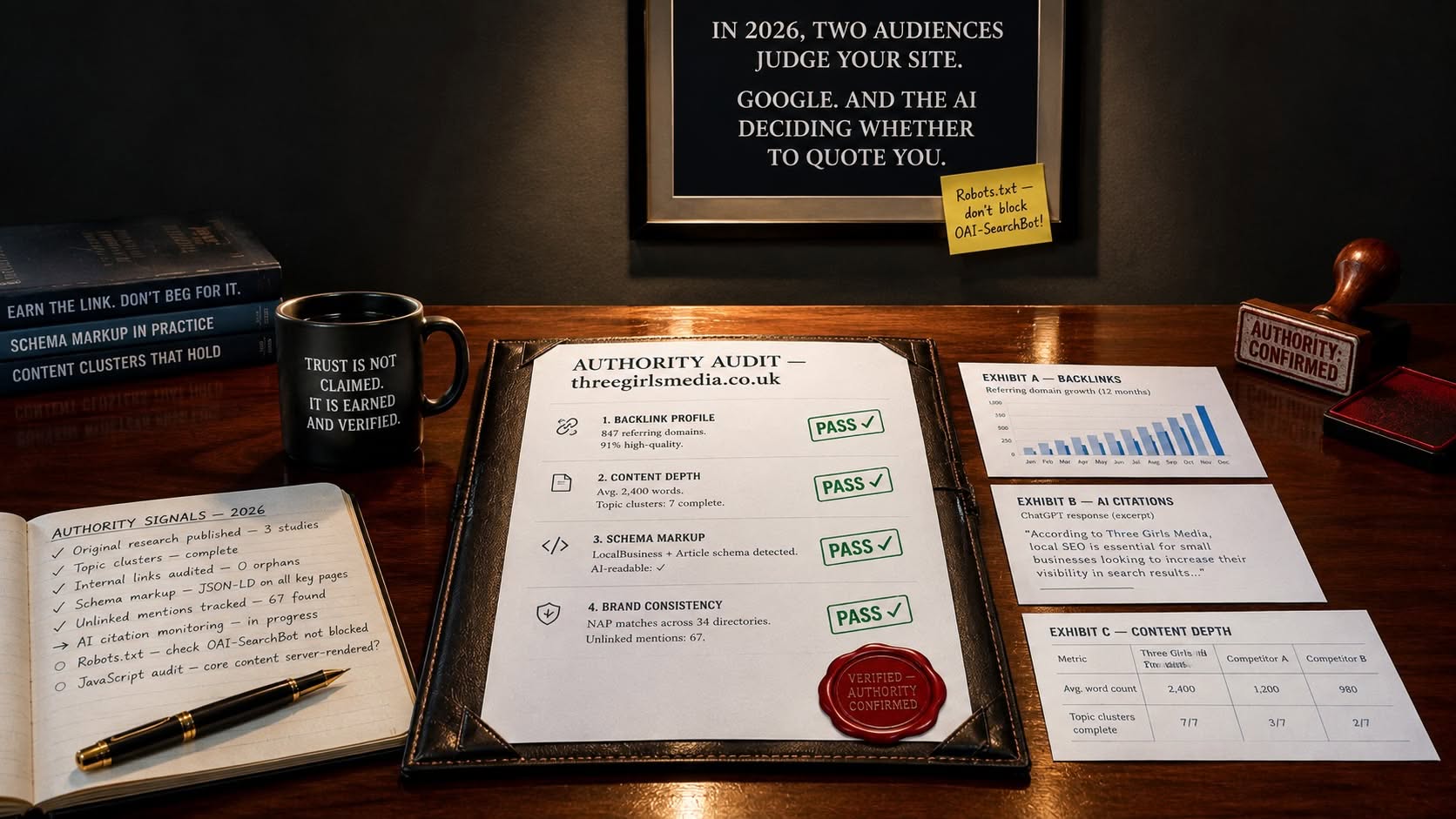
Rankings don’t move because you wished for them. They move because a page gives search engines and AI tools a reason to trust it more than the ten other pages fighting for the same click. That’s really the whole game now — Google’s algorithm and tools like ChatGPT or Perplexity are all trying to answer one question: which source deserves to be shown first?
Below is what actually separates the pages that rank from the ones that quietly sit on page four, based on how search and AI discovery genuinely work in 2026.
1. Know What the Searcher Actually Wants Before You Write a Word
Every ranking factor is downstream of one thing: search intent. If your content doesn’t match what someone meant when they typed a query, nothing else you do will save it.
Take a phrase like “best project management software.” That’s not someone wanting a definition — they’re comparing options before spending money. A page that opens with “what is project management” instead of a comparison table has already lost, no matter how well it’s written.
The fastest way to check intent is to look at what’s currently ranking and what an AI assistant returns for the same query. If the top results are list-style comparisons, product roundups, or tables, that’s your format. If they’re long explainers, write an explainer. Tools such as Semrush’s Keyword Magic Tool label queries by intent type — informational, commercial, transactional, or navigational — which saves a lot of guesswork. Google’s own guidance on search intent makes the same point: content built around what people are genuinely trying to accomplish outperforms content built around a keyword alone.

2. Go Deep on a Topic Instead of Scattering Content Everywhere
A single great article rarely outranks a site that’s built a network of related pages around the same subject. This is topical authority — the idea that covering a subject from multiple angles, and linking those pages together, signals real expertise rather than a lucky one-off post.
The practical version looks like this: pick a core topic tied to your business, build one strong “pillar” page that gives a broad overview, and then support it with narrower pages that each answer a specific sub-question. Link the pillar page to every supporting page, and link each supporting page back to the pillar. Search engines read that internal link structure as a signal of depth, not just volume.
This matters even more now that AI search overviews tend to pull from sites that already demonstrate authority on a subject rather than a single standout page with no supporting context around it.
3. Structure Pages So Both Humans and AI Can Actually Parse Them
Well-organised content gets extracted, quoted, and summarised far more often than content that buries its point in dense paragraphs. Search engines and AI crawlers are essentially trying to lift the answer out of your page — make that easy and you get chosen more often.
A few things make the biggest difference here. Headings should follow a logical order, with the H1 stating the main topic and H2s or H3s breaking it into digestible sections. Each section should answer its own heading directly, in the first sentence or two, rather than building up to the point. Paragraphs should be able to stand alone, since AI tools often lift a single paragraph rather than an entire page. And structured data — schema markup like Article, FAQPage, or HowTo — gives machines extra context about what type of content they’re looking at. You can check whether your markup is valid using Google’s Rich Results Test.

4. Fix the Technical Foundation Before Anything Else
None of the above matters if search engines can’t crawl, render, or index your pages properly. Technical SEO is unglamorous, but it’s the floor everything else stands on.
The core checks are consistent: page speed, mobile usability, secure HTTPS connections, clean site architecture, and no accidental blocks in your robots.txt file. It’s also worth checking which pages might be invisible specifically to AI crawlers, since some bots respect different crawl rules than traditional search engines. Tools like Semrush’s Site Audit or Google Search Console will surface most of these issues automatically, along with prioritised fixes.
5. Show That a Real, Credible Source Is Behind the Content
Google evaluates content partly through a framework it calls E-E-A-T — Experience, Expertise, Authoritativeness, and Trustworthiness — and while it isn’t a single ranking factor you can tick off, it shapes how favourably your content is judged against competitors covering the same ground.
In practice, that means writing from genuine, specific experience rather than generic summary; crediting the actual person or team behind the content with a real bio explaining their qualifications; linking out to credible, independent sources instead of vague claims; and making basic trust signals easy to find, like contact information, an About page, and a secure site. None of this is about gaming an algorithm — it’s about giving readers, and by extension search systems, a reason to believe what they’re reading. Google outlines the full framework in its Search Quality Rater Guidelines.

6. Don’t Leave Image SEO on the Table
Images are one of the easiest wins to skip and one of the easiest to fix. A properly optimised image can earn visibility in image search, improve page load speed, and give AI systems more context about what a page covers.
The basics: use descriptive file names instead of default camera or export names, write specific alt text that actually describes the image rather than stuffing it with keywords, compress files so they don’t drag down load times, and enable lazy loading so images only load as a visitor scrolls to them — which helps Core Web Vitals like Largest Contentful Paint. Where it’s relevant, such as for infographics or product photos, adding ImageObject schema can help images surface in rich results.
7. Earn Links Instead of Chasing Them
Backlinks still function as one of the clearest trust signals search engines use, because they represent other sites vouching for yours. But not all links carry equal weight, and some — like reciprocal link swaps where two sites simply agree to link to each other — can do more harm than good if they look manipulative.
The links worth having come from sites that are genuinely relevant to your niche and have their own credibility. A few approaches tend to work reliably: publishing something genuinely useful enough that other writers cite it naturally, building a stronger, more current version of a piece of content that already attracts links elsewhere in your industry, and finding unlinked mentions of your brand online and simply asking the publisher to add a link. This last point matters even for AI visibility specifically — being mentioned and cited across other credible sites appears to influence how often AI tools surface you as a source, even without a direct link. Before investing heavily in link building, it’s worth reading through Google’s spam policies so outreach efforts don’t accidentally cross into penalty territory.

8. Write the Way People Actually Talk
Voice assistants and AI chat tools respond to conversational phrasing far better than stiff, keyword-heavy copy. Nobody asks Siri or ChatGPT the way they’d type into a search bar in 2010 — they ask full, natural questions, the way they’d ask a knowledgeable friend.
Writing for that shift means paying attention to how your actual audience talks — in forums, reviews, comment sections — and mirroring that phrasing rather than industry jargon. It means using contractions, shorter sentences, and a natural rhythm instead of a stiff, formal tone. Signposting phrases like “here’s the thing” or “let’s break this down” help guide a reader (or a model summarising your page) through your logic. And reading your own copy aloud is still one of the most reliable ways to catch anything that sounds robotic before it goes live.
None of these eight practices work in isolation. A technically flawless site with no topical depth won’t outrank a modest site that’s genuinely useful and well-linked. A brilliantly written article buried under bad site architecture will never get the chance to prove itself. The sites that consistently show up — in Google, in AI Overviews, in ChatGPT’s answers — are the ones treating all of this as one connected system, not a checklist to run through once and forget.