A few years ago, “optimising for search” meant one thing: climbing Google’s list of blue links. Today, plenty of people skip the list entirely. They ask ChatGPT for a recommendation, glance at the AI summary above Google’s results, or put a question to Gemini or Perplexity and take whatever answer comes back.
That shift has produced a new buzzword: generative engine optimisation, or GEO. Some agencies treat it as a revolution. Others dismiss it as old SEO in a new coat. The truth sits somewhere in between, and for a small business, understanding where can save you both worry and money.
What Generative Engine Optimisation Actually Means
GEO in Plain English
Generative engine optimisation is the practice of making your business and content easy for AI tools to find, understand and mention when they generate answers. Instead of fighting for a position in a list of results, you’re aiming to be named, quoted or recommended inside the response itself.
The term gained traction after a research paper from academics, GEO: Generative Engine Optimization, explored how content can be shaped to appear more often in AI-generated answers. Since then, it has become shorthand for improving visibility in tools like ChatGPT, Google’s AI Overviews, Gemini, Perplexity and Microsoft Copilot.
How GEO Differs From SEO
Traditional SEO aims to rank pages so people click through to your website. GEO aims to make your brand part of the answer, whether or not anyone clicks. In practice, though, the two overlap heavily. AI tools generally draw on content that is well-written, trustworthy, clearly structured and widely referenced, which is exactly what good SEO has always rewarded.
You may also see the term AEO, or answer engine optimisation, which covers earning visibility in featured snippets, voice assistants and AI answers. For a small business owner, the labels matter far less than the underlying idea: be clear, credible and easy to cite.
Why GEO Is Suddenly a Talking Point
Search Behaviour Is Changing
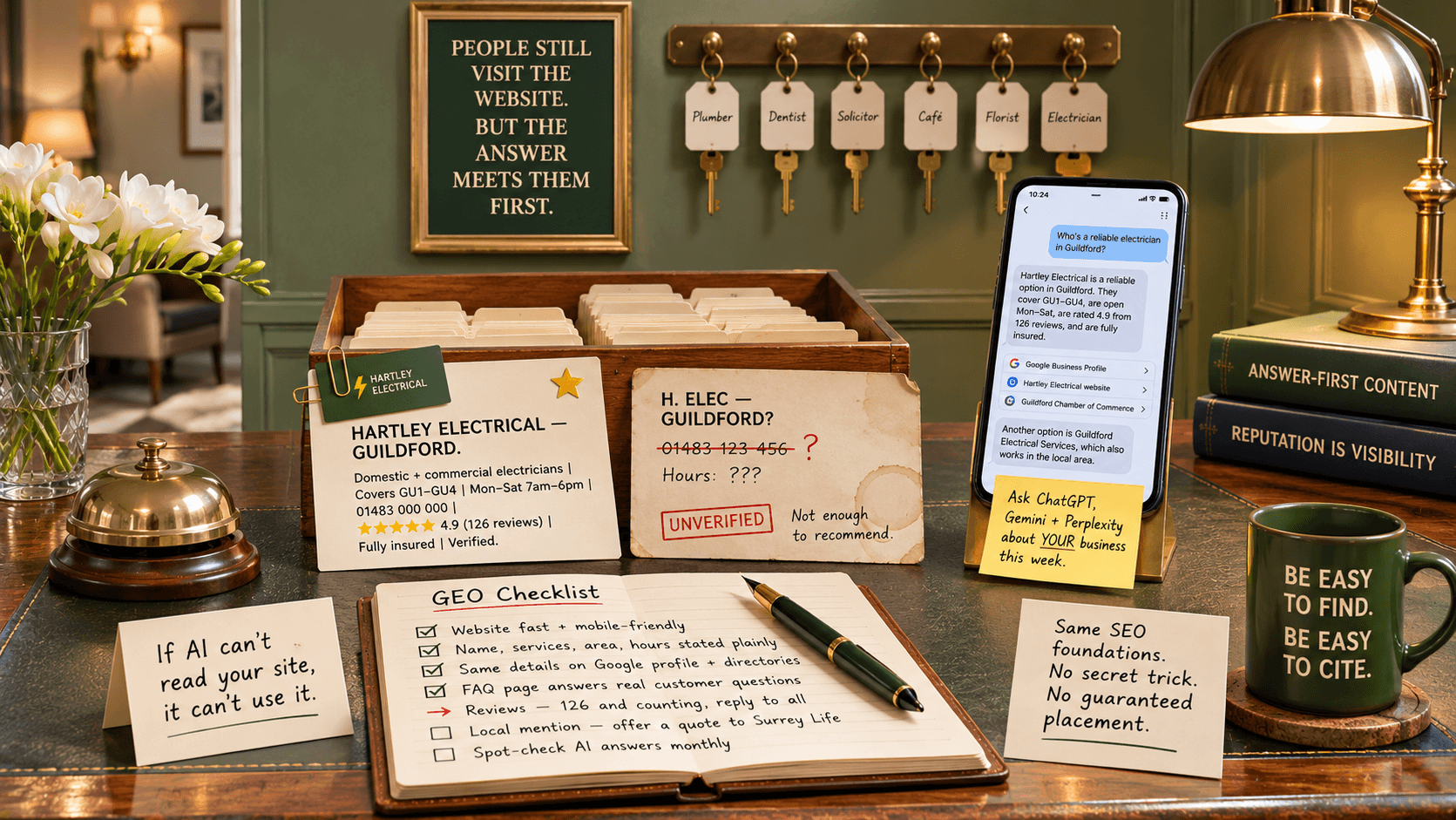
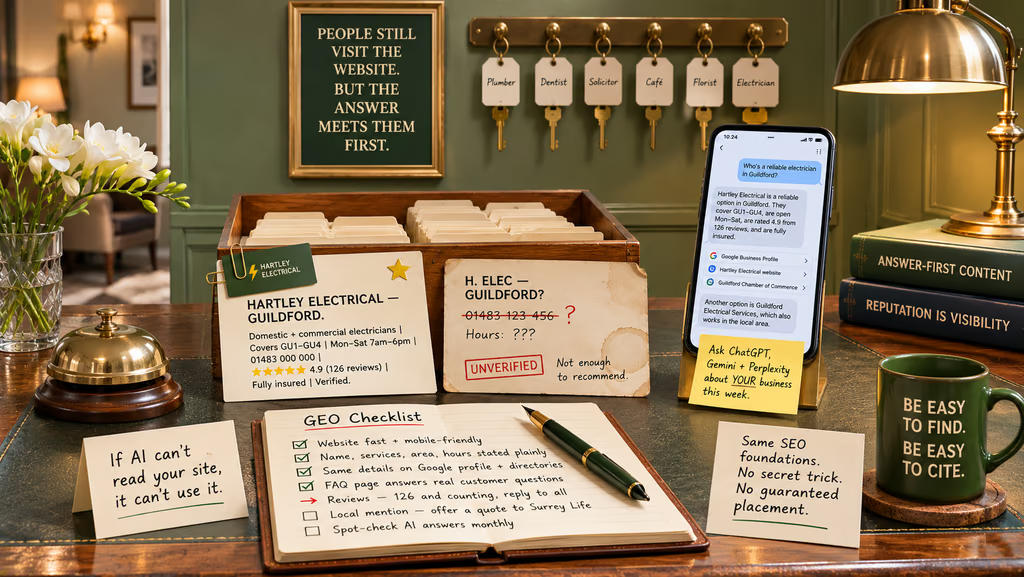
People increasingly ask full questions in natural language, such as “Who’s a reliable electrician in Guildford?” or “What’s the best way to protect a new patio?” AI tools respond with a summarised answer, often with only a handful of linked sources. For many informational searches, that means fewer clicks reach any website, including yours.
That doesn’t make websites obsolete. People still visit sites to book, buy and make final decisions. But the first impression of your business may now be formed by an AI summary before a visitor ever lands on your page.
AI Tools Rely on What’s Already Out There
AI assistants build answers from a mixture of their training and live information from the web, depending on the tool. That includes your website, your Google Business Profile, directories, reviews, news mentions and other sites that talk about you. If that information is thin, inconsistent or out of date, AI may overlook you or describe you inaccurately.
So, Should Small Businesses Care?
Yes, but with a sense of proportion. GEO is worth paying attention to, but it’s not a reason to panic or hand over a large budget.
Google itself is fairly clear on this point. Its guidance on AI features and your website explains that the same SEO fundamentals apply to AI Overviews, and that there’s no special markup or secret trick required to appear in them. Content that’s helpful, accessible to search engines and genuinely useful to people remains the foundation.
For local and service-based businesses, the case for caring is practical. When someone asks an AI tool for a plumber, solicitor, dentist or café in their area, the businesses with clear information, strong reviews and a consistent online presence are more likely to be mentioned. If you’re already doing good local SEO, you’re partway there.
What you should be wary of is hype. Anyone promising guaranteed placement in ChatGPT answers is overselling. These systems change constantly, and nobody controls what they say.
Practical GEO Steps for Small Businesses
Get the SEO Fundamentals Right First
Before anything else, make sure your website is fast, mobile-friendly and easy for search engines to crawl. Check your pages in PageSpeed Insights, fix broken links, and use Google Search Console to find indexing problems. If AI tools can’t read your site properly, they can’t use it.
Make It Obvious Who You Are and What You Do
AI systems work better when they can clearly identify a business, what it offers and where it operates. State this plainly on your homepage and service pages: your business name, services, service area, opening hours and contact details. Keep those details consistent across your website, social profiles and directories.
You can also help machines understand your pages by adding structured data for local businesses. It won’t guarantee a mention, but it removes ambiguity.
A strong “About” page matters too. Explain who runs the business, your experience, your qualifications and what makes you different. AI tools and human visitors both look for evidence that you’re real and credible.
Answer Real Questions Directly
AI answers are built around questions, so build your content around them. Think about what customers ask before they buy: how much does it cost, how long does it take, what’s included, what should I look out for? Write pages and FAQs that answer these questions clearly and early, then add detail below.
Short, direct answers followed by depth work well for readers and AI alike. Avoid fluff, vague claims and keyword-stuffed paragraphs. Specific, accurate, experience-led information is far more likely to be quoted than generic filler.
Build Mentions and Reviews Beyond Your Own Site
AI tools don’t just trust what you say about yourself. They pay attention to what others say too. Reviews on Google and relevant industry platforms, listings in reputable directories, mentions in local news, trade bodies and partner websites all add weight.
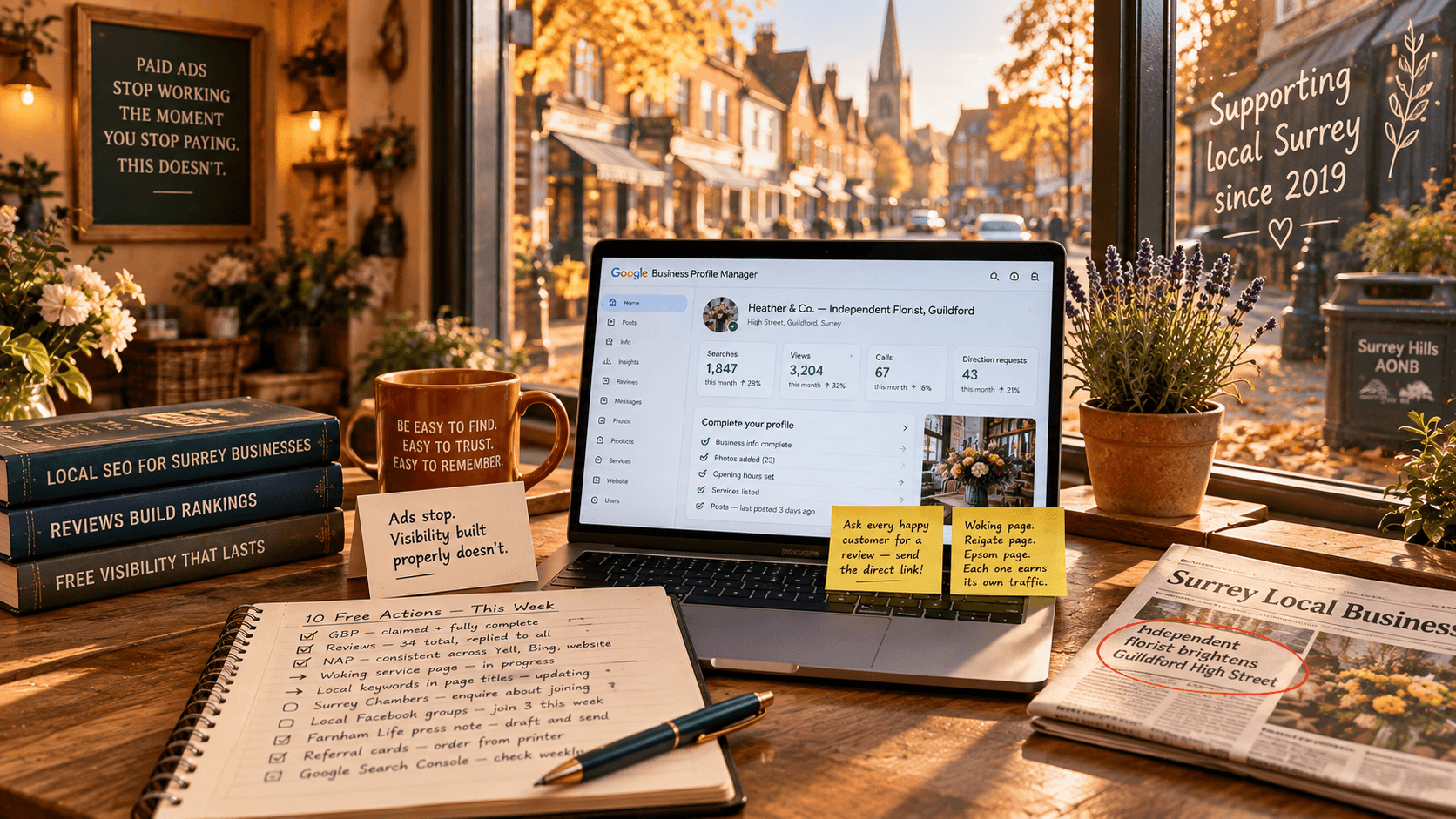
Keep your Google Business Profile complete and active, ask satisfied customers for genuine reviews, and reply to them professionally. If a local publication or industry site would plausibly feature your expertise, offer a useful comment or story. Real-world reputation feeds directly into online visibility.
Keep Your Information Fresh and Accurate
Outdated prices, old opening hours or discontinued services can confuse both people and AI tools. Review your key pages regularly and update them when anything changes. Add dates to time-sensitive guides, and remove content that no longer reflects what you do.
Check How AI Tools Describe You
It costs nothing to see where you stand. Type questions your customers might ask into ChatGPT, Gemini, Perplexity and Google, such as “best [your service] in [your town]” or “who offers [your service] near me”. Note whether you’re mentioned, how you’re described and which sources are cited.
If you find errors, such as wrong services or old contact details, trace them back to the source and correct them where you can. If competitors appear and you don’t, look at what their online presence offers that yours doesn’t.
What Not to Spend Money On
You don’t need to buy an expensive “GEO package” built on vague promises. Be sceptical of services that claim to manipulate AI results, flood the web with low-quality content or secretly insert hidden text to influence chatbots. Those tactics are risky and tend to backfire.
Tracking tools can be useful for larger brands, but most small businesses will get more value from improving their website, reviews and local presence than from a monthly dashboard. Spend on fundamentals first, then reassess.
How to Measure Progress
Because AI platforms rarely report detailed data, progress can feel fuzzy. Use a few practical signals instead. Watch your organic traffic and enquiries in Search Console and analytics, check whether you’re being mentioned in AI answers during periodic spot checks, and ask new customers how they found you. A simple “How did you hear about us?” question on your enquiry form can reveal more than any dashboard.
Treat results as directional, not exact. AI answers vary from day to day and person to person, so look for broad trends over several months.
Care About GEO, But Keep Your Feet on the Ground
So, what is generative engine optimisation, and should small businesses care? GEO is the practice of making your business easy for AI tools to understand and mention, and it matters because more people now start their search with an AI answer. But it isn’t a separate universe from SEO. It’s built on the same foundations: a fast, clear website, genuinely helpful content, consistent business details and a solid reputation.
If you’re a small business, the smartest move is a measured one. Strengthen your SEO, tidy your Google Business Profile, answer customer questions clearly, collect honest reviews and check periodically how AI tools describe you. Ignore the hype, avoid shortcuts, and keep your information accurate. Do that, and you’ll be well placed whether customers find you through a list of links or a conversation with an AI assistant.