| Key Insight | Explanation |
|---|---|
| Web design services cover more than visuals | A professional service includes UX strategy, SEO structure, and conversion planning, not just how a site looks. |
| First impressions happen in milliseconds | Research suggests users form a visual opinion of a website in as little as 50 milliseconds, making design quality critical. |
| Small businesses benefit most from full-service agencies | Agencies that combine web design with SEO, PPC, and support deliver more consistent results than one-off freelance builds. |
| Mobile-first design is non-negotiable in 2026 | Over 60% of web traffic now comes from mobile devices, so responsive design directly affects both rankings and revenue. |
| Ongoing support matters as much as the launch | Many businesses get left stranded post-launch; choosing a provider with hosting and maintenance support prevents this. |
| Cost varies widely by scope and provider type | Freelancers, DIY builders, and full-service agencies all occupy different price and quality tiers with distinct trade-offs. |
Your website is often the first thing a potential customer sees. Before they call, before they visit, before they even read a review, they land on your site and make a snap judgment. That’s why web design services matter more than most business owners realize. Web design services are professional offerings that plan, build, and optimize websites to attract visitors, communicate credibility, and convert browsers into paying customers. In this guide, you’ll learn exactly what these services include, how the process works, what results you can realistically expect, and how to choose a provider who won’t leave you stranded after launch day.
What Are Web Design Services?
Web design services are professional solutions that plan, design, build, and maintain websites to help businesses establish an effective online presence and achieve measurable commercial goals.
The term covers a broad spectrum. At the entry level, you have template-based builds that get a basic site live quickly. At the professional end, you have custom, strategy-led projects that integrate UX design (the practice of structuring a site around how real users think and behave), SEO architecture, and conversion optimization from day one.
What’s Typically Included
A quality web design service isn’t just about picking colors and fonts. According to the University of Pennsylvania’s SAS Web Design Services, professional web work involves upgrading and maintaining digital presences to meet both user needs and institutional goals [1]. In a commercial context, that translates to:
- Discovery and strategy (understanding your business, audience, and goals)
- Information architecture (planning how pages and content are organized)
- Visual design (brand-aligned layouts, typography, and imagery)
- Front-end development (building the site in code or a CMS like WordPress)
- Responsive design (ensuring the site works perfectly on mobile, tablet, and desktop)
- On-page SEO setup (page titles, meta descriptions, heading structure, site speed)
- Testing and quality assurance before launch
- Post-launch hosting and support
Web Design vs. Web Development: What’s the Difference?
These terms get used interchangeably, but they’re not the same thing. Web design focuses on how a site looks and feels. Web development refers to the technical build, the actual code that makes it function. Most professional agencies handle both. The Duke University Office of Information Technology describes this as a combined service covering both design and development to meet diverse website needs [2].
For small and medium-sized businesses, the distinction rarely matters in practice. What you need is a partner who handles both, so nothing falls through the gap between the creative and technical teams.
Pro Tip: Before you contact any web design agency, write down three things your current site does badly and three things you want your new site to achieve. This single exercise will sharpen every conversation you have with a provider and help you evaluate proposals objectively.
How Web Design Services Work
Most professional web design services follow a structured process from initial brief to live site, typically spanning four to twelve weeks depending on project complexity.
Understanding the process helps you stay in control as a client. It also makes it much easier to spot agencies that skip important steps, usually to cut costs at your expense.
The Typical Project Process
- Discovery call and brief: The agency learns about your business, target audience, competitors, and goals. This stage defines the project scope and budget.
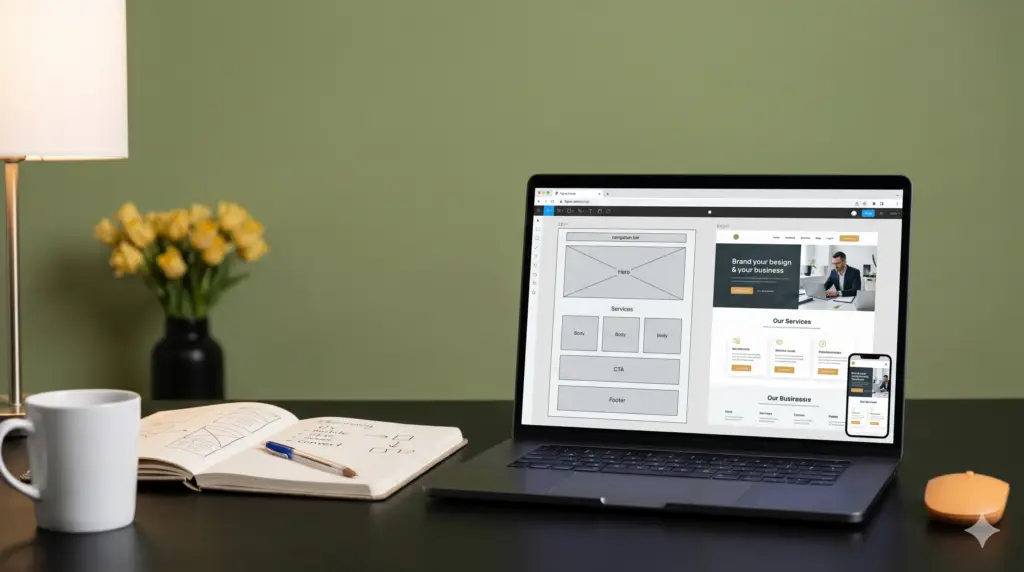
- Sitemap and wireframes: Before any design work begins, the structure of the site is mapped out. Wireframes (low-fidelity layout sketches) show where content, navigation, and calls to action will sit.
- Design concepts: Visual mockups are created for key pages, usually the homepage and one or two inner pages. You review, provide feedback, and approve.
- Development: The approved designs are built into a functioning website. A CMS (content management system) like WordPress is typically used so you can update content yourself after launch.
- Content integration: Copy, images, and other assets are loaded into the site. Some agencies write copy for you; others work with content you supply.
- Testing: The site is checked across browsers, devices, and screen sizes. Forms, links, and load speeds are all verified.
- Launch: The site goes live on your domain. DNS settings are updated and the site is submitted to Google Search Console.
- Ongoing support: A good agency doesn’t disappear after launch. Hosting, security updates, and maintenance keep your site performing reliably.
What Happens Behind the Scenes
Industry analysts at Clutch.co, which ranks the top web design companies as of May 2026, note that the agencies achieving the best client outcomes consistently invest in the discovery and wireframing phases rather than jumping straight into visual design [3]. Skipping these steps is one of the most common reasons projects run over budget or miss the brief entirely.
From experience working with businesses across healthcare, education, and retail, the projects that go smoothest are the ones where the client comes prepared. Know your brand colors, have your logo in a vector format, and have at least a rough idea of the pages you need. It saves weeks.
It’s also worth understanding how design principles apply across disciplines. Just as precision matters in cold forging and machined parts design for mechanical engineers, the same commitment to structural integrity and user-focused planning is what separates a professional web build from a rushed one.
Key Benefits of Professional Web Design Services
Professional this method generate measurable business outcomes including more enquiries, stronger brand credibility, better search engine rankings, and higher conversion rates compared to DIY or template-based alternatives.
The numbers back this up. Research from WebFX indicates that professionally designed, conversion-focused websites can significantly outperform template builds in organic traffic and lead generation [4]. Here’s why.
Business Benefits You Can Measure
- Better first impressions: Studies suggest users form a visual opinion of a website in roughly 50 milliseconds. A polished, professional design signals credibility before a single word is read.
- Higher search rankings: SEO-structured web design (clean code, fast load times, logical heading hierarchy, mobile responsiveness) directly influences where Google places your site. The U.S. Web Design System standards, used across federal government sites, highlight accessibility and mobile-friendliness as foundational requirements for any well-built site [5].
- More enquiries and conversions: A site built around user behavior, with clear calls to action and logical page flows, converts more visitors into leads. This is what UX-led design actually means in practice.
- Competitive advantage: If your competitor has a slick, fast website and yours looks like it was built in 2014, you’re losing customers before you even know they were looking.
- Time savings: A professionally built site on a robust CMS means you can update content yourself without needing a developer every time you change a price or add a new service.
The Case for Full-Service Over Piecemeal
| Provider Type | Typical Cost | Strengths | Limitations |
|---|---|---|---|
| DIY Builder (Wix, Squarespace) | £13–£36/month | Low cost, fast setup | No strategy, limited SEO depth, generic templates |
| Freelancer (Upwork, Bark) | £300–£2,000 one-off | Flexible, lower cost | No continuity, no integrated marketing, variable quality |
| Full-Service Agency | £2,000–£10,000+ | Strategy, SEO, design, support all integrated | Higher upfront investment |
| Large National Agency | £10,000–£50,000+ | Deep resources, large portfolios | Expensive, less personal, SMBs often deprioritized |
At Three Girls Media, we’ve found that small businesses consistently get the best return from a full-service agency approach, where web design, SEO, and ongoing support are coordinated under one roof rather than stitched together from multiple suppliers who don’t communicate with each other.

Common Mistakes to Avoid in 2026
The most common mistakes businesses make with this strategy include prioritizing aesthetics over function, neglecting mobile performance, and failing to plan for post-launch support.
These mistakes are expensive. Not just in money, but in lost customers and wasted time. Here’s what to watch for.
Design and Strategy Mistakes
- Choosing a designer based on portfolio style alone: A beautiful portfolio doesn’t guarantee the designer understands conversion strategy or SEO. Ask for traffic and enquiry data from past projects, not just screenshots.
- Skipping the brief: Vague instructions produce vague websites. If you can’t clearly describe your target customer and what you want them to do on your site, no designer can build that for you.
- Ignoring page speed: Google’s Core Web Vitals (a set of performance metrics that directly influence search rankings) penalize slow-loading pages. A visually stunning site that takes five seconds to load will rank poorly and frustrate users.
- Building for desktop only: As of 2026, over 60% of web traffic globally comes from mobile devices. A site that isn’t optimized for mobile isn’t just inconvenient; it’s actively losing you customers.
Vendor and Process Mistakes
- No post-launch plan: A common mistake is treating the website launch as the finish line. In reality, a site needs ongoing security updates, content refreshes, and performance monitoring to stay competitive.
- Choosing the cheapest option without scrutiny: Platforms like Upwork offer access to freelance designers at low rates, but results vary enormously [6]. Without a clear brief and robust review process, cheap can end up being very expensive.
- Not owning your own domain and hosting: Some providers retain ownership of your domain or lock your site into proprietary platforms. Always ensure you own your domain outright and have full access to your hosting account.
- Overlooking accessibility: Web accessibility (designing sites that work for users with disabilities) is increasingly a legal consideration in the UK and US. Ignoring it exposes businesses to reputational and regulatory risk.
Pro Tip: Before signing any web design contract, ask the agency three questions: Who will own the domain? What CMS will the site be built on, and will you be able to update it yourself? What does post-launch support include? The answers will tell you a lot about how the relationship will play out.
Best Practices for Choosing Web Design Services in 2026
Choosing the right this approach in 2026 means evaluating agencies on strategy, process, post-launch support, and industry experience, not just visual portfolio work.
The market is crowded. DesignRush lists hundreds of web design companies across the US alone [7], and the UK market is equally fragmented. Here’s how to cut through the noise.
How to Evaluate a Web Design Agency
- Check for industry experience: An agency that has worked with businesses similar to yours, whether healthcare, retail, education, or professional services, will understand your audience’s expectations without needing to be educated from scratch.
- Ask about their SEO process: Web design and SEO are inseparable in 2026. Any agency that treats them as separate services is behind the curve. The site architecture decisions made during the build directly affect how well you rank on Google.
- Request case studies with outcomes: Portfolio screenshots are table stakes. Ask for specific results: traffic growth, enquiry volume, conversion rate improvements. Reputable agencies like those reviewed on Clutch.co publish verified client reviews that include outcome data [3].
- Understand the full scope: Does the quote include copywriting? Photography? Ongoing support? Get a line-by-line breakdown so you’re comparing like for like.
- Assess communication style: You’ll be working with this team for weeks, possibly months. If they’re slow to respond during the sales process, they’ll be slow during the project too.
What Good Web Design Services Look Like in Practice
Our team at Three Girls Media recommends looking for agencies that lead with outcomes rather than features. A provider who says “we’ll build you a site that generates enquiries from local search” is thinking about your business. A provider who leads with “we use the latest frameworks and responsive grid systems” is thinking about their own process.
Industry analysts at Thrive Internet Marketing Agency note that conversion-driven web design, where every page element is built with a specific user action in mind, consistently outperforms design-led approaches in terms of measurable business results [8].
The AIDA framework (Attention, Interest, Desire, Action) is one established methodology that well-structured this apply to every page. Each section of a page should first capture attention, build interest through relevant content, create desire through social proof and benefits, and then prompt a clear action. When this framework is applied consistently, conversion rates improve noticeably.
Pro Tip: When reviewing an agency’s portfolio, visit the actual live sites rather than just looking at screenshots. Check how fast they load on your phone, how easy they are to navigate, and whether they have clear calls to action. That’s the real test of their work.
Sources & References
- University of Pennsylvania SAS Computing, “Web Design Services”, 2026
- Duke University Office of Information Technology, “Website Design and Development”, 2026
- Clutch.co, “Top Web Design Companies — May 2026 Rankings”, 2026
- U.S. Web Design System (USWDS), “A Design System for the Federal Government”, 2026
- Upwork, “Best Freelance Web Designers for Hire (May 2026)”, 2026
Frequently Asked Questions
1. What are website design services?
it are professional offerings that plan, design, build, and maintain websites for businesses and organizations. They go well beyond visual design to include user experience strategy (UX), SEO architecture, mobile optimization, and conversion planning. A quality web design service delivers a site that not only looks professional but actively generates enquiries, ranks on search engines, and reflects the credibility of your business.
2. How much do web design services cost for a small business?
Costs vary significantly by provider type and project scope. DIY platforms like Wix or Squarespace run from roughly £13 to £36 per month. Freelancers typically charge £300 to £2,000 for a one-off project. A full-service agency offering custom this method with integrated SEO and ongoing support will generally start from £2,000 and scale upward depending on complexity. Results may vary, but the return on investment from a professionally built, conversion-focused site typically outweighs the higher upfront cost.
3. How long does it take to build a website?
A typical small business website takes four to eight weeks from initial brief to launch when working with a professional agency. More complex sites, including ecommerce stores with multiple product categories, custom integrations, or large content libraries, can take ten to sixteen weeks. Timelines depend heavily on how quickly the client provides feedback, content, and approvals, so having your copy, images, and brand assets ready before the project starts makes a measurable difference.
4. What’s the difference between web design and web development?
Web design covers the visual and structural decisions: layouts, typography, color palettes, and user experience flow. Web development is the technical implementation: writing the code that makes those designs function in a browser. Most professional this strategy handle both disciplines together. For small and medium-sized businesses, the practical distinction rarely matters as long as your agency delivers a fully functional, well-designed site. What matters is that both aspects are handled to a professional standard.
5. Do web design services include SEO?
They should, but not all providers include it. Basic on-page SEO, including proper heading structure, meta titles and descriptions, page speed optimization, and mobile responsiveness, should be built into any professional web design service as standard. Ongoing SEO, such as content strategy, link building, and keyword targeting, is typically offered as a separate retainer service. If your agency doesn’t mention SEO during the design process at all, that’s a red flag worth raising before you sign anything.
6. Can I update my website myself after it’s built?
Yes, if it’s built on a CMS (content management system) like WordPress. Most professional agencies build on WordPress or similar platforms precisely because it lets non-technical business owners update text, images, blog posts, and basic page content without needing a developer. Before your project starts, confirm which CMS will be used and ask for a brief training session after launch. A good agency will want you to feel confident managing your own site.
7. What should I look for in a web design agency near me?
Look for an agency with verifiable case studies from businesses similar to yours, a clear process that includes discovery and strategy (not just design), and explicit post-launch support. Local agencies serving your area often have an advantage: they understand your market, your competitors, and the expectations of your local customers. Ask specifically about their SEO approach, who owns the domain after launch, and what ongoing support looks like. The answers will quickly tell you whether you’re talking to a genuine partner or just a build-and-disappear shop.
Conclusion
A great website doesn’t happen by accident. It’s the result of deliberate strategy, skilled execution, and a clear understanding of what your customers need to see before they pick up the phone or fill in a form. Professional this approach deliver all of that, and when they’re done well, the return on investment is tangible and measurable.
The businesses that struggle online usually share one of two problems: they either built a site on the cheap and got what they paid for, or they invested in design without thinking about strategy. The sweet spot is a provider who combines both, someone who understands conversion, SEO, and your industry, not just how to make things look good on screen.
Three Girls Media brings over 10 years of award-winning experience to every project, with first-hand ecommerce expertise and a full-service approach that covers web design, SEO, PPC, and ongoing support. Whether you’re based in Warlingham, Caterham, Coulsdon, or anywhere across Surrey and South London, we build websites that work as hard as you do. Get in touch for a free, no-obligation quote and let’s talk about what your business actually needs.
Recommended Articles
Explore more from our content library: