
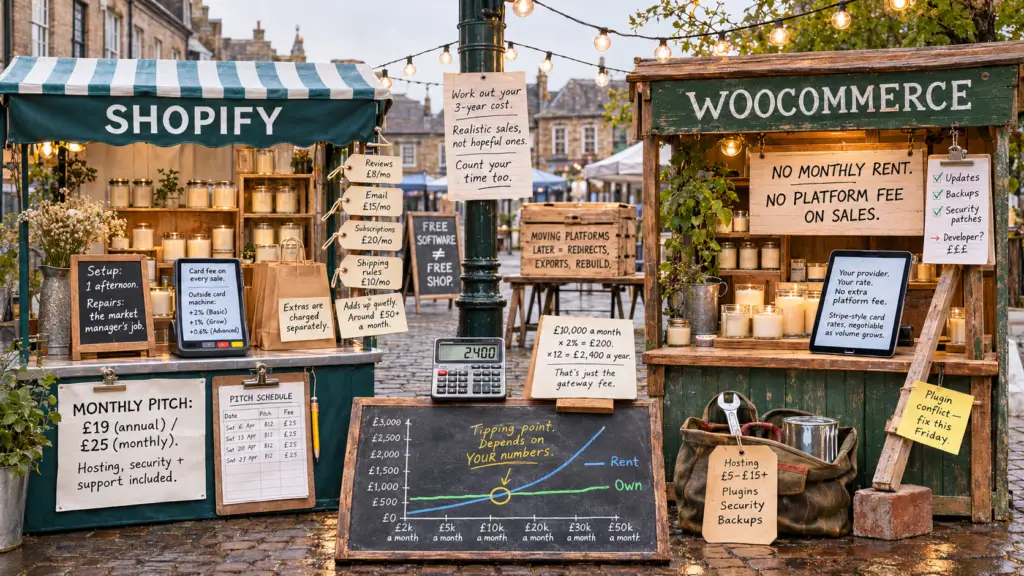
Ask around and you’ll hear two confident but opposite claims. Shopify is “simple and all-inclusive”, so it must be cheaper. WooCommerce is “free”, so it must be cheaper. Both are half true, which is exactly why this question trips so many UK shop owners up.
The honest answer is that WooCommerce usually costs less as sales grow, while Shopify often costs less in time and hassle, particularly in the early days. The tipping point depends on your revenue, your payment setup and how much of the technical work you can handle yourself. Here’s where the money actually goes on each platform.
What Shopify Really Costs
The Monthly Subscription
Shopify’s headline pricing is easy to understand, which is part of its appeal. As of a UK price check in late September 2026, the Basic plan was £19 a month on annual billing or £25 monthly, Grow was £49 or £65, and Advanced was £259 or £344. Prices change, so confirm the current figures on Shopify’s UK pricing page before you plan around them.
The subscription covers hosting, security, updates and customer support, which is a genuine saving compared with arranging those yourself.
Payment and Transaction Fees
This is where the real long-term cost sits. Shopify takes card processing fees on every sale, and if you use a payment provider other than Shopify Payments, it can also add a platform transaction fee. The same late September check showed third-party gateway fees of 2% on Basic, 1% on Grow and 0.6% on Advanced.
Those percentages look small until your sales grow. A shop taking £10,000 a month through an outside gateway on the Basic plan would pay £200 a month, or £2,400 a year, in transaction fees alone. Using Shopify Payments avoids that extra fee, but it means being tied to Shopify’s payment system and its card rates.
Apps and Themes
Shopify’s core features are solid, but many shop owners end up adding apps for reviews, email marketing, subscriptions, upsells, advanced search or shipping rules. Many of these are monthly subscriptions, so a handful can quietly add £50 or more a month. Premium themes typically cost a one-off fee, and customising them may require a developer.
Moving Up the Plans
As you grow, you may need better reporting, lower card rates or more staff accounts, which pushes you towards higher-priced plans. That’s not necessarily a bad thing, since it’s tied to growth, but it’s a cost that rises in steps.
What WooCommerce Really Costs
Free Software, Not a Free Shop
WooCommerce is a free plugin for WordPress, but running a store still costs money. You need hosting, a domain, a theme, security, backups and often paid extensions. The software is free; the infrastructure isn’t.
Hosting
Hosting is WooCommerce’s main fixed cost, and it varies hugely. Basic shared hosting can start at around £5 to £15 a month, and many UK hosts advertise attractive introductory prices. But those low prices often rely on long prepayment terms and rise on renewal. A growing shop with real traffic is better off with quality managed WordPress or WooCommerce hosting, which costs more but delivers faster, safer performance. Slow hosting means lost sales, so this isn’t the place to cut corners.
Plugins, Themes and Extensions
Core WooCommerce handles the basics, but extras such as subscriptions, bookings, advanced shipping, memberships or specialised payment options often come as paid plugins, usually billed annually. These tend to cost less than equivalent monthly Shopify apps, but you’ll need to keep them updated and compatible with each other.
Maintenance, Security and Developer Time
This is the hidden cost people overlook. Because you’re responsible for the site, you’re also responsible for updates, backups, security patches and fixing things when a plugin conflict breaks something. If you can do this yourself, great. If not, you’ll pay a developer or a maintenance plan, which can range from modest monthly fees to far more for complex shops.
Estimates for this vary widely, so get a firm quote rather than relying on generic figures. A poorly maintained WooCommerce site can cost you more in downtime and lost sales than any subscription would.
Payment Gateway Fees
On WooCommerce, you choose your payment provider and pay its rates, with no extra platform transaction fee on top. Providers such as Stripe publish their UK card rates openly, and you can compare options or negotiate better rates as your volume grows. This is WooCommerce’s biggest structural cost advantage as sales increase.
Putting the Numbers Side by Side
Let’s use rough scenarios to show how the picture changes. These are illustrations, not quotes.
A New Shop Taking Around £2,000 a Month
At this level, the difference is small. Shopify Basic’s subscription and its card fees are predictable, setup is quick, and you don’t need technical help. A low-cost WooCommerce setup may undercut it on paper, but the time you spend configuring, securing and maintaining it can wipe out the saving. For many new sellers, Shopify is the lower-stress and sometimes lower-cost choice.
A Growing Shop Taking Around £10,000 a Month
Now fees start to matter. If you rely on a non-Shopify gateway, Shopify’s extra 2% on Basic alone costs around £2,400 a year before apps. WooCommerce on decent hosting, with sensible plugins and a small maintenance budget, often comes out ahead here, particularly if you’re comfortable managing it or already have a developer.
A Established Shop Taking £50,000 or More a Month
At higher volumes, the gap widens. Even at Shopify’s lower third-party fee rates, the percentages become thousands of pounds a year, and monthly app subscriptions pile up. WooCommerce’s lack of platform transaction fees and its flexibility can deliver significant long-term savings, as long as you invest properly in hosting, security and development. Several UK cost comparisons suggest WooCommerce overtakes Shopify on cost once monthly revenue passes the low thousands, though they use different assumptions, so treat that as a rough guide.
When Shopify Costs Less
Shopify tends to be the cheaper choice overall when your sales are modest, you want to launch quickly and you have no technical support. It’s also strong if your time is limited, since every hour you spend fixing technical problems is an hour you’re not selling. Reliable uptime, built-in security and 24/7 support carry real value, even if they don’t appear on an invoice.
It also makes sense if you’re happy using Shopify Payments, which removes the extra third-party fee and keeps your costs simple.
When WooCommerce Costs Less
WooCommerce usually wins on long-term cost when you have higher or fast-growing sales, want to use your own payment provider, need unusual functionality or run a content-led shop already built on WordPress. It’s also attractive if you want to avoid ongoing app subscriptions and keep full control over your data and design.
The catch is that it works best when someone competent looks after it. If you have the skills, or the budget to pay someone who does, the numbers tend to favour WooCommerce over time.
The Costs People Forget
Whichever platform you choose, a few extras catch people out. Professional email, a decent theme, product photography, shipping software and a sensible backup plan all add to the bill. Migration is another consideration: moving platforms later means exporting products and customer data, setting up redirects to protect your search rankings and rebuilding your design, which costs time and sometimes money.
There’s also the cost of mistakes. A slow, insecure or poorly set up store loses sales regardless of the platform. Spend where it improves speed, reliability and customer experience, and economise elsewhere.
How to Decide
Ask yourself a few honest questions. What are your realistic sales for the next two years? Which payment methods do you want to use? Do you, or someone you trust, have the skills to maintain a WordPress site? How important is launching quickly? And how complex are your products, shipping rules or customer journeys?
Then build a three-year cost estimate for each platform, including subscriptions or hosting, apps or plugins, payment and transaction fees, maintenance and developer help. Use realistic sales figures, not hopeful ones. The cheaper option will usually become clear once you see it on paper.
The Cheaper Platform Depends on Your Stage
So, which costs less in the long run, WooCommerce or Shopify? For small or new shops, Shopify’s predictable pricing and low maintenance often make it the cheaper choice once your time is counted. As sales grow, WooCommerce’s lack of platform transaction fees and lower plugin costs frequently tip the balance in its favour, provided you budget properly for hosting, security and upkeep.
There’s no universal winner, only the platform that fits your volume, skills and plans. Work out your three-year costs using your own numbers, check the latest pricing on both platforms and pick the one that lets you sell comfortably today without trapping you tomorrow.


