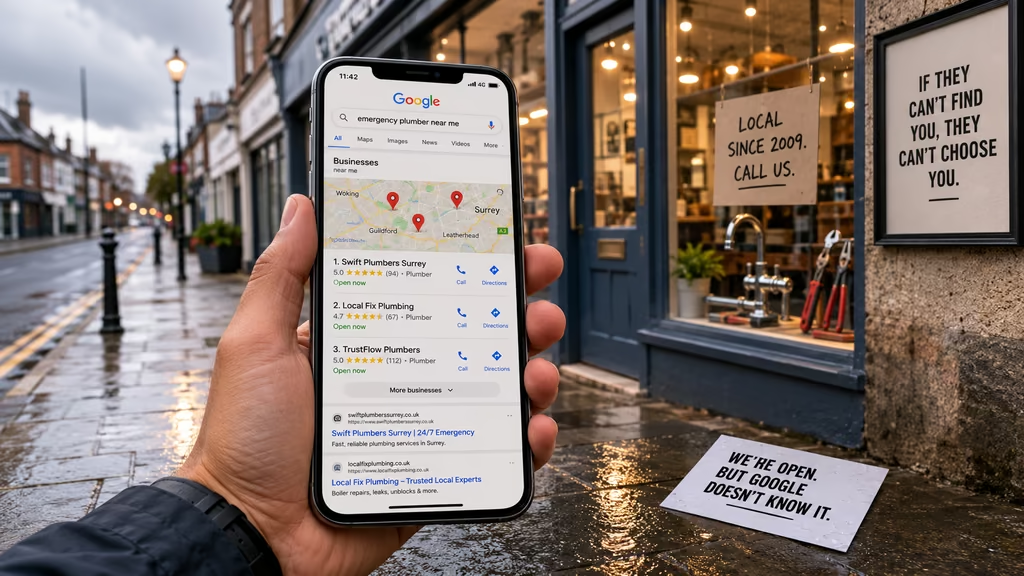
You could have the best plumbing service, coffee shop, or law firm in your city, and still be invisible the moment someone types “emergency plumber near me” into Google. That’s not bad luck. It’s a keyword problem.
Local keyword research is how you figure out exactly what your potential customers are typing into search bars before they choose who to call. Get it right, and you show up in the Google Local Pack, the map results, and the organic listings all at once. Get it wrong, and a competitor three streets away eats the business you should have gotten.
Here’s how to actually do it, without drowning in jargon.
What Local Keyword Research Actually Means
At its core, this is the process of finding the exact phrases people use when they’re searching for something nearby — a service, a shop, a fix to a problem. But it’s not just about stuffing “in [city name]” onto a page. Search engines are smarter than that now.
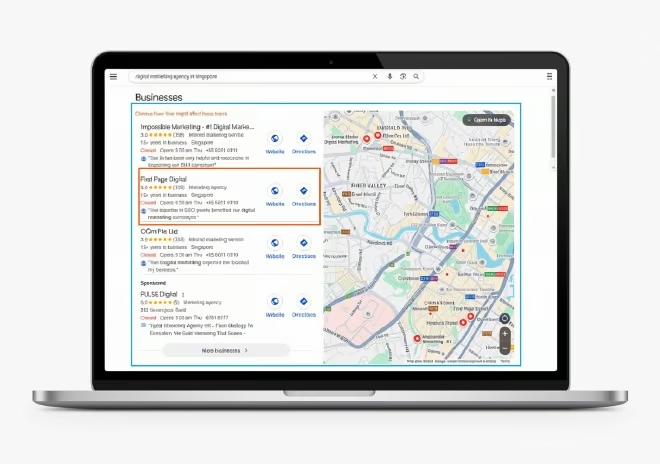
When someone searches “[service] near [location],” Google can return several different result types on the same page: a row of image-based place listings, the Local Pack (a map with three business listings underneath), and traditional blue-link organic results further down. Local businesses often show up in more than one of these zones simultaneously, which is exactly why the research matters — you’re not just optimizing for one ranking system, you’re optimizing for two or three at once.
That distinction matters because they work differently. Organic rankings lean on classic SEO signals: page content, backlinks, site authority. The Local Pack, meanwhile, cares more about your Google Business Profile, how close you are to the searcher, and how strong your review signals are. Good local keyword research tells you which terms are triggering which type of result, so you’re not optimizing blindly.
The Keyword Types You Need on Your Radar
Not all local searches look the same, and treating them identically is one of the biggest mistakes businesses make. A few patterns show up again and again:
City-level terms like “roofing contractor Denver” make sense if you serve an entire metro area. Neighborhood-level phrases — “coffee shop Williamsburg Brooklyn” — carry less competition and often convert better because the intent is hyper-specific. Then there’s urgency-based language: “24 hour locksmith,” “same day appliance repair,” which signals someone who needs help now, not next week. And of course, “near me” searches, which only work in your favor if your Google Business Profile is dialed in correctly. Round it out with landmark or ZIP-based searches — “hotels near Fenway Park,” “gyms in 78701” — which are gold if your location happens to sit near something recognizable.
The smart move is matching keyword type to page type rather than treating your whole site like one big bucket for “local keywords.”

Explicit vs. Implicit: The Distinction Most People Miss
This is where a lot of local SEO advice gets lazy. There are two flavors of local intent, and they behave differently.
Explicit local keywords spell it out — “locksmith in London,” “dentist near Central Park.” There’s no ambiguity about what the searcher wants. Implicit local keywords, on the other hand, don’t mention a place at all, yet Google still serves up local results because it can infer intent from context. Someone typing just “locksmith” while standing in Manchester is going to get Manchester locksmiths, no location word required.
Here’s the part that trips people up: “locksmith London” and “locksmith in London” aren’t treated identically by Google, even though they look nearly the same to a human. The version with “in” is more geographically anchored. Drop the “in,” and Google starts blending the query with the searcher’s actual location and nearby Local Pack signals — meaning two people in different parts of the same city can see completely different results for the identical phrase.
Why should you care? Because this affects which pages can realistically rank, explains why your rankings sometimes swing for no obvious reason, and changes how you should write your copy. You don’t need to cram “in London” into every sentence on your homepage. Natural phrasing — “trusted across London,” “your local London specialists” — still builds the relevance signal search engines are looking for, without reading like a robot wrote it.
Building Your Local Keyword List
Start by listing two separate things: your services, and your locations.
For services, jot down the general terms people use for what you do, the specific offerings you provide, and — this one gets skipped a lot — the actual problems you solve. People search for solutions to pain points (“leaky faucet fix”) almost as often as they search for job titles (“plumber”).
For locations, go beyond just your city name. List your neighborhood, your ZIP or postcode, and any nearby landmarks people might reference. If you’re a service-area business like a contractor or a mobile repair company, neighborhood and postcode terms are usually your best shot — lower competition, and the person searching is often standing right in your service radius. “Plumber South End Boston” is a much easier climb than the crowded “plumber Boston.”
Once you’ve got your seed list, plug it into a proper research tool. Google Keyword Planner is free and fine for a rough sense of volume, though it only gives you broad ranges and doesn’t support neighborhood-level targeting. For sharper data, a tool like Semrush’s Keyword Magic Tool lets you filter specifically for local intent, layering in both city and hyperlocal modifiers, and checking a personalized difficulty score based on your own site’s authority rather than a generic industry-wide number.
Don’t Skip the Metrics Check
Once you’ve got a list, resist the urge to target everything. Some of those keywords will have zero local search volume, and others will be brutally competitive for a site your size. Check search volume and difficulty for each term, and cut anything that isn’t realistic. The goal isn’t the longest list — it’s the shortest list of terms you can actually win.
Find What Your Competitors Are Ranking For (That You Aren’t)
One of the fastest ways to uncover opportunities is to simply search your target keyword and note who shows up in both the Local Pack and the organic results below it. Those are your real competitors — not every business in your category, just the ones currently winning the visibility you want.
From there, a keyword gap analysis (Semrush’s Keyword Gap tool works well for this) shows you terms competitors rank for that you don’t. Switch the device filter to mobile, since most local searches happen on phones, and exclude competitor brand names so you’re not chasing terms that were never available to you anyway.
Map Every Keyword to a Real Page
A keyword list is useless sitting in a spreadsheet. Each term needs a home — a specific page built (or optimized) to satisfy that exact search intent. For multi-location businesses, this usually means separate pages per city or neighborhood, each with genuinely different content, not just a swapped-out place name. Google calls those thin, duplicated pages “doorway pages,” and they can actively hurt you rather than help.
Put the Keywords to Work on Your Google Business Profile
Your website isn’t the only place local keywords matter. Your Google Business Profile description, categories, and services should reflect the language your customers actually search — naturally, not stuffed. It won’t guarantee a ranking boost on its own, but it helps Google match your profile to the right queries, and it reassures a browsing customer that you offer exactly what they’re looking for. Pair that with a steady stream of genuine customer reviews, since reviews remain one of the strongest local ranking signals available.
Keep Watching the Numbers
Local rankings shift more than people expect, partly because of that implicit-versus-explicit blending mentioned earlier. Track your visibility over time — tools like Semrush’s Position Tracking and Map Rank Tracker let you see how you’re performing across different neighborhoods within the same city, not just a single average position.
Local search still drives real business. Recent consumer research shows the majority of U.S. shoppers search for local businesses on a weekly basis, with a meaningful share doing so daily — which means the businesses treating this as a one-time task, rather than an ongoing practice, are the ones quietly losing ground.

Related reading: How Do You Write Copy That Actually Converts? Here’s the Real Formula, SEO Isn’t Dead — But Most People Are Still Doing It Wrong.