Most copy fails not because the writer lacks talent, but because it skips a step. It jumps straight to clever wording without first understanding who’s reading it, what they’re afraid of, or what would make them click “buy.” Great copywriting isn’t about sounding smart. It’s about being understood instantly, believed immediately, and acted on without hesitation.
If you’ve ever rewritten a headline ten times and still watched your bounce rate creep up, this guide walks through what separates copy that gets skimmed from copy that gets results.
Know exactly who you’re writing for
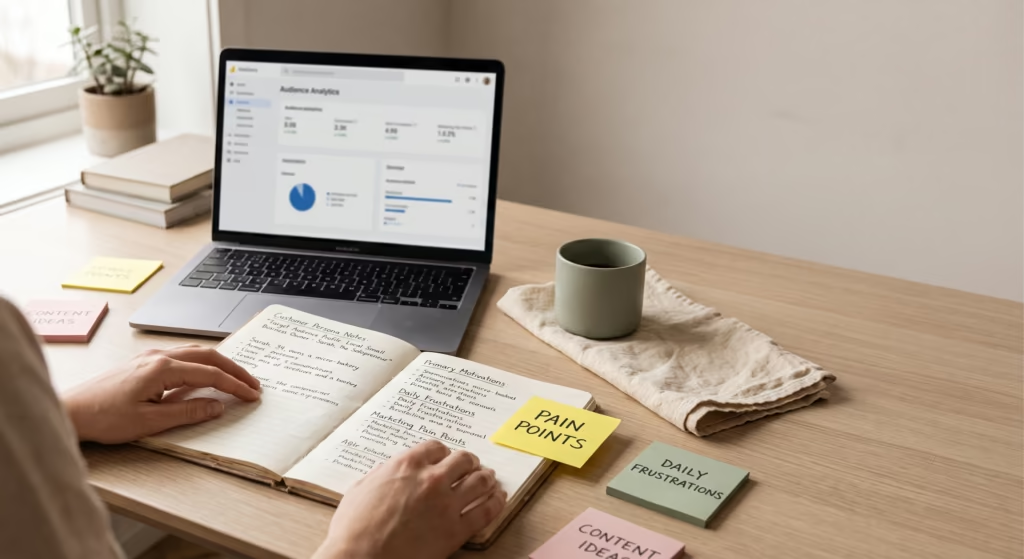
Before a single sentence gets written, you need clarity on your reader. Not a vague sense of “professionals aged 25–45,” but a real understanding of their daily frustrations, the words they already use to describe their problem, and what’s stopped them from solving it so far.
This matters because language choice is everything. A financial advisor writing for retirees needs a completely different vocabulary, pace, and tone than a SaaS founder writing for developers. When you skip audience research, you end up writing copy that sounds fine to you but says nothing to the person you’re trying to reach.
Build a simple profile before you write: what does this person Google at 11 p.m. when they can’t sleep because of this problem? What objections do they raise before buying? Answer those questions first, and the copy practically writes itself.
Make your headline do the heavy lifting
Roughly eight out of ten people will read a headline, and only two of those will read the rest, according to research popularized by copywriting legend David Ogilvy and still cited across the industry today. That means your headline isn’t decoration — it’s the entire pitch, compressed.
A strong headline does four things at once: it states a clear benefit, uses specific language instead of vague adjectives, front-loads the most important word, and speaks directly to a need the reader already has. Weak headlines describe a feature. Strong ones promise an outcome.
Avoid the temptation to be clever at the expense of clarity. A headline that requires a second read to understand has already lost half its audience. If you’re stuck, write ten versions in five minutes without editing, then pick the one that would make you personally stop scrolling.
Sell the outcome, not the object
Nobody buys a mattress because of its coil count. They buy the feeling of waking up without back pain. This is the core idea behind outcome-based selling: you’re not describing your product, you’re describing the life your reader gets to live once they own it.
This works because it triggers mental simulation. When someone reads copy that paints a vivid picture of their problem solved, their brain processes it almost as if they’ve already experienced the benefit. That’s a powerful psychological nudge toward conversion, and it’s backed by decades of consumer psychology research, including work referenced by the Nielsen Norman Group on how users process persuasive web content.
Instead of listing specifications, ask yourself: what does my customer’s Tuesday afternoon look like after this problem is solved? Write toward that image.
Show proof instead of making claims
Telling someone your product is “powerful” or “industry-leading” means nothing without backup. These words have been used so often in marketing that readers now filter them out automatically. The fix is to replace assertion with demonstration.
Instead of saying your process is simple, walk through exactly how few steps it takes. Instead of saying your service is fast, state the actual turnaround time. Concrete details are inherently more credible than adjectives, because they give the reader something they can verify or picture, rather than something they just have to take your word for.
This same principle extends to social proof. A vague claim of “trusted by thousands” carries far less weight than a specific, verifiable number or outcome. Readers have become skeptical of marketing language, and specificity is one of the fastest ways to rebuild that trust.

Use numbers and specifics wherever you can
Precision persuades. “Increase your output” is forgettable. “Increase your output by 40% in six weeks” sticks. Specific numbers signal that a claim is measured rather than invented, and that alone makes copy feel more trustworthy.
The catch is that every specific claim needs to be true and defensible. Exaggerated statistics erode credibility fast, and once a reader catches one inflated number, they’ll question everything else on the page. If you can’t verify a figure, round it down or reframe the sentence around something you can prove.
Structure copy so it’s easy to scan, not just read
Online readers don’t read top to bottom the way they would a printed page. Eye-tracking studies from usability researchers, including foundational work from the Nielsen Norman Group, consistently show that people scan web content in an F-shaped or zigzag pattern, picking up headings, bolded phrases, and the first few words of paragraphs before deciding whether to slow down and actually read.
That means your structure carries almost as much weight as your wording. Break content into short, digestible sections with descriptive subheadings that could stand alone and still tell the story. Keep paragraphs to two or three sentences. Vary sentence length so the rhythm doesn’t feel robotic — a short sentence after a longer one gives the reader’s eye somewhere to rest.
Bullet points have their place, but overusing them flattens your copy into a list of fragments instead of a persuasive argument. Use them sparingly, for genuinely list-like information, and let prose carry the emotional and logical weight of your pitch.

Write like you’re talking to one person
The biggest giveaway of AI-generated or overly corporate copy is that it sounds like it’s addressing a boardroom instead of a person. Conversational copy — using contractions, second person (“you”), and natural phrasing — consistently outperforms stiff, formal writing because it mirrors how people actually think and speak.
Compare a formal instruction like “users are advised to configure their preferences accordingly” with something more direct: “you can set this up in under a minute.” The second version does the identical job with a fraction of the friction. Read your draft back and ask whether it sounds like something a real person would say out loud. If it doesn’t, rewrite it until it does.
Close with a call to action that removes hesitation
A call to action is the final handshake between your copy and your reader’s decision. Weak CTAs are vague (“Learn more,” “Submit”) and give the reader no reason to act right now. Strong CTAs start with an action verb, communicate a clear benefit, and match the emotional tone of the page that led up to them.
Placement matters as much as wording. According to conversion research from HubSpot, CTAs positioned at natural decision points — right after a key benefit is explained, rather than buried at the very bottom of a page — tend to convert at meaningfully higher rates. Give readers a reason to act at more than one point in the page, especially if the content is long enough to require scrolling.
Reduce the perceived risk of that action wherever possible. Phrases like “no credit card required” or “cancel anytime” work because they directly answer the unspoken objection stopping someone from clicking.

Tie it all together
Copy that converts isn’t built from one clever line — it’s built from a sequence of decisions: knowing your reader, earning attention with a sharp headline, painting the outcome instead of the feature list, backing claims with specifics, structuring for scanning, sounding human, and closing with a CTA that removes friction.
Every strong piece of copy you’ve ever read followed this same underlying logic, even if the writer never wrote it down as a checklist. Apply it consistently, and the difference shows up exactly where it matters — in your conversion rate.
Related reading: Content Creation Is Harder Than It Looks — Here’s How to Actually Do It Right, Want to Rank on the First Page of Google? Here’s What Actually Moves the Needle.