| Key Insight | Explanation |
|---|---|
| One goal per page | Every effective landing page focuses on a single conversion action. Multiple goals dilute attention and reduce conversions. |
| Above-the-fold content is critical | Visitors decide within seconds whether to stay. Your headline, subheadline, and primary CTA must all be visible without scrolling. |
| Mobile-first is non-negotiable | As of 2026, over 60% of web traffic arrives via mobile devices. Pages not optimized for small screens lose conversions immediately. |
| Trust signals drive action | Testimonials, security badges, and social proof reduce friction and increase the likelihood a visitor completes your desired action. |
| Page speed affects conversions | A one-second delay in load time can reduce conversions by up to 7%. Fast, lightweight design is a conversion tool, not just a technical detail. |
| A/B testing compounds results | Systematic testing of headlines, CTAs, and layouts reveals what actually works for your specific audience rather than what looks good in theory. |
You’ve spent money on ads, written solid email copy, and driven real traffic to your website. But the enquiries aren’t coming. Sound familiar? The problem is often not your ads or your offer. It’s your landing page design. A well-built landing page is the difference between a visitor who bounces in three seconds and one who fills out your contact form. In this guide, we’ll break down exactly what landing page design involves, how it works, and what separates the pages that convert from the ones that don’t.
What Is Landing Page Design?
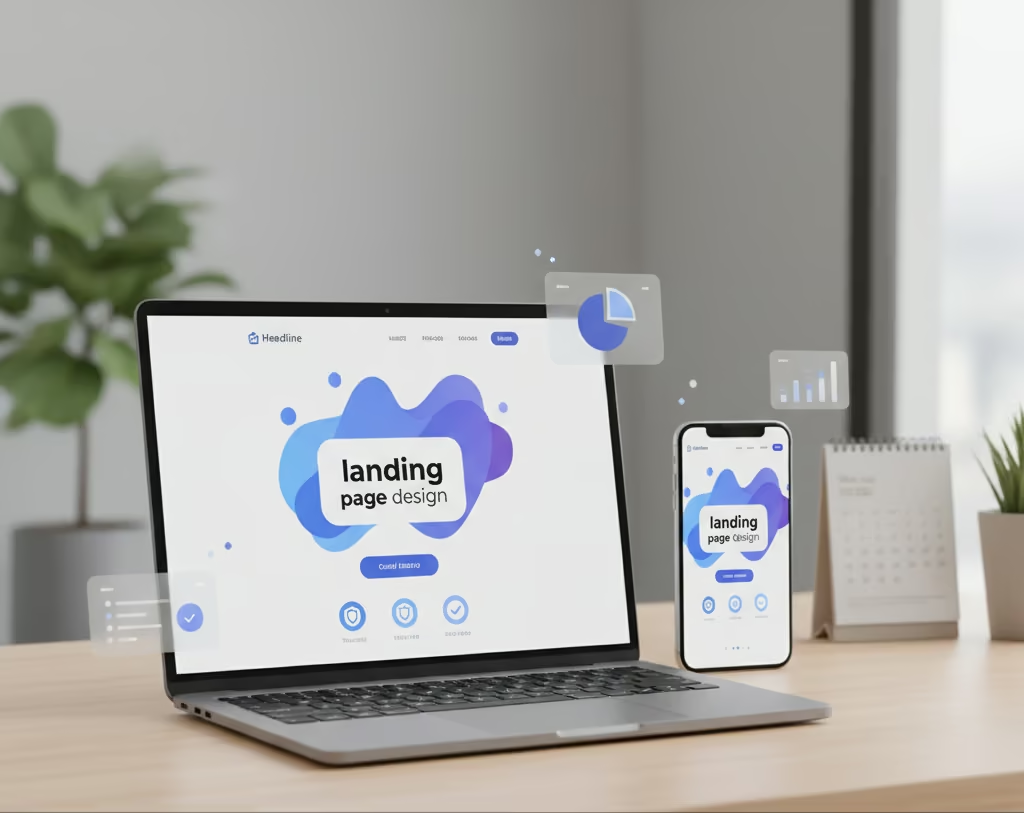
Landing page design is the process of creating a focused, standalone web page built to convert visitors into leads or customers through a single, clear call-to-action. Unlike a homepage, it removes distractions and guides the visitor toward one specific goal.
Defining the Landing Page
A landing page is a standalone web page created for a specific marketing campaign or traffic source. [1] It’s where visitors arrive after clicking a paid ad, an email link, or a social media post. The page has one job: to persuade that visitor to take a defined action, whether that’s filling out a form, booking a call, or making a purchase.
Landing page design is the discipline of structuring, writing, and visually arranging all the elements on that page to maximize the likelihood of conversion. It draws on UX design (user experience design, which focuses on how people interact with a page), copywriting, visual hierarchy, and psychology.
According to the U.S. Web Design System, a strong landing page must be “clear, engaging, and contextualizing” because visitors often arrive without much prior context. [1] That clarity is the foundation of every design decision you make.
Landing Pages vs. Regular Web Pages
The key difference is intent. A homepage introduces your business and serves multiple audiences. A landing page serves one audience with one message and one goal.
| Feature | Homepage | Landing Page |
|---|---|---|
| Purpose | Introduce the brand | Drive one specific action |
| Navigation | Full site navigation present | Minimal or no navigation |
| Audience | Broad, mixed visitors | Targeted campaign audience |
| Content | Multiple topics and services | Single offer or message |
| Success metric | Engagement, time on site | Conversion rate |
Research from Carnegie Mellon University confirms that design match between your ad creative and your landing page is “one of the easiest techniques to master” for improving conversion rates. [2] When the visual and messaging continuity is strong, visitors feel they’re in the right place.
How Landing Page Design Works
Landing page design works by combining visual hierarchy, persuasive copy, and psychological triggers to guide a visitor from arrival to conversion in a single, uninterrupted flow.
The Anatomy of a High-Converting Page
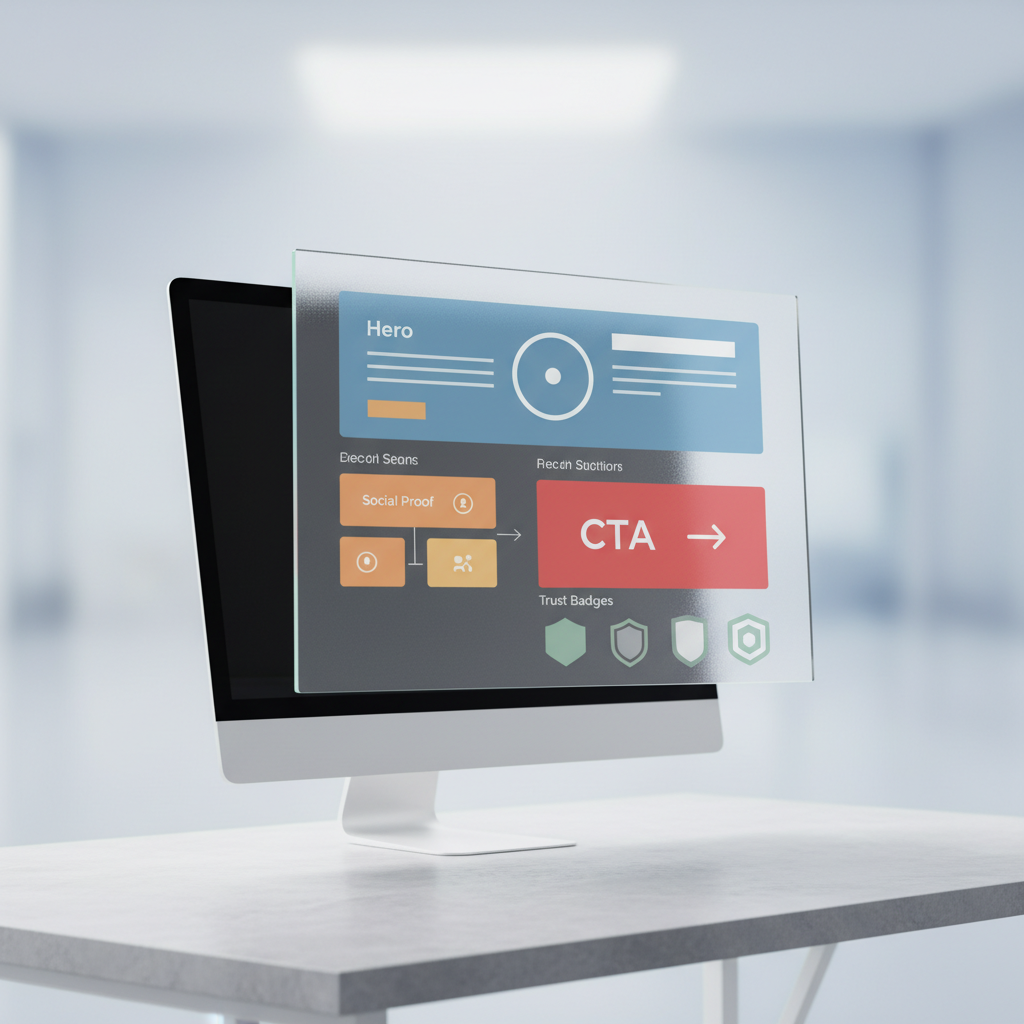
Every effective landing page shares a predictable structure. The components below work together to build attention, interest, desire, and action. This mirrors the AIDA framework (Attention, Interest, Desire, Action), a foundational model in both advertising and UX design.
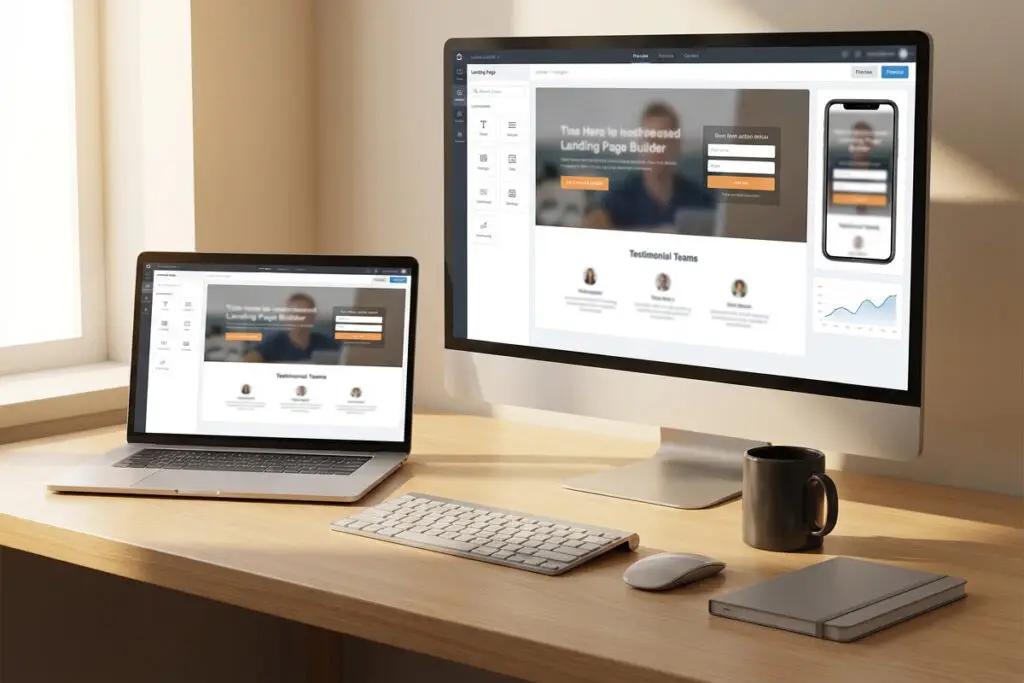
- Hero section: Your headline, subheadline, and primary CTA (call-to-action, the button or form you want visitors to use). This must appear above the fold, meaning visible without scrolling.
- Value proposition: A concise explanation of what you’re offering and why it matters to this specific visitor.
- Social proof: Testimonials, star ratings, client logos, or case study results that reduce skepticism.
- Feature or benefit breakdown: A short section explaining what the visitor gets, framed around their needs rather than your process.
- Trust signals: Security badges, accreditations, money-back guarantees, or privacy statements that lower perceived risk.
- Repeated CTA: A second call-to-action lower on the page for visitors who need more convincing before scrolling back up.
According to Unbounce, best-practice landing page design uses “a mobile-friendly layout, minimal distractions, and clear navigation” to ensure that forms and CTAs are easy to find and use. [3]
The Role of Visual Hierarchy
Visual hierarchy is the arrangement of design elements so the visitor’s eye moves in a deliberate sequence. Size, color contrast, whitespace, and typography all direct attention. A common approach is the F-pattern or Z-pattern reading flow, where the eye naturally scans across the top, then down the left side of a page.
In practice, this means your headline should be the largest text on the page, your CTA button should use a contrasting color that stands out from the background, and supporting text should be smaller and secondary. Cluttered pages with competing visual elements confuse the eye and reduce conversions. Simplicity is a design choice, not a limitation.
Pro Tip: Use a single accent color for all CTA buttons throughout your landing page. Consistency trains the visitor’s eye to recognize what’s clickable, reducing hesitation at the moment of conversion.
Key Benefits of Effective Landing Page Design
Effective this method directly increases your conversion rate, reduces wasted ad spend, and gives you measurable data on what your audience responds to.
Why Conversion Rate Matters More Than Traffic
Many businesses focus almost entirely on driving more traffic. More visitors, more enquiries, right? Not necessarily. A landing page with a 1% conversion rate and 1,000 visitors generates 10 leads. The same traffic hitting a well-designed page with a 4% conversion rate generates 40. That’s four times the return without spending an extra penny on ads.
Industry analysts at UX Planet note that those creating landing pages “must clearly understand who they’re designing it for and why” before making any design decisions. [4] That audience clarity is what separates pages that generate real enquiries from pages that simply look attractive.
The practical benefits of strong this strategy include:
- Higher conversion rates: Focused pages with one goal consistently outperform multi-purpose pages.
- Lower cost per lead: When more visitors convert, your advertising budget stretches further.
- Better audience insights: A/B testing (comparing two versions of a page to see which performs better) reveals what messaging resonates with your specific audience.
- Improved Quality Score in PPC: Google rewards ad campaigns that send traffic to highly relevant, well-designed landing pages with lower cost-per-click rates.
- Stronger brand credibility: A polished, professional page signals that your business takes quality seriously.
- Faster campaign deployment: Standalone pages can be built and launched quickly without redesigning your entire website.
Real-World Impact for Small Businesses
A Three Girls Media client, a healthcare practitioner in Surrey, recently faced a frustrating situation: their Google Ads campaign was generating clicks but almost no enquiries. The issue wasn’t the ad. It was the destination. Visitors were landing on a generic services page with no clear CTA, a navigation menu full of distractions, and no social proof. After building a dedicated landing page with a single booking form, targeted headline, and three patient testimonials, their conversion rate improved significantly within the first month.
This kind of result isn’t unusual. According to SCORE, a nonprofit resource for small business owners, high-converting landing pages consistently “turn casual visitors into paying customers” by removing friction and focusing the visitor’s attention. [5]
Just as the choice between Design Build Vs Traditional Construction affects project outcomes in the built environment, the choice between a purpose-built landing page and a generic web page has a measurable impact on your marketing results.
Common Mistakes in Landing Page Design
The most damaging mistakes in this approach are not technical errors. They’re strategic ones: too many goals, mismatched messaging, and ignoring mobile users.
The Top Pitfalls to Avoid
From experience working with small businesses across Surrey and South London, the same mistakes appear repeatedly. Here are the ones that cost the most conversions:
- Multiple CTAs competing for attention: Asking visitors to book a call, download a guide, and follow you on social media simultaneously guarantees they’ll do none of those things. One page, one goal.
- Headline-ad mismatch: If your ad promises “Free Website Audit” and your landing page headline reads “Welcome to Our Agency,” visitors feel misled and leave immediately. This is called message match failure, and it’s one of the most common causes of high bounce rates.
- Keeping the full navigation menu: Every link in your navigation is an exit route. On a landing page, those exits work against you. Remove or minimize navigation to keep visitors focused.
- Neglecting mobile design: As of 2026, the majority of paid ad clicks happen on mobile devices. A page that looks great on desktop but breaks on a small screen is losing more than half its potential conversions.
- Weak or vague headlines: “Welcome to Our Services” tells the visitor nothing. A strong headline names the benefit and speaks directly to the visitor’s situation.
- No social proof: Visitors don’t know you. Without testimonials, reviews, or recognizable client names, there’s no reason to trust your claims.
- Slow page load speed: Research consistently shows that a one-second delay in load time can reduce conversions by up to 7%. Heavy images and unoptimized code are conversion killers.
Pro Tip: Run your landing page through Google PageSpeed Insights before launching any paid campaign. Aim for a score above 85 on mobile. A slow page wastes every penny you spend on traffic.
The Misconception About Design Complexity
A common mistake is assuming that a more elaborate, visually complex page will perform better. In practice, the opposite is usually true. Courey Wong, writing on Medium, notes that the best-performing landing pages share a clean, focused structure rather than a showcase of design techniques. [6] Complexity introduces friction. Simplicity removes it.
Another pitfall to watch for: designing for yourself rather than your audience. Your color preferences and aesthetic instincts are secondary to what your specific visitors respond to. That’s why testing matters more than opinion.
Best Practices for Landing Page Design in 2026
The most effective this in 2026 combines mobile-first layouts, fast load times, AI-assisted personalization, and rigorous A/B testing to maximize conversions from every traffic source.
A Step-by-Step Framework for Building Your Page
- Define a single conversion goal. Before you design anything, decide exactly what action you want the visitor to take. Book a call? Download a resource? Make a purchase? Everything else on the page serves that goal.
- Write your headline first. The headline is the most important element on the page. It should name the benefit, speak to the visitor’s situation, and be specific. “Get More Patients for Your Surrey Clinic” outperforms “Welcome to Our Healthcare Marketing Service” every time.
- Match the page to your traffic source. The visual design, tone, and offer on your landing page should directly mirror the ad or email that brought the visitor there. This is message match, and it’s foundational to conversion. [2]
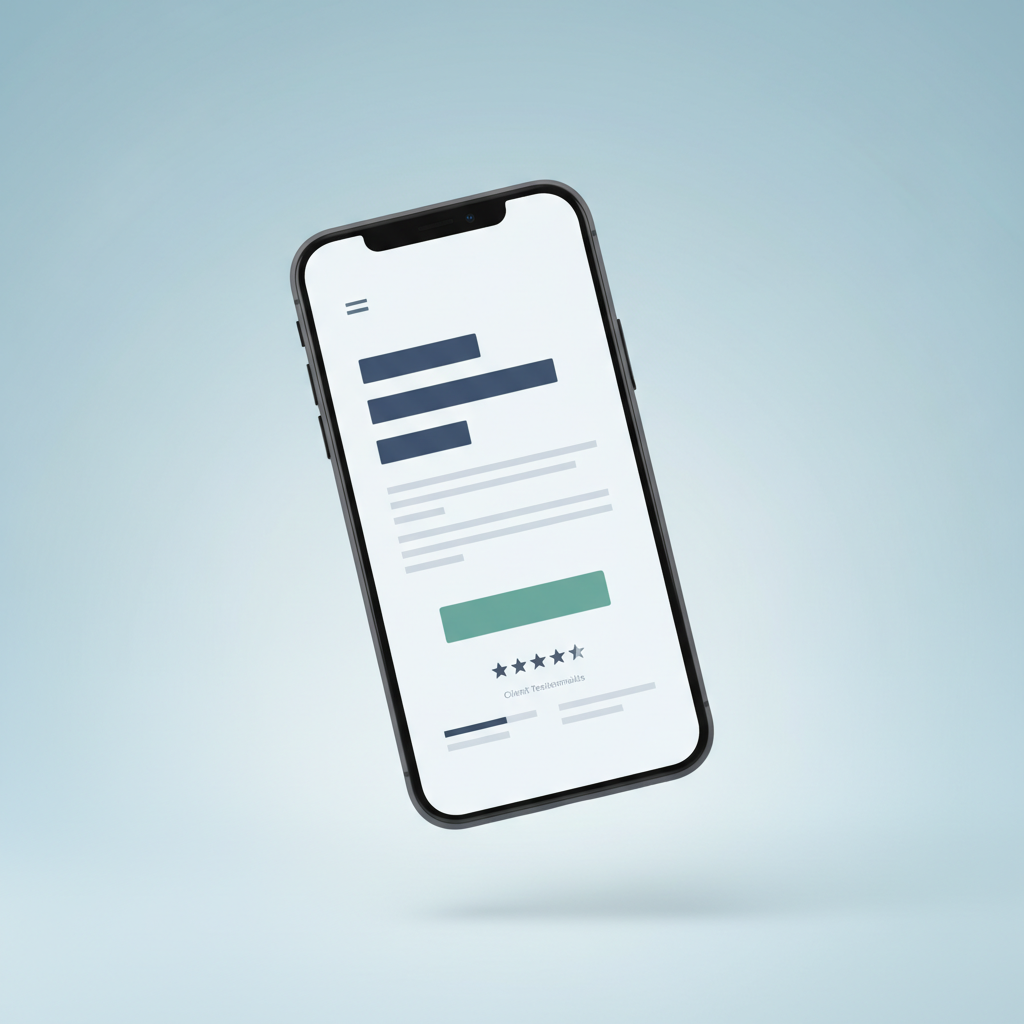
- Design mobile-first. Start with the mobile layout and scale up to desktop. This forces you to prioritize only the most essential elements and ensures the majority of your visitors have a good experience.
- Place your CTA above the fold. Don’t make visitors scroll to find out what you want them to do. The primary call-to-action should be visible immediately on arrival.
- Add social proof near the CTA. Position testimonials, star ratings, or client logos close to your conversion button. Proximity matters: social proof works best when it’s right next to the moment of decision.
- Test one variable at a time. Use A/B testing to compare headlines, button colors, form lengths, and page layouts. Change one element per test so you know exactly what drove the difference in results.
Design Tools and Resources Worth Knowing
Several platforms make it more accessible for small business owners. Figma offers free, editable landing page templates that work well for prototyping before development. [7] For inspiration, Landingfolio curates real-world examples of high-performing pages across industries, which is useful for benchmarking your own design decisions. [8]
At Three Girls Media, we’ve found that the most effective approach for small businesses is not to start with a template and fill it in, but to start with the visitor’s question (“What’s in it for me?”) and build the page backward from there. That mindset shift produces more focused, more persuasive pages than any template can deliver on its own.
Pro Tip: Keep your lead capture form to three fields or fewer for top-of-funnel campaigns. Every additional field you add reduces form completions. Name, email, and phone number is usually enough to start a conversation.
Our team at Three Girls Media recommends pairing every PPC campaign (pay-per-click advertising, where you pay each time someone clicks your ad) with a dedicated landing page rather than sending traffic to your homepage. In one project we handled for a childcare provider in Caterham, this single change reduced their cost per enquiry by nearly a third within six weeks of launch.
Frequently Asked Questions
1. What is a landing page design?
this method is the practice of creating a focused, standalone web page built around a single conversion goal, such as generating a lead, booking an appointment, or selling a product. Unlike a standard web page, a landing page removes navigation and competing calls-to-action so that every element on the page directs the visitor toward one specific outcome. Good this strategy combines persuasive copywriting, clear visual hierarchy, trust signals, and mobile-optimized layouts to maximize the percentage of visitors who take that desired action.
2. How do I build a landing page?
Building a landing page effectively starts with defining a single, measurable goal before touching any design tool. From there, write a benefit-led headline that speaks directly to your target visitor, create a concise value proposition, and add social proof such as testimonials or client logos near your call-to-action button. Keep the form short (three fields or fewer for lead generation), remove the main site navigation to eliminate exit routes, and ensure the page loads in under three seconds on mobile. Test at least two headline variations before scaling any paid traffic to the page.
3. How long should a landing page be?
Page length should match the complexity of your offer and the temperature of your audience. A warm audience already familiar with your brand may convert from a short page with a strong headline and one CTA. A cold audience arriving from a paid ad for a high-value service will need more information, including benefits, social proof, an FAQ section, and multiple CTAs placed at intervals. In practice, shorter pages work better for simple, low-commitment actions (like downloading a free resource), while longer pages suit higher-ticket offers that require more trust-building before conversion.
4. What makes a landing page convert well?
The highest-converting landing pages share five consistent traits: a specific, benefit-led headline; strong message match with the ad or email that brought the visitor there; a visible CTA above the fold; genuine social proof positioned near the conversion point; and a fast, mobile-optimized layout. According to Unbounce, clean and intuitive design with minimal distractions is a consistent feature of top-performing pages. [3] Removing unnecessary links, form fields, and competing messages is often more impactful than adding new design elements.
5. Should a landing page have navigation?
For most campaign-specific landing pages, removing or significantly reducing navigation is recommended. Every link in your navigation is a potential exit point that pulls visitors away from your conversion goal. Studies consistently show that landing pages without navigation menus outperform those with full site navigation in terms of conversion rate. If your brand guidelines require some navigation, limit it to a single logo link back to the homepage rather than a full menu.
6. What is the difference between a landing page and a website homepage?
A homepage serves a broad audience and introduces your entire business, covering multiple services, audiences, and goals simultaneously. A landing page serves a specific audience with a specific message and pushes toward a single action. Homepages are designed for exploration; landing pages are designed for conversion. Sending paid ad traffic to your homepage is one of the most common and costly mistakes in digital marketing, because the homepage lacks the focus and message match that campaign visitors need to convert.
7. How do I know if my landing page design is working?
The primary metric is your conversion rate, which is the percentage of visitors who complete your desired action. Industry benchmarks vary by sector, but a conversion rate above 3-5% is generally considered solid for a lead generation page. Beyond conversion rate, monitor bounce rate (the percentage of visitors who leave without any interaction), average time on page, and scroll depth. These signals tell you whether visitors are engaging with your content or leaving immediately. Use A/B testing to make incremental improvements based on real data rather than assumptions. Results will vary depending on your industry, offer, and traffic source.
Conclusion
Effective this approach isn’t about making something that looks impressive. It’s about making something that works. Every element on the page, from the headline to the button color to the number of form fields, either helps or hinders your visitor’s path to conversion. Get those decisions right, and a well-designed landing page becomes one of the most cost-effective tools in your marketing toolkit.
The principles covered in this guide, including single-goal focus, message match, mobile-first layouts, trust signals, and systematic testing, apply whether you’re running a healthcare practice in Surrey, a nursery in Caterham, or an independent retail business anywhere in South London.
If your current pages aren’t converting the traffic you’re paying to attract, the issue is almost certainly fixable. You don’t need more visitors. You need a better page. Three Girls Media builds conversion-focused landing pages and full websites for small businesses that want measurable results without the complexity of managing it alone. With 10+ years of hands-on experience and first-hand eCommerce expertise, we know what separates a page that generates enquiries from one that doesn’t.
Recommended Articles
Explore more from our content library: