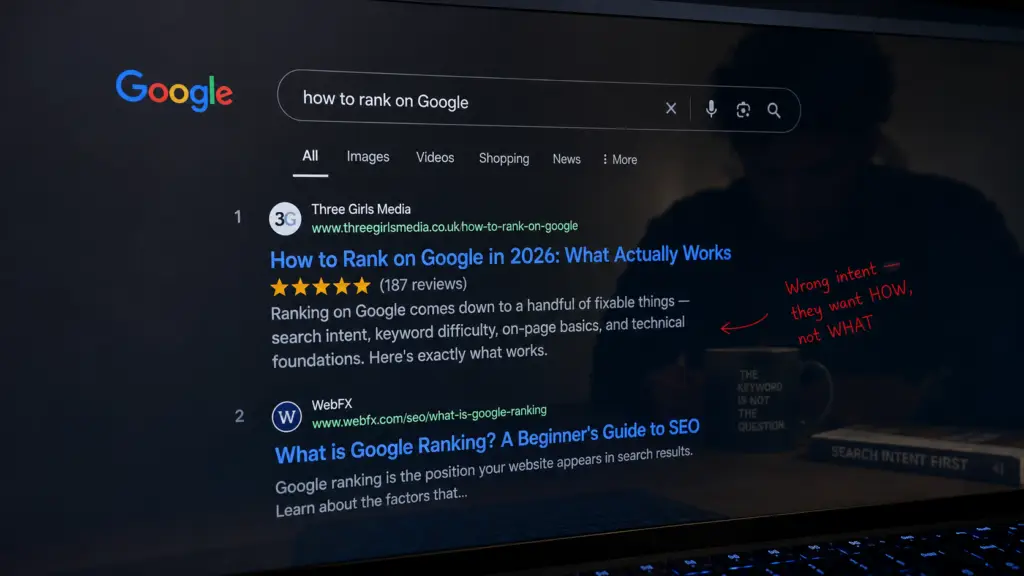
Google doesn’t rank pages. It ranks answers to questions people haven’t quite finished asking. That distinction is the whole game, and it’s why so many well-written, keyword-optimised pages still sit on page two while a thinner, scrappier competitor sits at the top. The thinner page simply understood what the searcher actually wanted.
Search intent is the reason for that gap. It’s the motivation sitting behind every query someone types into Google, and if your content doesn’t match it, no amount of clever keyword placement will save you.
What search intent actually means
Search intent is the underlying goal a person has when they search for something. Not the words they typed, but the outcome they’re chasing. Someone typing “resin driveway cost” isn’t hunting for a dictionary definition of resin. They want a number, or at least a ballpark, and probably a sense of whether it’s worth the money.
Google has invested enormously in getting this right. Its own How Search Works documentation explains that before any ranking system can decide what’s relevant, it first has to work out what the searcher is actually looking for. That’s not a footnote in the process; it’s the starting point.
This matters because two searches can use almost identical language and mean completely different things. “Glass balustrade” might be someone browsing for design inspiration, or someone three quotes deep and ready to book an installer. Get that distinction wrong and your page, however well-written, is answering a question nobody asked.

The four categories, and why they’re not the whole story
Most SEO guides split search intent into four buckets: informational, navigational, commercial, and transactional. Informational searches want knowledge. Navigational searches are looking for a specific site. Commercial searches are comparing options before buying. Transactional searches are ready to act, whether that’s booking, purchasing, or signing up.
That framework is useful shorthand, but treating it as the finished picture is where a lot of content strategies quietly go wrong. Google’s own Search Quality Rater Guidelines actually use a slightly different split, dividing intent into “know,” “do,” “website,” and “visit-in-person” queries, and dedicate an entire section to explaining how nuanced this classification can get in practice.
The truth is that most real searches don’t sit neatly in one box. Somebody searching “composite decking vs resin patio” wants information, yes, but they’re also implicitly comparing two purchasing paths. Somebody searching “emergency glazier near me” wants information about who’s available, but the actual goal is transactional: get someone out today. If your content only serves the surface-level category and ignores the layered motivation underneath, you’ll answer the question technically while missing what the person actually needed.
Reading the SERP like it’s a briefing document
The single fastest way to understand what Google thinks a query means is to look at what’s already ranking. Search results are, in effect, Google showing its working. If the top ten results for a phrase are all long-form guides, that’s a strong signal the query has informational intent. If they’re mostly product or service pages, Google has already decided this is a buying query.
Beyond format, look at structure. Are the top pages listicles, single long-form explainers, comparison tables, or short direct-answer pages? Are there rich features like a featured snippet, a knowledge panel, or a map pack sitting above the organic results? Those SERP features tell you plenty about intent on their own; a map pack, for instance, is Google flagging a local, visit-in-person motivation.
It’s also worth paying attention to the “People Also Ask” boxes and related searches at the bottom of the page. They’re a free, constantly updated map of the adjacent questions real users are asking around your topic, and they’re one of the quickest ways to spot content gaps competitors haven’t filled yet.

Letting the query’s own wording guide you
Language inside the search term itself is a strong intent signal, and it’s often underused. Words like “best,” “cheap,” “near me,” “how to,” or “vs” each nudge toward a different motivation. “Cheap resin bound driveway” tells you budget matters more than premium finish. “How to maintain a resin driveway” tells you the person already has one and wants aftercare advice, not a sales pitch.
Word order matters too, more than people expect. “Glass splashback ideas” and “splashback glass ideas” read almost identically to a human skimming quickly, but subtle shifts like this can separate someone browsing for inspiration from someone comparing specific glass types. It’s worth actually typing the exact phrase into Google yourself rather than assuming you know what it implies.
Using research tools to remove the guesswork
Manual analysis gets you a long way, but dedicated keyword tools speed the process up considerably and reduce human bias. Platforms such as the Semrush Keyword Magic Tool or Ahrefs’ Keywords Explorer will label a keyword’s intent directly, alongside search volume and difficulty, which is useful when you’re trying to prioritise dozens of keyword variations at once rather than analysing each one by hand.
These tools are particularly valuable for catching intent shifts across similar phrases. Two keywords that look almost interchangeable can carry entirely different intent labels once you check the data, which changes what kind of page you should be building for each one.

Building content that actually satisfies the searcher
Once you know the intent, the next job is matching your content’s format to it. This is where a lot of otherwise decent content underperforms: writing an in-depth explainer for a query that clearly wants a quick, scannable answer, or building a single product page for a query that’s really asking for a comparison.
Match the format the SERP has already validated
If competitors ranking above you are all comparison tables, don’t publish a 3,000-word essay instead. If they’re short direct-answer pages, don’t bury your answer under six paragraphs of preamble. This isn’t about copying competitors’ content; it’s about respecting the format Google has already tested against real user behaviour and found works.

Cover the full scope of the question, not just its surface
Most queries carry hidden layers. Someone searching for advice on a specific home improvement rarely wants just the headline steps; they usually also want to know about cost, timeframe, common pitfalls, and maintenance. Building genuinely comprehensive content around a topic, rather than narrowly targeting one keyword phrase, tends to satisfy more of that hidden intent and picks up long-tail traffic in the process.
Write for skimmers first, readers second
Most people scanning a search result are deciding within seconds whether to stay. Clear H2 and H3 headings, short paragraphs, and a direct answer near the top of each section all help both human readers and search engines quickly grasp what a page covers. Front-loading the key point of each section, rather than building up to it, respects how people actually read online.
Get the title tag and meta description doing real work
Your title tag and meta description are effectively your pitch on the results page, and they should speak directly to the intent you’ve identified. If competing titles use numbers, specifics, or clear promises, that’s the language searchers are responding to. Google’s own guidance on writing helpful titles and links is worth reading directly if you want the technical detail on how these elements get displayed and truncated.
Keep your title tag under roughly 60 characters so it doesn’t get cut off, and lead with your primary keyword rather than burying it. Meta descriptions have more flexibility but still perform best under about 155 characters, with your main keyword included where it reads naturally rather than forced in.

The bigger picture
Search intent isn’t a box-ticking exercise you complete once during keyword research and forget about. It should shape the format of your page, the depth of your coverage, the order you present information in, and even the words you choose for your headline. Content that nails the technical SEO checklist but ignores what the searcher actually wants will always lose out to content that gets the intent right first and the mechanics second.
Get the intent right, and the rest of your optimisation work has something solid to stand on.