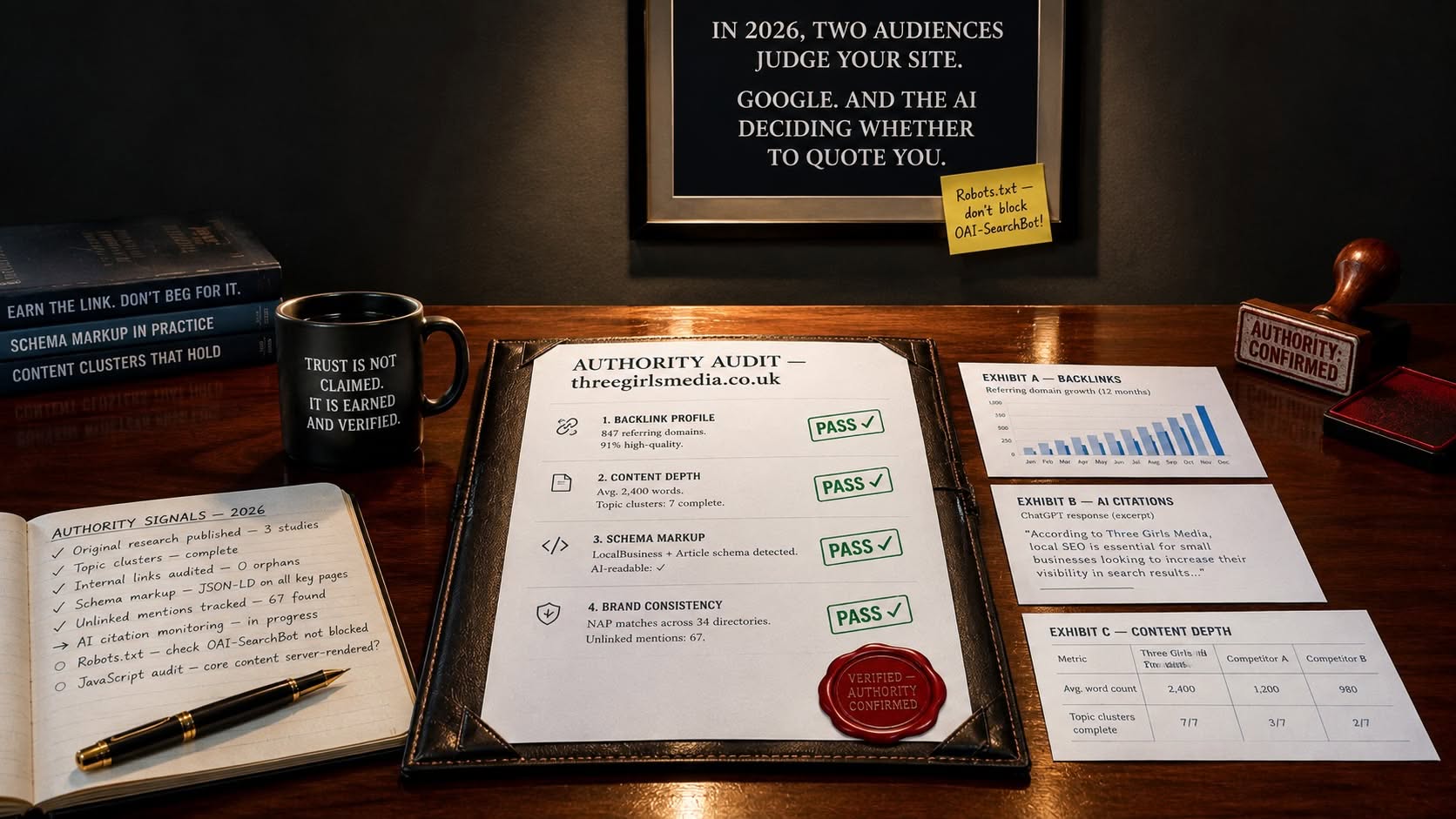
| Key Insight | Explanation |
|---|---|
| Strategy before content | Publishing content without a documented plan wastes time and budget. A clear strategy ties every piece of content to a measurable business goal. |
| Audience clarity is non-negotiable | Content that isn’t built around a specific audience persona rarely converts. Define who you’re talking to before you write a single word. |
| Distribution is half the job | Great content that nobody sees achieves nothing. Channel selection and promotion are as important as the content itself. |
| SEO and content are inseparable | Organic search remains the highest-volume discovery channel for most businesses. Keyword research should inform every content decision. |
| Measurement drives improvement | Without tracking key metrics, you can’t tell what’s working. Regular audits and KPI reviews turn a static plan into a living strategy. |
| AI is reshaping content production | As of 2026, AI tools accelerate ideation and drafting, but human expertise and brand voice remain the differentiators that build trust. |
A solid content marketing strategy is the foundation every business needs before publishing a single blog post, social update, or video. Content marketing is the strategic creation and distribution of valuable, relevant content designed to attract and engage your target audience — and ultimately drive profitable customer action [1]. Done well, it builds trust over time, improves your organic search rankings, and turns browsers into buyers. Done without a plan, it drains time and budget with little to show for it. This guide walks you through everything you need to know: what a content marketing strategy actually is, how to build one from scratch, which channels work best in 2026, and how to measure whether it’s working.

What Is a Content Marketing Strategy?
A content marketing strategy is a documented plan that outlines how your business will use content to meet specific goals, reach a defined audience, and deliver measurable results. It covers what you’ll create, who you’re creating it for, where you’ll publish it, and how you’ll track success.
The Core Definition
The Content Marketing Institute describes a content marketing strategy as “an outline of your key business and customer needs, plus a detailed plan for how you will use content to address them” [2]. That framing is useful because it keeps the focus on business outcomes, not just content production.
According to the American Marketing Association, “content marketing is the strategic creation and distribution of valuable, relevant content designed to attract and engage your target audience” [1]. The word “strategic” is doing a lot of work in that sentence. Random acts of content — a blog post here, a social caption there — don’t constitute a strategy.
Strategy vs. Tactics
A common point of confusion is the difference between strategy and tactics. Your strategy answers the “why” and “who.” Your tactics answer the “what” and “how.” For example:
- Strategy: Attract local healthcare practitioners searching for web design services by becoming the most trusted educational resource on small business digital marketing in Surrey.
- Tactics: Publish two SEO-optimised blog posts per month, distribute them via a monthly email newsletter, and repurpose key insights as LinkedIn posts.
Harvard Business Review notes that a content marketing strategy doesn’t have to be complicated — it can accomplish one of six business objectives: branding, community building, public relations, market research, customer service, or direct sales [3]. Picking the right objective for your situation is the first real decision you’ll make.
As of 2026, the most effective strategies also account for AI-driven search and answer engines (AEO, or Answer Engine Optimization), which extract structured content from well-organised pages. That means clear headings, direct answers, and factual precision matter more than ever.
Why Your Business Needs a Documented Strategy
Businesses with a documented content marketing strategy consistently outperform those that operate on instinct alone, generating more leads, higher search visibility, and stronger audience loyalty.
The Case for Writing It Down
Research from the Content Marketing Institute shows that marketers with a documented strategy are significantly more likely to report success than those with only a verbal or informal plan [2]. “Documented” is the operative word. Writing your strategy forces clarity. It surfaces assumptions, exposes gaps, and creates a shared reference point for everyone involved in content production.
For small and medium-sized businesses — the nurseries, healthcare practices, and independent retailers that make up the backbone of local economies in Surrey and South London — a documented strategy is especially valuable. You don’t have an in-house marketing team to absorb wasted effort. Every piece of content needs to pull its weight.
Real-World Impact
Consider a scenario we see regularly at Three Girls Media: a local physiotherapy clinic publishes occasional blog posts about injury prevention, but with no keyword research behind them, no internal linking structure, and no promotion plan. The posts get written, published, and forgotten. Traffic stays flat. Compare that to a clinic that maps three core audience questions per month, optimises each post for a specific local search term, and promotes each piece via email and social. Within six months, organic enquiries have measurably increased.
The difference isn’t talent or budget. It’s the presence of a plan.
Industry analysts suggest that content marketing, when properly executed, generates approximately three times as many leads as traditional outbound marketing at a fraction of the cost [4]. That ratio makes it particularly attractive for businesses operating on tight margins.
Pro Tip: Before you write a word of content, open a shared document and write down your single most important business goal for the next 12 months. Every content decision you make should trace back to that goal. If it doesn’t, cut it.
How to Build a Content Marketing Strategy Step by Step
Building a content marketing strategy from scratch involves eight sequential steps, from goal-setting through to performance review. Each step informs the next, so skipping ahead tends to create problems later.
The Eight-Step Framework
Harvard Business School’s guide to content strategy describes the process as a roadmap: “a plan for producing and distributing valuable content that attracts, engages, and converts your target audience” [5]. Here’s how to build that roadmap:
- Set a measurable goal. Tie your content effort to a specific outcome — more organic traffic, more email sign-ups, more enquiry form completions. Vague goals produce vague results.
- Define your audience. Build at least one detailed persona. Who are they? What do they search for? What problems keep them up at night? The more specific, the better.
- Conduct a content audit. If you already have content, review what exists. Identify what’s performing, what’s outdated, and what gaps need filling.
- Research keywords and topics. Use tools like Semrush or Google Search Console to find the terms your audience actually types. Map each piece of planned content to a primary keyword [6].
- Choose your content formats. Blog posts, videos, infographics, podcasts, case studies, email newsletters — pick the formats your audience already consumes and that you can produce consistently.
- Select your distribution channels. Organic search, email, social media, paid promotion. Not all channels suit all businesses. A B2B service firm may get more traction on LinkedIn than Instagram.
- Build a content calendar. Plan topics, formats, publication dates, and responsible owners at least four weeks ahead. Consistency beats brilliance every time.
- Define your KPIs. Key performance indicators (KPIs) are the metrics you’ll track to judge success — organic sessions, time on page, conversion rate, email open rate. Set benchmarks before you launch.
Expanding on step six: your distribution plan should also include building an email list, which remains one of the highest-ROI channels available to small businesses. A strong foundation in email list growth strategy can dramatically amplify the reach of every content piece you publish, turning one-time readers into repeat visitors and eventual customers.
Aligning Content to the Buyer Journey
One of the most practical frameworks for content planning is mapping content to the three stages of the buyer journey:
- Awareness: The prospect has a problem but doesn’t know you exist. Blog posts, how-to guides, and educational videos work well here.
- Consideration: They’re evaluating options. Comparison articles, case studies, and webinars are effective.
- Decision: They’re ready to buy. Testimonials, pricing pages, and free consultations close the gap.
A common mistake is producing only awareness-stage content and wondering why it doesn’t convert. You need content at every stage.

Content Types and Channels in 2026
The most effective content types in 2026 include long-form blog posts, short-form video, email newsletters, and interactive tools — each suited to different audience segments and stages of the buying journey.
Choosing the Right Format
Format choice should follow audience behaviour, not personal preference. According to GWI’s content marketing research, audiences increasingly expect content that is useful first and promotional second [7]. The formats that consistently deliver on that expectation include:
| Content Format | Best For | Primary Channel | Effort Level |
|---|---|---|---|
| Long-form blog posts (1,500+ words) | SEO, authority building | Organic search | Medium–High |
| Short-form video (under 90 seconds) | Brand awareness, engagement | Instagram, TikTok, LinkedIn | Medium |
| Email newsletters | Retention, nurturing leads | Low–Medium | |
| Case studies | Decision-stage conversion | Website, email | High |
| Infographics | Data visualisation, sharing | Social, blog | Medium |
| Podcasts | Thought leadership, community | Spotify, Apple Podcasts | High |
The Role of AI in Content Production
As of 2026, AI writing and ideation tools have become a standard part of most content workflows. They accelerate first drafts, generate topic ideas, and help with keyword clustering. Adobe’s content marketing guidance notes that AI is best used as a production accelerant, not a replacement for strategic thinking or authentic brand voice [8].
The businesses that use AI most effectively treat it as a capable assistant: useful for structure and speed, but requiring human editorial judgment to ensure accuracy, tone, and genuine expertise come through. That’s especially true for trust-sensitive sectors like healthcare, education, and childcare — where a generic, AI-generated tone can actively undermine credibility.
Salesforce’s content strategy research highlights that personalisation at scale is now a realistic goal for mid-sized businesses, thanks to AI-powered content tools that can tailor messaging based on audience segment, device, or stage in the buying journey [9].
Pro Tip: Don’t try to be everywhere at once. Pick two primary channels where your audience already spends time, and do those brilliantly before expanding. A mediocre presence on five platforms is far less effective than a strong presence on two.
Measuring and Optimizing Your Content Marketing Strategy
Measuring a this approach means tracking specific KPIs tied to your stated goals — traffic, engagement, leads, and conversions — and using that data to refine future content decisions.
The Metrics That Actually Matter
Not all metrics are created equal. Vanity metrics — page views, social followers, impressions — look good in a report but don’t tell you whether content is driving business outcomes. The metrics worth tracking are:
- Organic search traffic: The number of visitors arriving via unpaid search results. This is the primary indicator of SEO-driven content performance.
- Bounce rate: The percentage of visitors who leave after viewing only one page. A high bounce rate often signals a mismatch between content and audience intent.
- Time on page: How long visitors spend reading. Longer dwell time generally indicates content is relevant and useful.
- Conversion rate: The percentage of content readers who complete a desired action — filling in a contact form, signing up for an email list, or making a purchase.
- Backlinks earned: Links from other websites pointing to your content. These signal authority to search engines and drive referral traffic.
- Email open and click rates: For content distributed via newsletters, these measure how compelling your subject lines and content actually are.
Running a Content Audit
A content audit is a systematic review of all existing content on your website. Run one at least annually. The process involves:
- Crawling your site to compile a full inventory of published URLs.
- Pulling performance data from Google Search Console and Google Analytics for each URL.
- Categorising each piece as: keep and optimise, update and republish, consolidate with another piece, or remove.
- Prioritising updates based on traffic potential and business relevance.
At Three Girls Media, we’ve found that auditing existing content before commissioning new work almost always surfaces quick wins — posts that rank on page two of Google and need only minor optimisation to reach page one. That’s often faster and cheaper than creating something new from scratch.
West Virginia University’s marketing communications team notes that consistent measurement and iteration are what separate good content programmes from great ones [4]. Strategy without review is just a plan that gets stale.
Pro Tip: Set a recurring 90-day review in your calendar. Pull your top five performing pieces and your five worst performers. Ask what the top performers have in common — topic, format, length, keyword — and replicate those patterns intentionally.
Common Mistakes and How to Avoid Them
The most common content marketing mistakes include publishing without a defined audience, ignoring SEO fundamentals, and failing to promote content after publication — all of which are avoidable with proper planning.
Mistakes That Undermine Results
From experience working with small businesses across Surrey and South London, the same patterns appear repeatedly. Here’s what to watch for:
- Writing for yourself, not your audience. Content that reflects what you find interesting, rather than what your audience is actively searching for, rarely drives traffic or conversions. Always start with audience research.
- Treating SEO as an afterthought. Adding keywords after writing is far less effective than building content around keyword intent from the start. Semrush’s content strategy guide recommends integrating keyword research into the ideation phase, not the editing phase [6].
- Inconsistent publishing. Sporadic content production confuses audiences and search engines alike. A realistic schedule you can maintain beats an ambitious one you can’t.
- Skipping promotion. Publishing and hoping is not a strategy. Each piece of content needs an active distribution plan: email, social, internal linking, outreach for backlinks.
- Ignoring existing content. Many businesses sit on dozens of underperforming posts that could rank with modest updates. New isn’t always better.
- No clear CTA (call to action). Every piece of content should guide the reader toward a next step. Without one, even engaged readers drift away without converting.
The Consistency Problem
HubSpot’s content marketing research consistently identifies consistency as one of the strongest predictors of content programme success [10]. Businesses that publish on a reliable cadence — even if that’s just once a fortnight — build audience expectations and search engine trust faster than those who publish in bursts.
One pitfall to watch for: setting an unsustainable publishing frequency at the outset. A nursery owner running their business solo cannot realistically produce four blog posts a month. Two well-researched, properly optimised posts will outperform four rushed ones every time.

Sources & References
- American Marketing Association, “What is Content Marketing? A Beginners Guide”
- Content Marketing Institute, “Developing a Content Marketing Strategy”
- Harvard Business Review, “Your Content Marketing Strategy Doesn’t Have to Be Complicated”
- West Virginia University, “From Good to Great: 7 Content Marketing Tips For Success”
- Harvard Business School Online, “How to Create a Content Strategy That Drives Results”
- Semrush, “The Ultimate Guide to Creating a Content Marketing Strategy”
- GWI, “Content Marketing: The Ultimate Guide To Acing Your Strategy”
- Adobe Business, “Content marketing: Basic strategies and how to get started”
- Salesforce, “Content Strategy: What is it, & How to Create One?”
- HubSpot, “Content Marketing Strategy: A Comprehensive Guide”
Frequently Asked Questions
1. What is a content marketing strategy, and why does it matter?
A this is a documented plan that defines what content you’ll create, who it’s for, where it will be published, and how you’ll measure results. It matters because businesses with a written strategy consistently outperform those without one — generating more organic traffic, more qualified leads, and stronger audience relationships over time. Without a strategy, content production becomes reactive and wasteful.
2. How long does it take to see results from content marketing?
Results from a it typically begin to appear within three to six months, with more significant organic search gains often visible at the six to twelve month mark. The timeline depends on your domain authority, publishing frequency, content quality, and how competitive your target keywords are. Paid promotion can accelerate early visibility while organic results build.
3. What’s the difference between a content strategy and a content marketing strategy?
A content strategy covers the governance, structure, and management of all content across an organisation — including internal documentation, product copy, and support materials. A this method is specifically focused on using content to attract, engage, and convert an external audience. The two overlap, but this strategy is the more commercially focused subset.
4. How much content do I need to publish to see results?
Quality consistently outperforms quantity. Two well-researched, properly optimised pieces of content per month will outperform eight thin, hastily written posts. That said, publishing frequency does affect how quickly search engines index and trust your site. For most small businesses, one to two substantial pieces per month is a realistic and effective starting point.
5. Which content formats perform best for small businesses?
Long-form blog posts optimised for organic search, email newsletters for audience retention, and short-form video for social engagement are the three formats that deliver the strongest ROI for most small businesses as of 2026. The best format is always the one your specific audience already consumes. Start with one format you can produce consistently, then expand.
6. Do I need a large budget to run a content marketing strategy?
No. Content marketing is one of the most cost-effective marketing channels available to small businesses. A basic strategy — a well-optimised blog, a monthly email newsletter, and consistent social sharing — can be executed with modest investment. The primary resource required is time, or a trusted agency partner who can manage production and strategy on your behalf.
7. How does SEO fit into a content marketing strategy?
SEO (search engine optimisation) and content marketing are deeply intertwined. SEO identifies the exact terms your target audience types into search engines; content marketing creates the material that answers those queries. Without SEO, even excellent content may go undiscovered. Without content, there’s nothing for search engines to rank. The two disciplines work best when planned together from the outset.
8. How do I know if my content marketing strategy is working?
Track KPIs tied directly to your stated goals. If your goal is organic traffic growth, monitor sessions from search in Google Analytics. If it’s lead generation, track form completions and email sign-ups. If it’s revenue, connect content attribution to sales data. Review performance quarterly, identify your top and bottom performers, and adjust your content plan accordingly. A strategy that isn’t measured can’t be improved.
Building a Strategy That Actually Delivers
A strong this approach isn’t a luxury reserved for large businesses with dedicated marketing teams. It’s a practical, scalable tool that any business — a local nursery, a healthcare practice, an independent retailer — can use to build visibility, earn trust, and generate consistent enquiries.
The core principles haven’t changed: know your audience, create content that genuinely helps them, distribute it where they spend time, and measure what matters. What has changed, as of 2026, is the speed at which content can be produced and the sophistication of the tools available to small businesses.
The businesses that win aren’t the ones publishing the most content. They’re the ones with the clearest strategy behind every piece they publish.
At Three Girls Media, we work with businesses across Surrey and South London to build and execute content marketing strategies that drive real results — more organic traffic, stronger search rankings, and more enquiries from the right customers. If your current content isn’t working as hard as your business does, we’d love to help you change that.
Recommended Articles
Explore more from our content library: