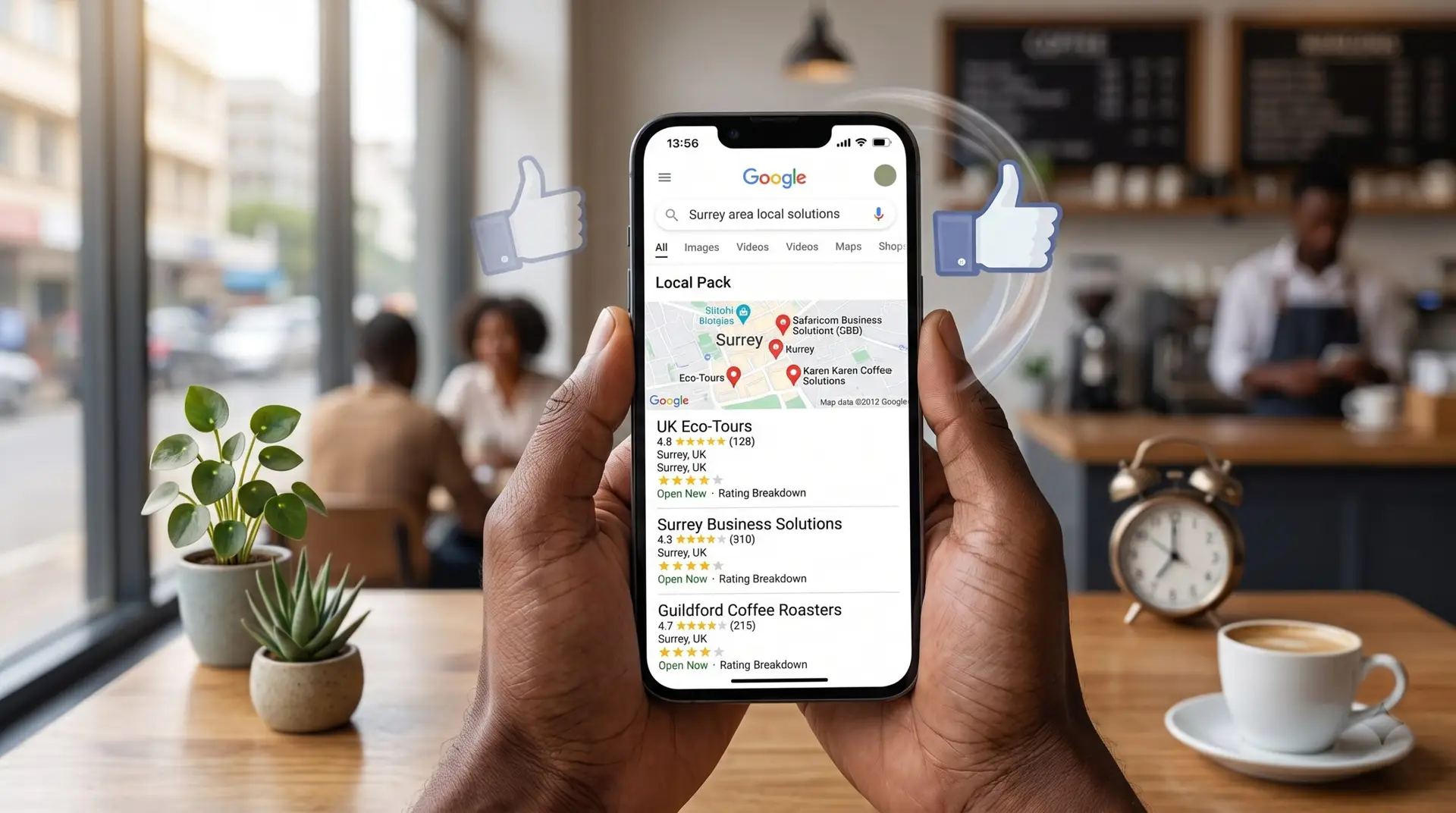
If you run a local business, you’ve almost certainly seen it: that little cluster of a map plus three business listings sitting right at the top of Google, above every “normal” blue link on the page. That’s the local pack, and if your business isn’t in it, someone else’s is — and they’re probably getting the phone call you wanted.
The local pack (sometimes called the “map pack” or “3-pack”) appears whenever Google decides a search has local intent — think “plumber near me,” “best coffee Manchester,” or “dentist Leeds.” Instead of ten organic results, searchers get a map, three highlighted businesses, and a “More places” link to expand the list further. For anyone chasing local SEO, this is arguably the single most valuable piece of real estate on the results page, because it sits above almost everything else and answers exactly what the searcher wants: a business, nearby, right now.
This guide walks through what the local pack actually is, why Google ranks certain businesses there, and — more importantly — the concrete steps you can take to earn a spot in it.
What Exactly Is the Google Local Pack?
The local pack is a featured block of local business results that Google displays for searches with a clear “find me a business” intent. It typically shows a map with pins marking business locations, followed by three listings that include the business name, star rating, category, address or distance, and opening hours.
Click on any one of those listings and you’re dropped into a much richer view: photos, a menu or list of services, popular times, contact details, and customer reviews. It’s essentially a mini business profile, generated entirely from the business’s Google Business Profile (formerly Google My Business) and reinforced by data Google pulls in from around the web.
What makes the pack so powerful is how dynamic it is. Change the wording of a search even slightly — “tacos in Raleigh” versus “tacos near North Hills” — and the results shift, because Google is constantly recalculating relevance and proximity based on the exact query and the searcher’s location.
How the Local Pack Actually Gets Populated
Unlike standard organic rankings, the local pack runs on its own algorithm, and Google has been fairly transparent about the three pillars behind it:
Relevance is how well your business profile matches what the searcher is after. If someone types “vegan bakery,” Google wants to know your business genuinely offers that — through your listed category, your business description, and even the words used in your reviews.
Distance measures how close your business is to the searcher, or to the location implied in their search (for example, “cafés in Bristol” even if the searcher is currently in London).
Prominence is Google’s read on how well-known and trustworthy your business is. This draws on your review volume and star rating, the strength of your backlink profile, general online mentions, and even offline reputation signals Google can infer from the web.
Nail all three and you’ve got a genuine shot at that top spot. Get one badly wrong — say, an unclaimed or poorly categorised listing — and you’ll likely never appear, no matter how good your website is.
Why Bother Chasing a Spot in the Local Pack?
It isn’t vanity. There are solid commercial reasons to fight for this position, and they compound.
It Dominates the Page
The local pack sits above the fold on most searches, pushing organic results further down and, on mobile, sometimes off the screen entirely. Searchers rarely scroll past it when it answers their question outright, which means the businesses inside it capture a disproportionate share of clicks and calls before anyone else even gets a look-in.
It Shortcuts the Decision-Making Process
Users can see hours, price range, star rating, and distance without clicking through to a website. That’s a huge advantage for local search intent, where people typically want a fast, low-effort answer rather than a research session.
It Pushes People Toward Action
Local pack listings come with built-in calls to action — call now, get directions, book online, order food. These remove friction from the buying journey almost entirely, turning a search into a transaction within seconds.
It Drives Real Foot Traffic
Local searches tend to come from people who are either nearby or actively planning a visit. Research from ReviewTrackers has found that a large share of consumers who run a local search go on to visit the business the same day, which underlines just how transactional this type of query really is.
It Builds Instant Trust
Star ratings and review counts appear front and centre in the pack, and for many consumers this is the single biggest trust signal on the page — often outweighing a polished website or clever ad copy. A business showing 4.8 stars from 300 reviews communicates credibility before a searcher has read a single word of your site.

How to Actually Get Into the Local Pack
Knowing why it matters is one thing. Earning the spot is another. Here’s what genuinely moves the needle.
Claim and Fully Build Out Your Google Business Profile
This is non-negotiable. Without a verified Google Business Profile, you simply cannot appear in the local pack or on Google Maps, regardless of how strong your website’s SEO is.
Head to Google Maps, search for your business to check whether a listing already exists, and either claim it or create a new one from scratch. Once you’re in, don’t just tick the minimum boxes. Fill in every available field: the correct primary category, secondary categories where relevant, your exact service area, opening hours (including holiday hours), a keyword-aware business description, and a steady stream of recent, high-quality photos. Profiles that are fully completed and actively maintained consistently outperform sparse, “set and forget” listings.
Target Local Keywords Properly
Local keywords combine a service or product term with a location — “electrician Cardiff,” “best Italian restaurant Shoreditch,” “emergency plumber near me.” These terms tend to have lower search volume than broad national keywords but convert far better, because the intent behind them is immediate.
Use a tool such as the Keyword Magic Tool to find variations specific to your niche and area, then weave the strongest ones naturally into landing pages, service pages, and blog content. Avoid stuffing them in clumsily; Google’s algorithms, and your readers, notice when keywords are shoehorned in rather than written naturally.
Get Your NAP Consistent Everywhere
NAP stands for name, address, and phone number, and consistency across directories, social profiles, and citation sites is one of the more overlooked ranking factors. Google cross-checks this information to validate that your business is legitimate and accurately located, so a mismatched phone number on Yelp or an old address lingering on a directory can quietly undermine your prominence score.
Tools like Semrush’s Listing Management can audit where you’re listed, flag inconsistencies, and, in some cases, push corrected details out across major platforms automatically.
Earn Backlinks From Local, Relevant Sites
Link building still matters enormously for prominence. Links from other local businesses, community organisations, local news outlets, or industry-relevant sites tell Google that your business is a recognised part of its community, not just a name on a map.
Sponsoring a local event, contributing a guest post to a local publication, or getting listed in a regional business directory are all realistic, low-cost ways to build this kind of authority over time.
Actively Encourage and Respond to Reviews
Reviews influence both the algorithm and the human being reading your listing. Ask happy customers for feedback shortly after a purchase or completed job, make the process as frictionless as possible by sending a direct Google review link, and always reply — to praise and criticism alike. A thoughtful response to a negative review often does more for your credibility than a dozen five-star ratings sitting unanswered.

Keeping Track of Your Progress
Local SEO isn’t a one-off task; it needs monitoring. Set up rank tracking for your target local keywords and check specifically for local pack appearances rather than just organic position, since the two can behave very differently. Semrush’s Position Tracking tool includes a dedicated local pack filter under SERP features, letting you see exactly which searches you’re winning and where competitors are still edging you out.
Review this data regularly, adjust your profile, content, and citations accordingly, and treat the local pack as an ongoing campaign rather than a box you tick once and forget.
Ultimately, everything Google rewards here — accurate information, genuine relevance, strong reviews, real community links — is also simply what makes a business easier and more trustworthy to choose. Optimise for the searcher first, and the ranking factors tend to follow.