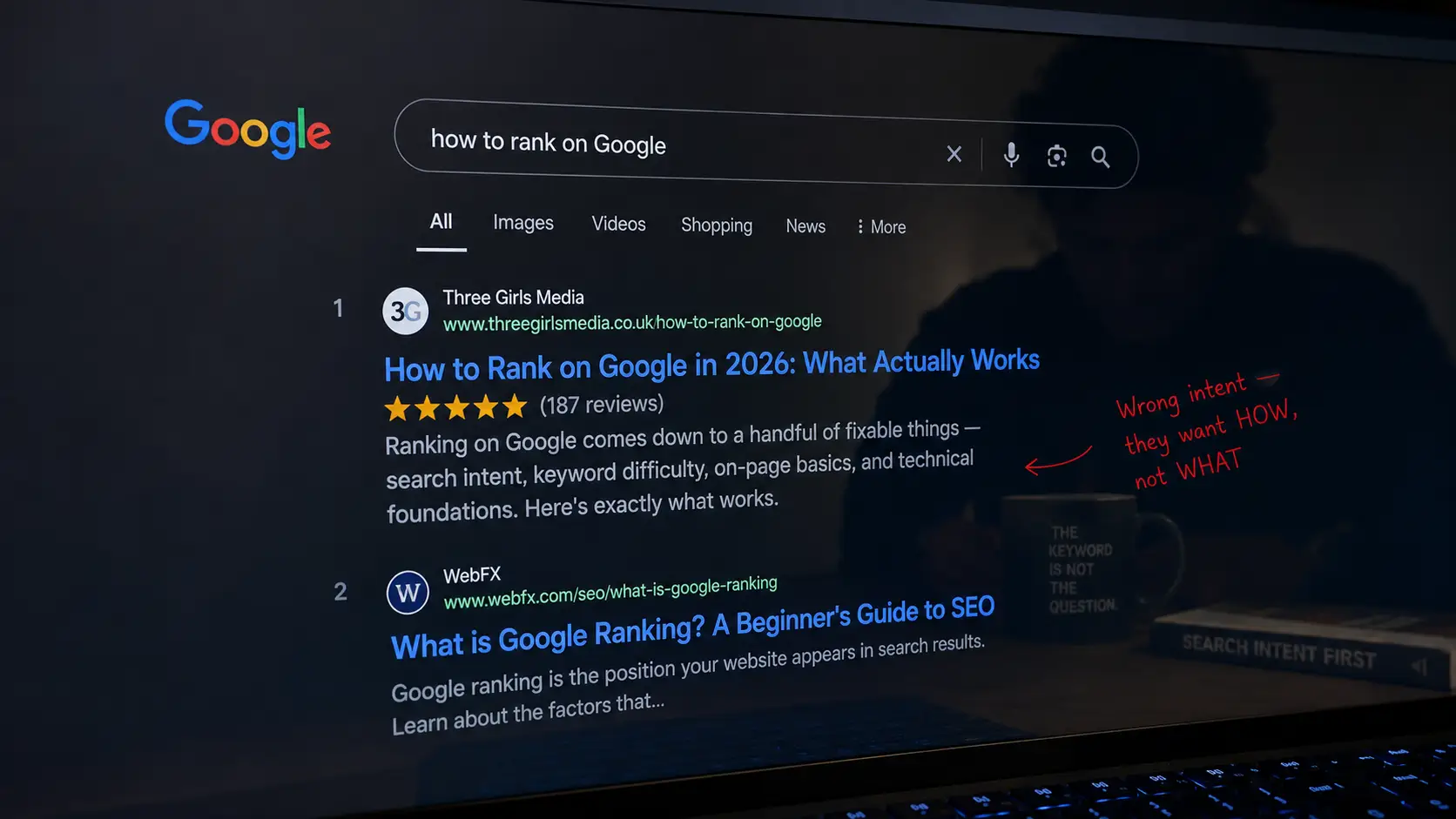
There’s a particular kind of frustration that comes from publishing a genuinely good page and watching it sit on page four of Google forever. Nine times out of ten, the problem isn’t the writing. It’s that the page answers a question nobody asked in quite that way — it’s aimed at the wrong intent.
Search intent (sometimes called keyword intent) is simply the reason behind a search: what the person typing actually wants to walk away with. Someone searching “cheap flights to Lisbon” wants to book something. Someone searching “is Lisbon expensive” wants context before they’ve even picked a destination. Same broad topic, completely different job to do — and Google has become remarkably good at telling the two apart.
That matters because Google’s entire ranking model is built around satisfying intent, not just matching words. If your content doesn’t match what the searcher is actually trying to achieve, no amount of keyword density, backlinks, or clever formatting will rescue it. Get the intent right, on the other hand, and you’re already halfway to ranking before you’ve written your first paragraph.
Why Google Cares So Much About Intent
Search engines don’t make money from showing pages — they make money from people trusting the results enough to keep coming back. So the ranking algorithm is tuned to reward pages that satisfy the underlying need behind a query, not just the string of words in the search box.
You can see this play out on the results page itself. Search “buy running shoes” and you’ll get shopping carousels, product listings, and retailer pages front and centre. Search “how to choose running shoes” and the results shift entirely — long-form guides, comparison articles, video content, and a “People Also Ask” box packed with related questions. Same general topic, two entirely different SERPs, because Google has already worked out what each searcher wants.
This is why a technically excellent blog post can fail to rank for a keyword that’s dominated by product pages, and why a beautifully designed product page can flop against a keyword that searchers only use when they’re still researching. Content and intent need to be aligned, or the algorithm won’t give the page a fair chance regardless of quality.

The Four Types of Search Intent
Most searches fall into one of four buckets, and a fair few straddle two at once. Knowing which one you’re dealing with tells you almost everything about how to structure your page.
Navigational Intent
This is when someone already knows where they want to go and is using the search bar as a shortcut rather than a discovery tool. Think “Spotify login,” “Ryanair baggage allowance,” or simply a brand name on its own. There’s rarely much appetite for the searcher to look elsewhere once they’ve found what they’re after, and buyer intent is generally low — though it can still lead somewhere useful, since a person searching for your opening hours might well turn up in person shortly after.
Navigational keywords tend to be easier to rank for precisely because they’re brand-specific; you’re not competing with the entire internet, just anyone else using that name.
Informational Intent
Here the searcher wants to learn something, not buy anything. Queries like “what is compound interest,” “how does a heat pump work,” or “pasta alla vongole recipe” all sit in this camp. They often — but not always — start with a question word.
This is where content marketing earns its keep. Informational searches carry low immediate buying intent, but they’re where trust gets built. A reader who finds a genuinely useful explainer on your site is far more likely to return when they’re ready to spend money, simply because you’ve already proven you know what you’re talking about.
Commercial Intent
Commercial searches sit in the research phase just before a decision. The person has narrowed things down but hasn’t committed — think “best noise-cancelling headphones,” “Squarespace vs Wix,” or “[brand] reviews.” These queries are frequently comparative by nature, which is why listicles, versus-style articles, and review pages tend to dominate the results.
Buyer intent here is meaningfully higher than informational searches, which makes commercial keywords some of the most valuable real estate in content strategy — get a comparison page ranking well and you’re often catching people in the exact window where a recommendation can tip a decision.
Transactional Intent
This is the “ready to act now” category: “buy iPhone 16 128GB,” “book table Nairobi Saturday,” “[brand] discount code.” Buyer intent is at its peak, and the content that satisfies it — product pages, booking flows, pricing pages, sign-up forms — looks nothing like a blog post. Trying to rank a long-form article against transactional keywords is usually a losing battle, because Google already knows the searcher wants a page they can act on, not one they need to read.
It’s worth noting plenty of real-world queries blend two categories — “trainers near me” is arguably both informational and transactional, and “[brand] shipping policy” is often navigational and transactional at once. Treat these as a signal to cover both angles on the same page rather than forcing a single label.

How to Actually Work Out a Keyword’s Intent
Read the Current Results, Properly
Open an incognito or private browser window — this stops personalisation skewing what you see — and search the term you’re targeting. Don’t just glance at the top result; open several of the top ten and study them properly.
Look at the format (article, product page, video, tool), the length, the structure (headings, tables, bullet points, FAQs), and crucially, what’s missing. If eight of the top ten results are 2,000-word guides with comparison tables and yours is a 400-word product blurb, that mismatch alone probably explains the ranking gap.
Use a Keyword Research Tool
Manually eyeballing SERPs works, but it doesn’t scale past a handful of terms. Tools such as Semrush’s Keyword Overview and Google’s Keyword Planner will flag a keyword’s intent automatically, alongside search volume and difficulty, which saves a huge amount of manual checking once you’re working through dozens or hundreds of terms.
Filter Bulk Keyword Lists by Intent
When you’re building out a content plan rather than checking one term, intent filters inside keyword research tools let you pull, say, every commercial-intent keyword in a niche in one go. That’s a far faster way to spot content gaps than sifting through an unfiltered export by hand.

Matching Content Format to Intent
Once you know a keyword’s intent, the content decision mostly makes itself:
- Navigational → the exact page the searcher is looking for (homepage, login page, contact page) — keep friction to a minimum.
- Informational → in-depth guides, explainers, how-to content, and FAQ-style pages that genuinely answer the question rather than skimming it.
- Commercial → comparison articles, “best of” round-ups, and review pages that help someone choose between options.
- Transactional → clean, fast product or service pages with clear calls to action — this is not the place for a 1,500-word backstory.
Publishing the wrong format against the right topic is one of the most common — and most fixable — reasons content underperforms. A stunning product page will rarely outrank a detailed guide for an informational query, no matter how well it’s written, because it’s answering a question the searcher isn’t asking yet.

Bringing It Together
Search intent isn’t a nice-to-have layer on top of keyword research — it’s arguably the whole point of it. Search volume tells you how many people are asking; intent tells you what they actually want when they ask it. Skip that second step and you’re essentially guessing.
The good news is that identifying intent doesn’t require guesswork either. A quick private-browsing search will tell you plenty, and tools like Semrush or Ahrefs will confirm it at scale. From there, it’s simply a matter of building the format the searcher is actually expecting — and letting the algorithm reward you for it.