| Key Insight | Explanation |
|---|---|
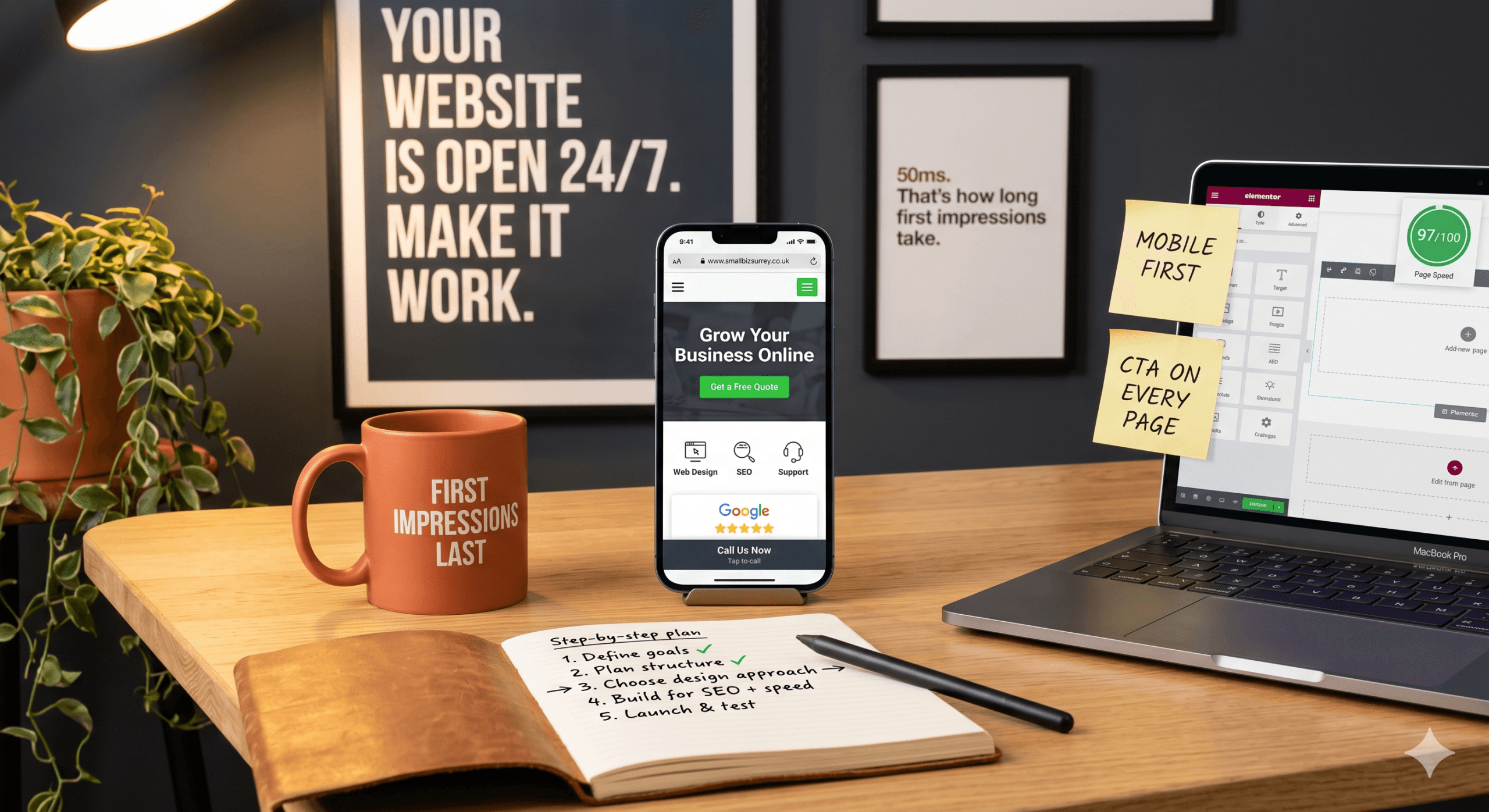
| First impressions happen fast | Visitors form an opinion about your website in roughly 50 milliseconds. Poor design drives them straight to a competitor. |
| Mobile-first is non-negotiable | As of 2026, over 60% of web traffic comes from mobile devices. A site that isn’t mobile-optimized loses more than half its audience. |
| UX drives conversions, not just aesthetics | User experience (UX) design, which means structuring a site around how visitors actually behave, directly affects how many enquiries your site generates. |
| Speed is a ranking factor | Google uses Core Web Vitals to assess page speed. Slow sites rank lower and lose visitors before a single word is read. |
| DIY tools have a ceiling | Template builders can get you online quickly, but they rarely deliver the bespoke UX, SEO depth, or brand credibility a professional agency provides. |
| Ongoing support matters post-launch | A website isn’t finished at launch. Hosting, security updates, and content changes are ongoing needs that many businesses underestimate. |
Your website is often the first thing a potential customer sees. Business website design is the process of planning, building, and optimizing a company’s online presence to attract visitors, build trust, and turn interest into real enquiries. Done well, it’s one of the highest-return investments a small business can make. Done poorly, it quietly sends customers to a competitor. This guide covers everything you need to know: what good design actually involves, how the process works, the benefits you can expect, the mistakes to avoid, and the best practices that separate high-performing sites from forgettable ones.
What Is Business Website Design?
Business website design is the strategic creation of a company’s website, combining visual design, technical development, and user experience principles to serve specific commercial goals. It goes well beyond choosing colors and fonts. A properly designed business site is built around how your customers think, what they need to see before they trust you, and what action you want them to take.
Definition and Scope
At its core, business website design covers every decision that shapes how a site looks, functions, and performs. That includes layout, navigation structure, typography, imagery, page speed, mobile responsiveness, and the clarity of your calls to action. It also covers how well the site integrates with search engines, which determines whether customers can find you in the first place [1].
The scope varies by business type. A local healthcare clinic needs a site that builds immediate trust, surfaces contact details fast, and reassures visitors about credentials. An ecommerce retailer needs product pages that load quickly, a frictionless checkout, and persuasive photography. A nursery or childcare provider needs warmth, clear information for parents, and strong local search visibility. One design approach doesn’t fit all of these needs, which is why generic templates often fall short [2].
Why It Matters More Than Ever in 2026
As of 2026, consumer expectations for website quality have risen sharply. Visitors arrive having already seen polished, fast-loading sites from large brands. They apply the same standard to every business they research, regardless of size. According to research highlighted by Dot IT, good web design directly influences trust, user engagement, and ultimately sales conversions [3].
The rise of AI-assisted website builders has also changed the baseline. Tools that generate a passable site in minutes are now widely available. That means a basic web presence is table stakes. What differentiates a business in 2026 is a site that’s genuinely conversion-focused, technically sound, and tailored to its audience rather than assembled from a generic template.
Pro Tip: Before briefing any designer or agency, write down the three things you most want a visitor to do on your site. Every design decision should serve at least one of those goals.
How Business Website Design Works
A professional business website design project follows a structured process, moving from discovery and strategy through to design, development, testing, and launch. Understanding the stages helps you ask better questions and get a better result.
The Design and Development Process
Most professional projects follow a sequence similar to this:
- Discovery: The agency or designer learns about your business, your customers, your competitors, and your goals. This stage defines what success looks like before a single pixel is placed.
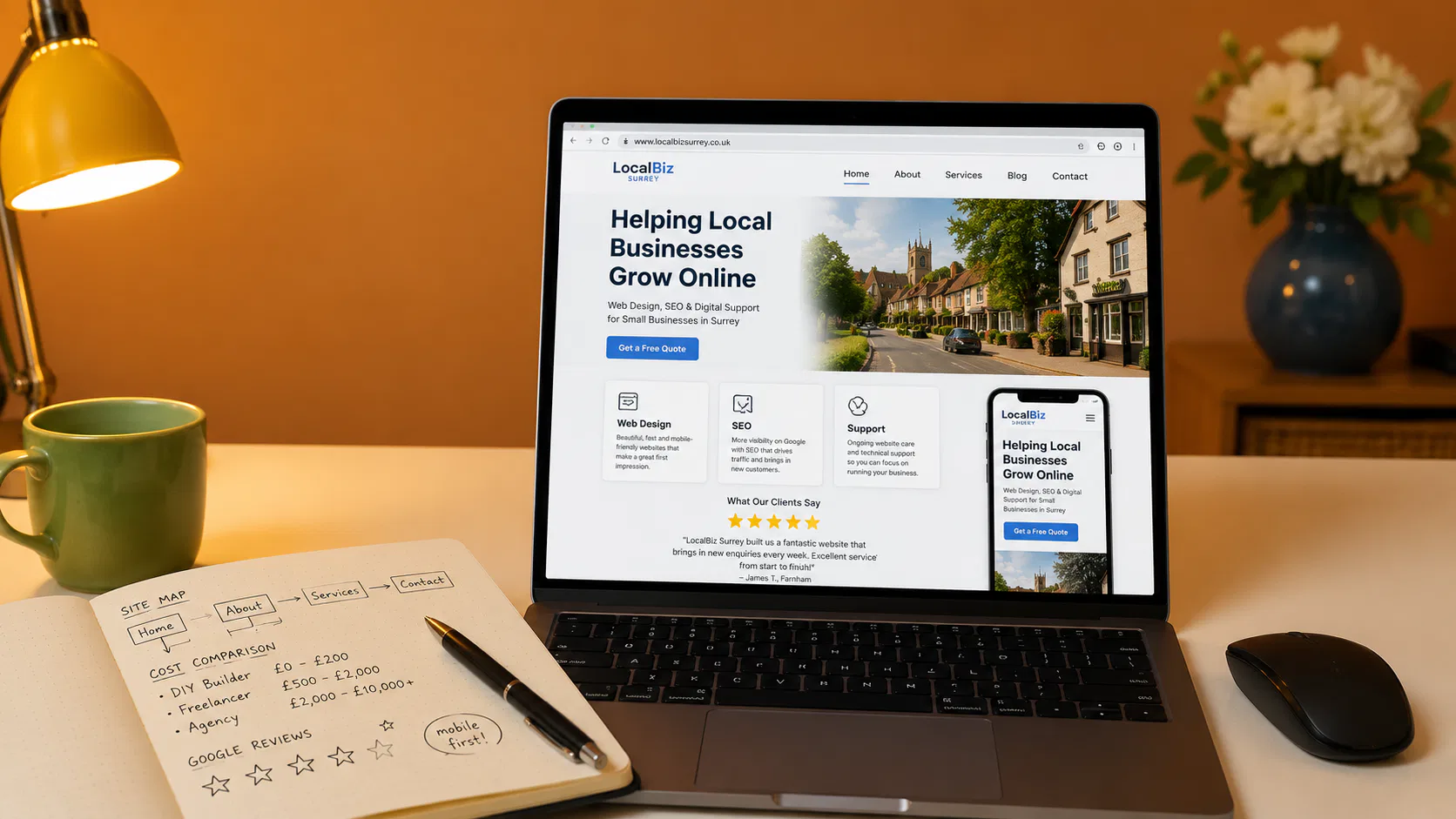
- Strategy and sitemap: The information architecture (IA) of your site is mapped out. IA refers to how pages are organised and linked, which directly affects both user experience and SEO performance.
- Wireframing: Low-fidelity layouts (called wireframes) sketch out the structure of key pages without visual styling. This is where decisions about content hierarchy and calls to action are made.
- Visual design: Colours, typography, imagery, and brand identity are applied to the wireframe structure to create the look and feel of the finished site.
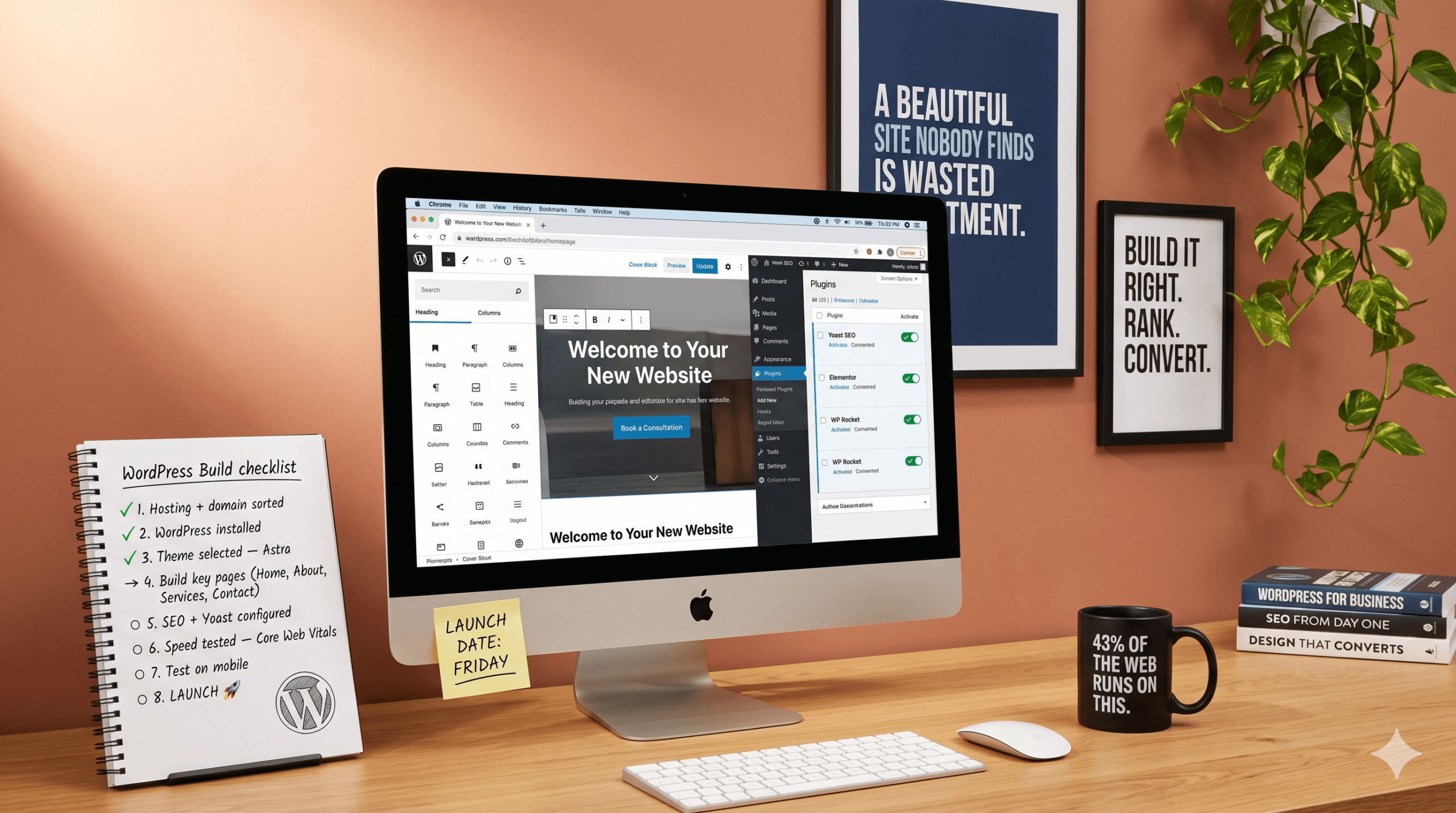
- Development: The design is built into a functioning website, typically using a content management system (CMS) such as WordPress, which allows you to update content without technical knowledge.
- Testing: The site is checked across devices, browsers, and screen sizes. Page speed, form functionality, and broken links are all reviewed before launch.
- Launch and handover: The site goes live. A good agency also provides training, documentation, and ongoing hosting and support so you’re never left stranded after go-live.
The U.S. Small Business Administration notes that a well-structured homepage, with clear messaging and easy navigation, is one of the most cost-effective improvements any small business can make to its online presence [4].
The Role of UX in Business Website Design
UX (user experience) design is the discipline of structuring a site around how real visitors behave rather than how the business owner imagines they behave. In practice, this means placing calls to action where the eye naturally travels, reducing the number of clicks needed to find key information, and writing page copy that answers the questions visitors actually have.
From experience, the sites that generate the most enquiries aren’t always the most visually striking. They’re the ones where a visitor can find what they need in under 10 seconds and feel confident enough to get in touch. That confidence comes from clear messaging, visible trust signals (like reviews and accreditations), and a design that feels professional and intentional.
Just as the design-build approach in construction integrates planning and execution under one team (for a useful parallel, see this overview of Design Build Vs Traditional Construction), a full-service web agency brings strategy, design, and development together so nothing gets lost in handoffs between separate contractors.
Key Benefits of a Well-Designed Business Website
A well-executed business website design delivers measurable advantages across credibility, search visibility, and lead generation. The returns compound over time as the site gains authority and traffic.

Credibility and First Impressions
Research consistently shows that visitors make a judgment about a website’s credibility within milliseconds. A poorly designed site signals that the business behind it may be equally careless. A polished, professional design says the opposite.
Key credibility signals include:
- A clear, professional logo and consistent brand identity
- Testimonials, reviews, and case studies from real customers
- Visible contact details and a physical address where relevant
- An SSL certificate (the padlock in the browser bar), which signals security
- Up-to-date content that shows the business is active
According to SBDCNet, small businesses that invest in professional website design consistently report stronger customer trust and higher conversion rates compared to those using generic templates [5].
Search Visibility and Lead Generation
A beautifully designed site that nobody finds is a missed opportunity. Good business website design integrates SEO (search engine optimisation) from the ground up. That means fast page load times, mobile responsiveness, clean code, proper heading structure, and on-page content that targets the terms your customers actually search for.
The benefits of getting this right include:
- Higher rankings in Google’s local search results, putting your business in front of customers who are already looking for what you offer
- Lower bounce rate (the percentage of visitors who leave after viewing just one page), which signals to Google that your content is relevant
- More qualified enquiries, because visitors arriving from search already have intent to buy or contact
- A foundation for paid advertising campaigns (PPC), where a high-quality landing page dramatically improves return on ad spend
At Three Girls Media, we’ve found that clients who invest in both design quality and on-page SEO from the start see significantly faster results than those who treat them as separate projects. The two disciplines reinforce each other in ways that are difficult to retrofit later.
| Website Type | Primary Goal | Key Design Priority | Critical Feature |
|---|---|---|---|
| Local service business | Phone calls and enquiry forms | Clear contact info, trust signals | Local SEO and Google Business integration |
| Ecommerce store | Online sales | Product UX, checkout flow | Secure payment gateway, mobile-optimized cart |
| Healthcare/clinic | Appointment bookings | Trust, credentials, accessibility | Online booking integration, WCAG compliance |
| Nursery/school | Parent enquiries and registrations | Warmth, clarity, Ofsted information | Clear fees, location, and contact details |
| Professional services | Lead generation | Authority, case studies, expertise | Blog/content hub, testimonials |
Common Business Website Design Mistakes to Avoid
The most damaging business website design mistakes are usually invisible to the business owner but immediately obvious to the visitor. Knowing what to look for helps you avoid costly redesigns down the line.
Design and Usability Errors
A common mistake is prioritizing aesthetics over function. A site that looks impressive but confuses visitors doesn’t convert. Specific errors to watch for include:
- No clear call to action: Visitors shouldn’t have to guess what to do next. Every page needs a logical next step, whether that’s calling, filling in a form, or reading more.
- Cluttered layouts: Too many fonts, colours, and competing elements create visual noise that erodes trust. Clean, focused design consistently outperforms busy design.
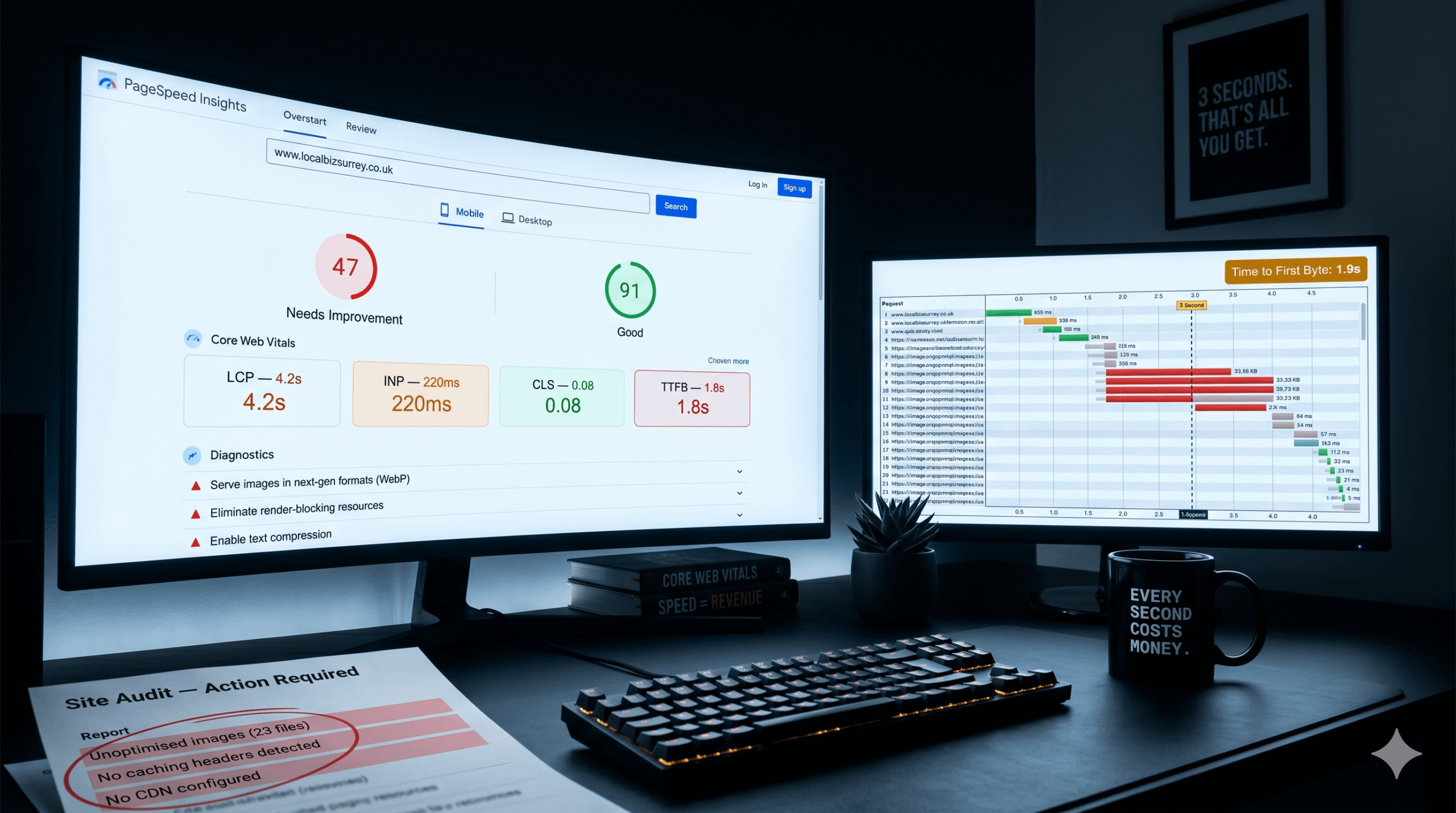
- Slow page load times: A page that takes more than three seconds to load loses a significant portion of visitors before it even appears. Image compression and efficient code matter.
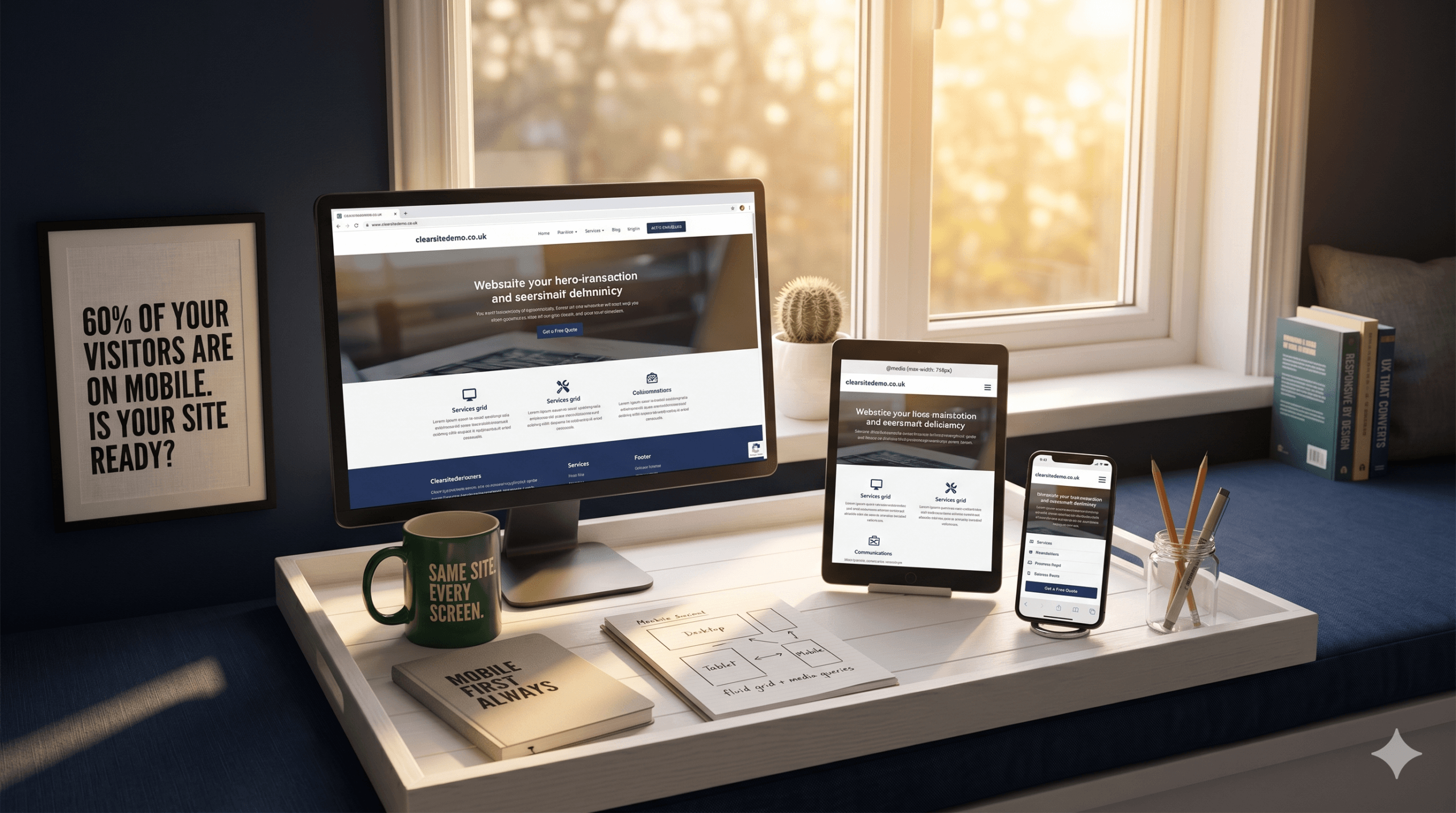
- Poor mobile experience: A site that works on desktop but breaks on a phone effectively turns away the majority of visitors in 2026 [6].
- Generic stock photography: Images of people in suits shaking hands don’t build trust. Real photos of your team, your premises, or your work are far more convincing.
Pro Tip: Run your current site through Google’s PageSpeed Insights (free tool) and aim for a score above 80 on mobile. Anything below 60 is actively costing you enquiries.
Strategic and Content Mistakes
Beyond the visual, strategic errors are just as damaging. One pitfall to watch for is writing website copy from the business’s perspective rather than the customer’s. Visitors don’t care about your company history on the homepage. They care about whether you can solve their problem.
Other strategic mistakes include:
- Launching a site with no SEO strategy, meaning it’s invisible to search engines from day one
- Ignoring analytics, so there’s no data to inform future improvements
- Choosing a platform that the business can’t update independently, creating a dependency on the developer for every small change
- Treating the website as a one-time project rather than an evolving asset that needs regular updates and maintenance [7]
- Skipping accessibility considerations, which can exclude users with disabilities and, in some contexts, create legal exposure
In one project we handled for a local healthcare practice in Surrey, the existing site had strong design but zero mobile optimisation. The practice was losing roughly 65% of its potential visitors before they’d even read the homepage. A mobile-first rebuild, combined with local SEO work, more than doubled enquiry volume within four months of launch.
Best Practices for Business Website Design in 2026
Effective business website design in 2026 combines timeless UX principles with the latest technical standards. The gap between a site that generates enquiries and one that doesn’t often comes down to a handful of disciplined decisions.
Design Principles That Convert
Industry analysts suggest that the most effective business websites share a set of core characteristics, regardless of sector. These include:
- Clear value proposition above the fold: The first thing a visitor sees should answer “what does this business do and why should I care?” in under five seconds.
- Consistent visual hierarchy: Use size, weight, and contrast to guide the eye from the most important information to supporting detail, then to the call to action.
- Social proof throughout: Testimonials, star ratings, client logos, and case studies should appear on multiple pages, not just a dedicated “reviews” page.
- Fast, accessible, and secure: Core Web Vitals (Google’s page experience metrics), WCAG 2.2 accessibility guidelines, and HTTPS encryption are baseline requirements in 2026.
- Minimal, purposeful navigation: Research from Business.com confirms that simpler navigation structures reduce cognitive load and improve the likelihood of visitors reaching a conversion point [8].
Technical and SEO Best Practices
Our team at Three Girls Media recommends treating SEO as part of the design process, not an afterthought. That means:
- Conducting keyword research before writing any page copy, so content targets terms with real search volume
- Structuring URLs, page titles, and meta descriptions to reflect what each page is about
- Compressing images and using modern formats (such as WebP) to keep page sizes small
- Implementing schema markup, which helps search engines understand your content and can trigger rich results in Google
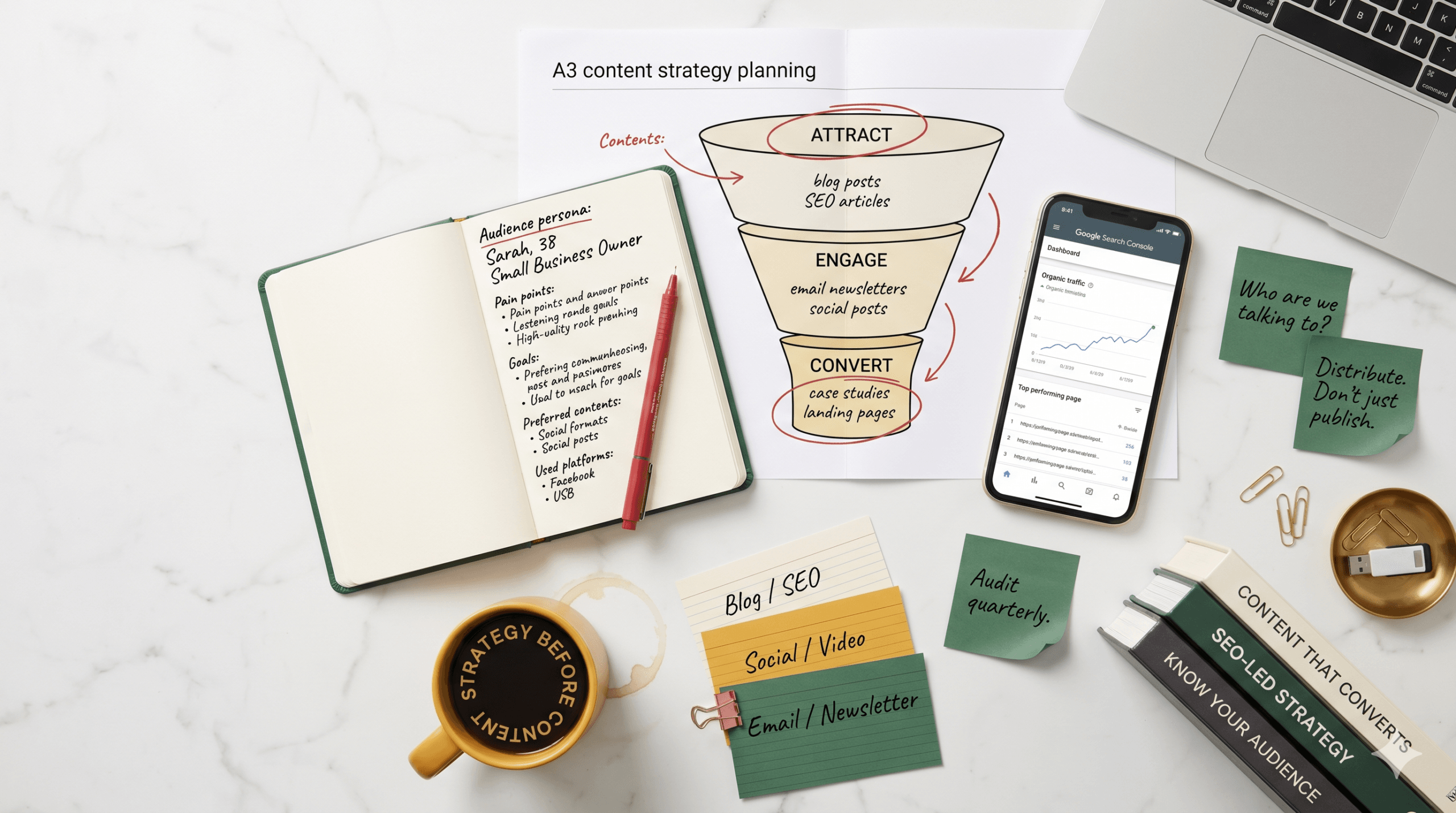
- Connecting Google Analytics and Google Search Console from day one to track performance and identify issues early
For ecommerce businesses specifically, the design stakes are even higher. Drawing on first-hand experience from launching and exiting their own ecommerce business, the team at Three Girls Media builds online stores with actual buying behaviour in mind. That means product page layouts that reduce hesitation, checkout flows that minimise abandonment, and trust signals positioned exactly where a buyer’s confidence is most likely to waver.
Pro Tip: Don’t launch a new site without setting up 301 redirects from any old URLs to their new equivalents. Failing to do this destroys the SEO equity your existing pages have built up and can cause a significant, temporary drop in rankings.
Award-winning web design, as recognised by bodies such as Awwwards, consistently demonstrates that the sites earning the highest user engagement scores combine strong visual identity with near-perfect technical performance [9]. That combination is achievable for small businesses too, with the right agency partner.
Sources & References
- SBDCNet, “Website Design for Small Business”
- Knapsack Creative, “15 Best Small Business Websites in 2025”
- Dot IT, “Best website design for business growth”, 2026
- U.S. Small Business Administration, “7 Ways to Improve Your Website Homepage”
- SBDCNet, “Website Design for Small Business”
- Business.com, “Website Design Tips for Small Businesses”
- U.S. Small Business Administration, “7 Ways to Improve Your Website Homepage”
- Business.com, “Website Design Tips for Small Businesses”
- Awwwards, “Website Awards — Best Web Design Trends”, 2026
Frequently Asked Questions
1. How much does business website design typically cost?
Cost varies significantly based on complexity, the number of pages, and whether ecommerce functionality is needed. A professionally designed small business website in the UK typically ranges from £1,500 to £8,000 for a bespoke build. Template-based builds cost less but come with limitations in flexibility, SEO performance, and brand differentiation. Ongoing costs for hosting, support, and SEO should also be factored into your budget from the start.
2. How long does it take to design and build a business website?
A typical professional business website design project takes between four and ten weeks from initial briefing to launch. Simpler brochure sites can be completed faster. Ecommerce builds with large product catalogues, custom integrations, or complex checkout requirements take longer. The biggest factor affecting timelines is usually how quickly the client can provide content, feedback, and approvals.
3. Do I need a new website or can my existing site be improved?
It depends on the underlying structure of your current site. If it was built more than four or five years ago, runs on an outdated platform, or scores poorly on mobile performance and Core Web Vitals, a rebuild is usually more cost-effective than trying to patch it. If the platform is sound but the design feels dated, a redesign (updating the look and feel without rebuilding from scratch) can deliver strong results at lower cost.
4. What’s the difference between a website builder and a professional agency for business website design?
Website builders like Wix or Squarespace offer speed and low entry cost, which suits very early-stage businesses. A professional agency delivers a bespoke design tailored to your brand, a deeper SEO foundation, conversion-focused UX, and ongoing support. For businesses that rely on their website to generate enquiries or sales, the difference in outcome between a template and a professionally designed site is substantial and measurable over time.
5. How important is mobile design for a business website?
Extremely important. As of 2026, the majority of web traffic arrives on mobile devices. Google also uses mobile-first indexing, meaning it crawls and ranks the mobile version of your site. A business website that isn’t properly optimized for mobile will rank lower in search results and lose a large proportion of visitors before they engage with your content at all.
6. What should a business website include?
At minimum, a business website should include a clear homepage with your value proposition, an about page, a services or products page, a contact page with multiple ways to get in touch, and customer testimonials or social proof. Depending on your sector, you may also need a blog, a booking system, a portfolio, or an ecommerce store. Every page should have a clear call to action guiding visitors toward the next step.
7. How does business website design affect SEO?
Design and SEO are closely linked. Page speed, mobile responsiveness, heading structure, internal linking, and URL architecture are all design decisions that directly affect how Google ranks your site. A this strategy that ignores SEO from the outset will require significant remedial work later. Building SEO into the design process from day one is always more efficient and cost-effective than retrofitting it after launch.
Conclusion
Getting this approach right is one of the most impactful decisions a small business can make. Your website works around the clock, representing your brand to every potential customer who searches for what you do. A site that’s fast, mobile-friendly, clearly structured, and built around what your customers need will consistently outperform one that’s simply attractive.
The principles covered in this guide apply whether you’re building from scratch, planning a redesign, or trying to understand why your current site isn’t converting. Start with strategy, invest in UX, build in SEO from the beginning, and don’t treat launch as the finish line.
At Three Girls Media, we bring over 10 years of award-winning experience to every project, combining UX-led design with integrated digital marketing to deliver websites that win real enquiries for businesses across Surrey, South London, and beyond. If your current site isn’t working as hard as you are, get in touch for a free quote and find out what a properly designed business website could do for you.
Recommended Articles
Explore more from our content library: