| Key Insight | Explanation |
|---|---|
| Quality beats quantity | A focused portfolio with 5-8 strong case studies outperforms one crammed with dozens of mediocre projects. |
| Results matter more than visuals | Prospective clients want to see measurable outcomes (traffic increases, conversion lifts) alongside beautiful screenshots. |
| UX (user experience) is non-negotiable | Your portfolio site itself must be fast, mobile-friendly, and easy to navigate — it’s your first live demo. |
| SEO visibility drives inbound leads | Optimizing your portfolio for search engines means clients find you without you chasing them. |
| Ongoing updates signal credibility | A portfolio last updated in 2022 raises doubts. Keeping work current shows you’re active and in demand. |
| Niche positioning wins more work | Portfolios that speak to a specific industry (healthcare, ecommerce, education) attract higher-quality enquiries than generic ones. |
A strong web design portfolio is the single most persuasive sales tool any designer or agency can own. It’s the first thing a prospective client looks at, and it’s the thing that either earns their trust or sends them clicking away to a competitor. Done well, your portfolio communicates skill, professionalism, and real-world results without you saying a word. Done poorly, it costs you work you’d otherwise win. This guide walks you through exactly how to build a web design portfolio that attracts the right clients, showcases your strongest projects, and positions you as the credible, experienced choice. Whether you’re starting from scratch or overhauling an outdated site, you’ll finish with a clear, step-by-step plan. Expect to invest 10-20 hours of focused effort, with no specialist technical knowledge required beyond basic website management.
What Is a Web Design Portfolio?
A web design portfolio is a curated online showcase of your best design work, structured to demonstrate your skills, process, and measurable results to potential clients or employers. It functions as both a proof-of-work document and a live demonstration of your design ability.
According to Florida National University, an online portfolio is “a website that provides professional information about an individual or company and presents a showcase of their work.” [1] That definition is accurate but undersells the strategic role a great portfolio plays. The best portfolios don’t just display screenshots — they tell stories about problems solved and outcomes delivered.
As of 2026, a web design portfolio typically includes:
- A homepage or landing page that immediately communicates your specialty and value
- A curated selection of 5-8 project case studies
- An “About” section that builds personal or team credibility
- Client testimonials or measurable results
- A clear contact or enquiry mechanism
- Optional: a blog or resources section to support SEO
Who Needs a Web Design Portfolio?
Freelance designers, in-house teams, and full-service agencies all benefit from a portfolio. The format differs slightly between them, but the core purpose is identical: build trust fast and give a prospective client the confidence to reach out.
For agencies like Three Girls Media, the portfolio also signals industry depth. Showing work across healthcare, ecommerce, and education tells a potential client that you understand their world, not just your own tools.
What You’ll Need: Prerequisites
Before building your web design portfolio, gather the assets, access, and permissions that will make the process smooth and professional from the start.
Essential Assets and Tools
- Client permission: Written or verbal sign-off to feature each project publicly. Never assume — always ask.
- Project screenshots and files: High-resolution visuals of finished work, ideally on device mockups.
- Performance data: Any analytics, conversion rates, or measurable outcomes from each project (with client approval).
- A domain name: Your own branded URL looks far more professional than a subdomain on a free builder.
- A CMS (Content Management System): WordPress remains the most flexible option as of 2026, though platforms like Webflow suit design-heavy portfolios well.
- Design tools: Figma offers over 2,800 free portfolio templates you can adapt as a starting point. [2]
- Basic SEO knowledge: Understanding of title tags, meta descriptions, and image alt text will help your portfolio rank.
Knowledge Prerequisites
- Familiarity with your chosen CMS or website builder
- A clear sense of the niche or industries you want to serve
- At least 3 completed projects you’re proud to show publicly
- A short professional bio (100-150 words is enough to start)
Pro Tip: If you don’t yet have real client work, build 2-3 spec (speculative) projects for fictional or local businesses. Clearly label them as concept work — clients respect honesty, and a polished spec project beats an empty portfolio every time.
Step 1: Select and Curate Your Best Projects
Curating your web design portfolio starts with a ruthless edit: choose only the work that represents the standard you want to be hired at, not every project you’ve ever completed.
The AIGA (American Institute of Graphic Arts) notes that “publishing your most compelling work samples creates a valuable promotional tool” — and the emphasis is firmly on “most compelling,” not “most comprehensive.” [3]
How to Choose the Right Projects
- List every project you’ve completed in the last three years.
- Score each one on three criteria: visual quality, measurable results, and relevance to the clients you want to attract.
- Select the top 5-8 scorers. Fewer strong pieces always outperform a longer list of average ones.
- Check for variety across industries, project types, and design challenges.
- Confirm permissions for every project before including it.
In practice, most designers make the mistake of including too much. A Three Girls Media client once reviewed a freelancer’s portfolio that featured 22 projects — and couldn’t remember a single one afterward. Six well-presented case studies with clear outcomes stick in the memory far more effectively.
Balancing Breadth and Depth
If you serve a specific niche (say, healthcare or nurseries in Surrey), weight your selection toward that sector. Specialization is a competitive advantage, not a limitation. That said, including one or two projects outside your core niche shows adaptability.
| Portfolio Size | Pros | Cons |
|---|---|---|
| 3-4 projects | Highly focused; every piece is impactful | May appear limited in experience |
| 5-8 projects | Ideal balance of depth and variety | Requires strong curation discipline |
| 10+ projects | Demonstrates broad experience | Risks diluting impact; harder to navigate |
Step 2: Structure Each Case Study for Impact
Structure each portfolio case study to tell a clear story: the client’s problem, your approach, the solution you built, and the results it delivered. This narrative format is what separates a memorable web design portfolio from a simple screenshot gallery.
Industry analysts consistently note that clients hire based on confidence in outcomes, not admiration of aesthetics alone. The case study format, borrowed from the consulting world, addresses this directly. It answers the unspoken question every prospective client has: “Can this designer solve my specific problem?”
The Four-Part Case Study Framework
- The Challenge: Describe the client’s situation before you got involved. What wasn’t working? What were they trying to achieve?
- Your Approach: Explain the design decisions you made and why. Reference your process — wireframing, user research, UX (user experience) testing — without drowning in jargon.
- The Solution: Show the finished work with high-quality visuals. Use device mockups to present it professionally.
- The Results: Quantify the impact wherever possible. “Organic traffic increased 40% in three months” is far more persuasive than “the client was happy.”
Platforms like Behance and Dribbble are useful references for seeing how top designers present their case studies — though bear in mind these communities skew toward visual polish over business outcomes. [4][5]
What to Include in Each Case Study
- A headline that names the client type and the core outcome (not just the client name)
- 2-3 high-quality visuals (desktop, mobile, and a detail shot)
- A 150-200 word narrative following the four-part framework above
- One or two specific metrics or client quotes
- A list of services or technologies used (brief, not exhaustive)
Pro Tip: Ask clients for a one-sentence testimonial specifically about results, not just satisfaction. “Our enquiry rate doubled in the first month” is worth ten times “Really happy with the design.”

Step 3: Build and Optimize Your Portfolio Site
Build your portfolio site with the same care and UX discipline you’d apply to any client project — because it is a client project, and the client is every person who visits it. Your portfolio site is your most important live demonstration of your capabilities.
Research from the Florida National University emphasizes that a portfolio site must be easy to navigate, visually consistent, and reflective of your personal brand. [1] These aren’t optional extras — they’re the baseline.
Technical Foundations
- Choose your platform: WordPress offers maximum flexibility and SEO control. Webflow suits designers who want pixel-perfect control without custom code. Avoid free subdomain builders for anything professional.
- Set up a custom domain: yourname.com or youragency.com signals professionalism immediately.
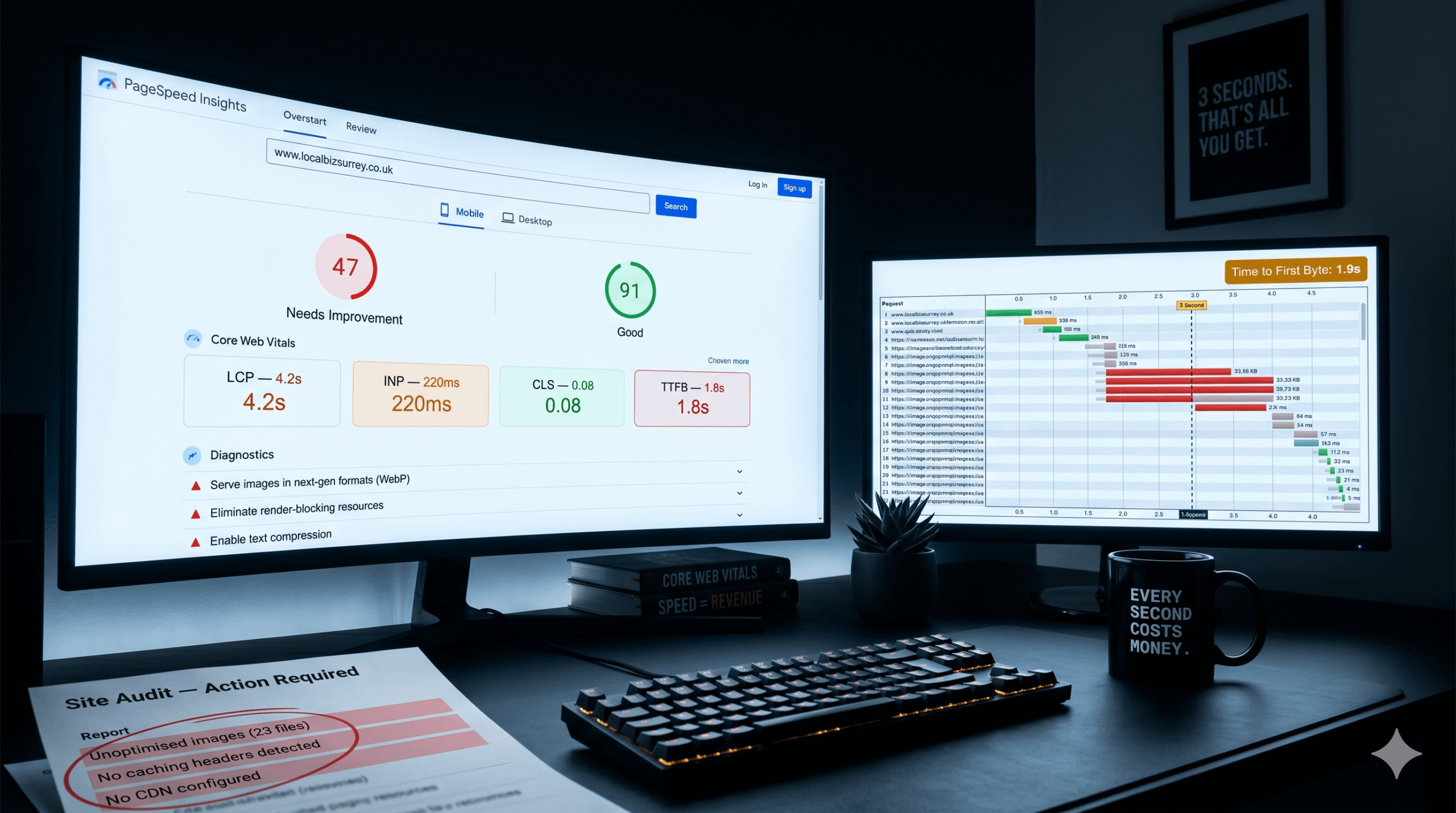
- Optimize page speed: Compress all images before uploading. A slow portfolio is a self-defeating one — Google’s Core Web Vitals (a set of performance metrics that affect search rankings) penalize slow-loading pages.
- Ensure mobile responsiveness: Over 60% of web traffic in 2026 arrives via mobile devices. Your portfolio must look and function perfectly on a phone.
- Structure your navigation clearly: Home, Work, About, Contact. Four links. Don’t overcomplicate it.
- Add an SSL certificate: The padlock in the browser bar (HTTPS) is a basic trust signal. Most hosting providers include this free.
Design Principles to Apply
- White space is your friend: Cramped layouts make work look cheaper than it is. Give each project room to breathe.
- Consistent typography: Use two typefaces maximum — one for headings, one for body text.
- Accessible color contrast: Follow WCAG 2.1 guidelines (the Web Content Accessibility Guidelines, a set of international standards for digital accessibility) to ensure your site is readable by everyone.
- Fast, obvious CTAs (calls to action): Every page should make it effortless to contact you.
For small businesses thinking about their own brand consistency online, resources like this guide to designing your own rubber stamp for SMEs show how even offline brand assets reinforce the professional identity your website establishes.
Step 4: Optimize for SEO and Discoverability in 2026
Optimizing your web design portfolio for search engines means potential clients find you through Google rather than you relying entirely on referrals or social media. SEO (search engine optimization) is the practice of structuring your content so search engines rank it prominently for relevant queries.
At Three Girls Media, we’ve found that many designers build beautiful portfolios and then wonder why nobody visits them. The answer is almost always the same: no SEO strategy. A portfolio that ranks for “web designer in Surrey” or “ecommerce web design Caterham” generates consistent inbound enquiries without ongoing ad spend.
On-Page SEO Essentials for Your Portfolio
- Write descriptive page titles: Each project page should have a unique title tag including the service type, industry, and location where relevant.
- Optimize meta descriptions: A compelling 150-160 character summary for every page improves click-through rates from search results.
- Use descriptive alt text on every image: Screen readers and search engines both rely on alt text to understand images.
- Create location-specific pages: If you serve Surrey, South London, or specific towns like Caterham or Oxted, dedicated landing pages for those locations capture local search traffic.
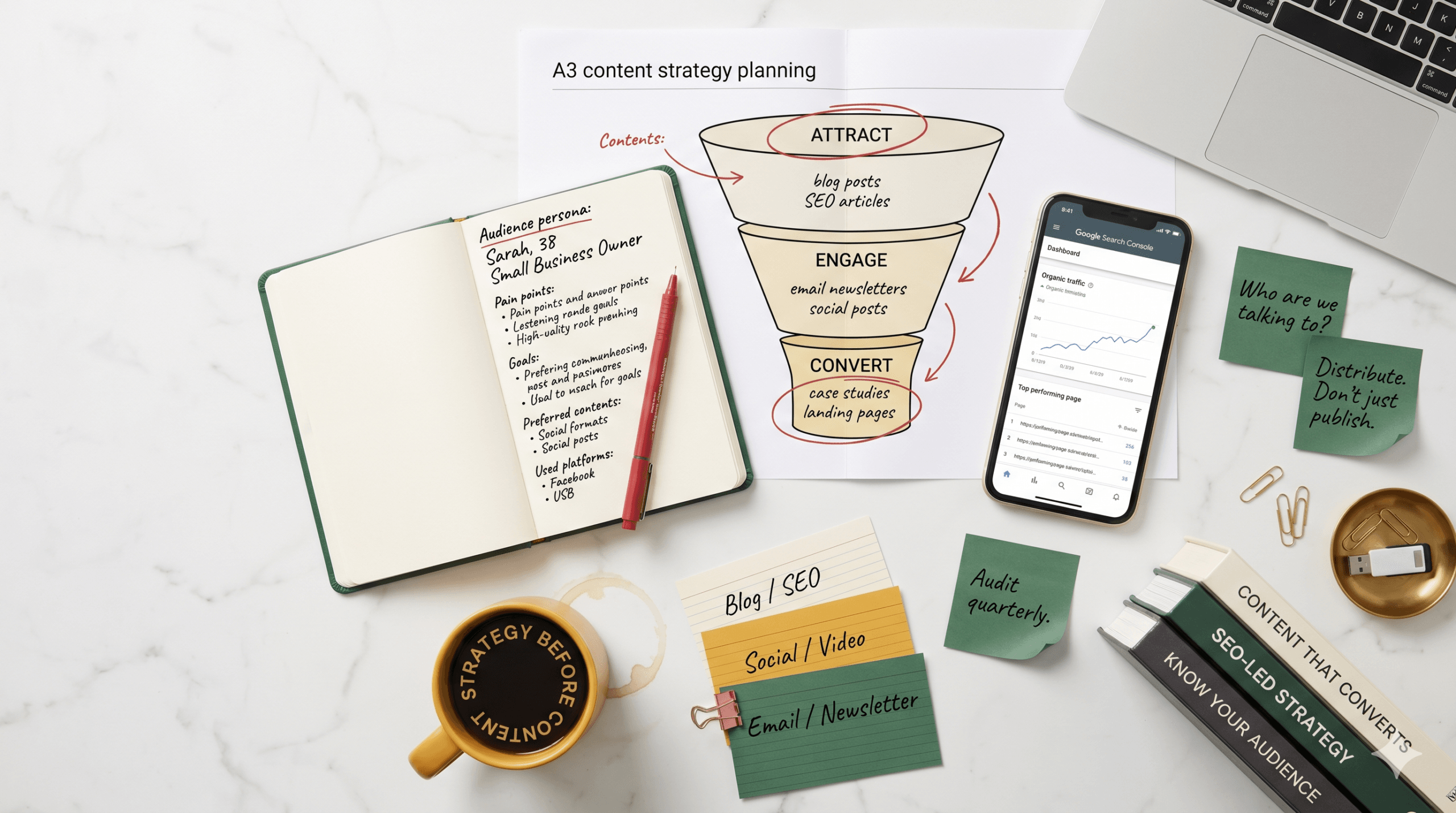
- Publish a blog: Regular articles answering questions your target clients ask (like this one) build topical authority over time.
- Build internal links: Connect your case studies to relevant service pages and blog posts to strengthen your site’s overall SEO structure.
Local SEO for Design Agencies
Local SEO (optimizing for searches tied to a geographic area) is particularly valuable for agencies serving a defined region. Claim and optimize your Google Business Profile, gather reviews, and ensure your name, address, and phone number are consistent across all online directories.
The Awwwards portfolio showcase demonstrates how agencies that combine visual excellence with strong discoverability consistently attract the highest-quality work. [6] Discoverability isn’t separate from portfolio quality — it’s part of it.
Pro Tip: Add a “Services” page to your portfolio site that lists what you offer in plain language. This page often ranks better than your homepage for specific service searches, and it answers the practical question clients ask before they look at your work: “Does this person do what I need?”
Step 5: Promote and Keep Your Portfolio Current
Promoting your web design portfolio actively and keeping it updated ensures it continues to work as a lead-generation tool rather than a static brochure that gradually becomes irrelevant.
A portfolio that hasn’t been updated since 2023 signals one of two things to a prospective client: either you’re not busy (which raises doubts), or you’re too busy to maintain your own site (which raises different doubts). Neither is the impression you want to make.
Promotion Channels That Work in 2026
- LinkedIn: Share new case studies as posts, focusing on the business outcome rather than the design process. Decision-makers scroll LinkedIn — they don’t browse Behance.
- Google Business Profile: Post project updates and photos here to boost local visibility.
- Design communities: Behance and Dribbble remain the two dominant platforms for peer recognition and creative discovery. [4][5]
- Email outreach: A short, personal email to past clients announcing a portfolio refresh often generates referrals.
- Local networking: For agencies serving Surrey and South London, in-person business events in Caterham, Croydon, and Redhill remain a reliable source of warm introductions.
Keeping Your Portfolio Fresh
- Schedule a quarterly review: Set a calendar reminder every three months to assess whether your portfolio still reflects your best and most recent work.
- Retire old projects: Remove anything that no longer represents the quality level or type of work you want to attract.
- Update results data: If a project’s performance metrics have improved since launch, update the case study to reflect that.
- Add new testimonials: Fresh client quotes signal ongoing activity and current client satisfaction.
The Interaction Design Foundation’s 2026 roundup of inspirational UX portfolios consistently highlights designers who treat their portfolio as a living document — updated regularly, with new case studies replacing older ones as skills and specializations evolve. [7]
Web Design Portfolio Best Practices for 2026
The most effective web design portfolios in 2026 combine strong visual presentation, measurable outcomes, and smart SEO to attract clients consistently without relying on referrals alone.
Several significant shifts have occurred in recent years that affect how portfolios should be built and presented:
What’s Changed in 2026
- AI-generated design is mainstream: Clients are now more aware that templates and AI tools can produce “good enough” visuals cheaply. Your portfolio needs to demonstrate the strategic thinking and business understanding that AI can’t replicate.
- Video walkthroughs are expected: Short screen-recorded walkthroughs of completed projects (30-90 seconds) dramatically increase engagement on portfolio pages.
- Accessibility is a differentiator: Portfolios that demonstrate WCAG 2.1 compliance in client work signal a level of professionalism that many designers still overlook.
- Core Web Vitals affect rankings directly: Google’s performance metrics (loading speed, interactivity, visual stability) now directly influence where your portfolio site appears in search results.
Comparison: Portfolio Platforms in 2026
| Platform | Best For | SEO Control | Cost (approx.) |
|---|---|---|---|
| WordPress | Agencies, full-service portfolios | Excellent | £5-20/month hosting |
| Webflow | Designers wanting visual control | Good | £14-30/month |
| Canva | Quick, low-budget starts | Limited | Free to £10/month |
| Behance | Creative community visibility | Minimal | Free |
| Custom-built site | Established agencies | Maximum | Variable (project cost) |
Our team at Three Girls Media recommends WordPress for most agencies and established freelancers, precisely because it offers the SEO depth and customization that platforms like Canva simply can’t match at scale. For designers just starting out, Canva’s free portfolio builder is a perfectly respectable starting point — just plan to migrate to a custom domain as soon as your first paying client comes through.
Common Mistakes to Avoid
The most common web design portfolio mistakes fall into three categories: curation errors, structural weaknesses, and maintenance failures. Knowing them in advance saves you from the frustration of a portfolio that looks good but generates no enquiries.
Curation and Content Errors
- Including work you’re not proud of: Clients assume your portfolio represents your average output, not your best. If a project makes you wince, cut it.
- No results or metrics: Screenshots without context are decoration. Always pair visuals with outcomes.
- Generic copy: Phrases like “passionate designer” and “creative solutions” appear on thousands of portfolios. Be specific about what you do and who you do it for.
- Missing client context: A visitor who doesn’t know the client’s industry can’t appreciate the design decisions. A brief sentence of context transforms a screenshot into a story.
Technical and Structural Pitfalls
- No mobile optimization: A portfolio that breaks on mobile tells clients exactly what their own website will look like if they hire you.
- Slow load times: Uncompressed images are the most common culprit. Every second of load time above 2-3 seconds increases bounce rate (the percentage of visitors who leave after viewing only one page).
- Buried contact information: If a motivated client can’t find how to reach you in under 10 seconds, you’ve lost them. Put your contact details in the navigation and at the bottom of every case study.
- No SEO foundation: A portfolio with no page titles, no meta descriptions, and no keyword strategy is essentially invisible to search engines.
- Outdated work: A Three Girls Media client once told us they almost didn’t contact a designer because their most recent project was dated three years ago. Fresh work signals an active, in-demand professional.
Community feedback on platforms like Reddit’s web development community consistently identifies these same issues when designers ask for portfolio reviews. [8] The patterns are remarkably consistent: too much work, too little context, and no clear next step for the visitor.
Sources & References
- Florida National University, “Tips for Making a Web Design Portfolio,” 2024
- Figma, “2,800+ Portfolio Templates — Free & Fully Customizable,” 2026
- AIGA, “4 Easy Steps to Create a Beautiful Design Portfolio,” 2024
- Behance, “Web Design Portfolio Projects,” 2026
- Dribbble, “Browse Portfolio Images for Design Inspiration,” 2026
- Awwwards, “Best Portfolio Websites — Web Design Inspiration,” 2026
- Interaction Design Foundation, “The 10 Most Inspirational UX Design Portfolio Examples in 2026,” 2026
- Reddit r/webdev, “I’ll Rate 1-10 Your Web Designer Portfolio / Agency Website,” 2025
Frequently Asked Questions
1. How many projects should a web design portfolio include?
Five to eight projects is the widely accepted sweet spot for a it. This range shows enough variety to demonstrate breadth without overwhelming visitors. Each project should be presented as a full case study with context, visuals, and results rather than a simple screenshot. Quality always outweighs quantity — three exceptional case studies will win more work than fifteen mediocre ones.
2. What should a web design portfolio include?
A strong this method should include a clear homepage that communicates your specialty, 5-8 case studies with problem-solution-results narratives, an “About” section with credibility signals, client testimonials or measurable outcomes, and a simple contact mechanism. As of 2026, adding short video walkthroughs of projects is increasingly expected and significantly boosts engagement.
3. How do I build a web design portfolio with no experience?
Start by creating 2-3 speculative (spec) projects for fictional businesses or local organizations, clearly labeling them as concept work. You can also offer to redesign a friend’s or local charity’s website at a reduced rate in exchange for permission to feature it. Platforms like Figma provide free templates to help you present concept work professionally from day one.
4. Which platform is best for hosting a web design portfolio?
WordPress is the strongest choice for most designers and agencies because it offers full SEO control, unlimited customization, and a custom domain. Webflow is excellent for designers who want visual precision without custom code. For those just starting out, Canva’s free portfolio builder is a practical entry point. Avoid free subdomains for anything you’re presenting to paying clients.
5. How often should I update my web design portfolio?
Review your portfolio at least quarterly. Add new case studies as projects complete, retire work that no longer represents your current standard, and update performance metrics when results improve post-launch. A portfolio last updated more than 12 months ago signals inactivity to prospective clients, which undermines the trust you’re trying to build.
6. Should I include client names in my web design portfolio?
Always get client permission before naming them publicly. Many clients are happy to be featured — it’s free publicity for them too. If a client prefers anonymity, describe them by industry and size instead (e.g., “a Surrey-based healthcare clinic with three locations”). The case study narrative and results are more important than the client’s name anyway.
7. How do I make my web design portfolio rank on Google?
Focus on on-page SEO fundamentals: descriptive page titles, meta descriptions, keyword-optimized case study copy, image alt text, and fast load times. Create location-specific pages if you serve a defined geographic area. Publishing a blog with articles answering questions your target clients search for builds topical authority over time and drives consistent organic traffic to your portfolio.
8. What’s the difference between a portfolio and a case study?
A portfolio is the overall collection of your work — the website or document that houses everything. A case study is the detailed write-up of a single project within that portfolio. Think of the portfolio as the book and each case study as a chapter. Strong portfolios are built from strong case studies; without them, you just have a gallery of screenshots with no story attached.
Conclusion
Building a compelling this strategy isn’t a one-time task. It’s an ongoing investment in your most important sales asset. The steps in this guide give you a clear path: curate ruthlessly, tell stories with data, build a technically sound site, optimize for search, and keep everything current.
The designers and agencies that win the best work in 2026 aren’t necessarily the most talented. They’re the ones who communicate their value most clearly, make it easy for clients to say yes, and show up consistently in search results when those clients go looking.
If you’re a business owner in Surrey or South London thinking about your own web presence, the same principles apply. Your website is your portfolio. It either earns trust at a glance or it doesn’t. At Three Girls Media, we’ve spent 10+ years building websites that do exactly that: convert visitors into enquiries, rank well locally, and reflect the genuine quality of the businesses behind them. A great this approach starts with a great web design partner.
Recommended Articles
Explore more from our content library: