If someone nearby searches for what you sell right now, does your business actually appear? For a huge number of local businesses, the honest answer is no — and it’s almost always down to local SEO, or the lack of it.
Local SEO is the practice of improving your visibility in location-based search results, whether that’s the map pack at the top of Google, Google Maps itself, or the regular organic listings underneath. It’s different from standard SEO because Google leans on a distinct set of signals — your Google Business Profile, your reviews, your citations — rather than just blog content and backlinks. If you run a shop, a clinic, a garage, or any service that depends on people nearby finding you, this is the SEO that pays your bills.
Below is a practical, no-nonsense walkthrough of how it works and what actually moves the needle.
What Local SEO Really Covers
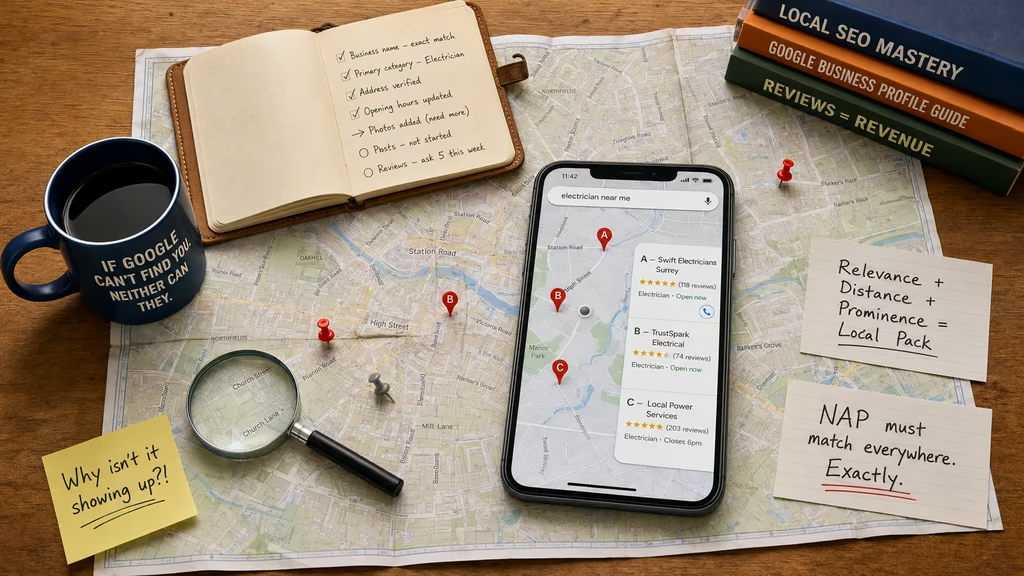
Local SEO optimises your presence for searches with a location intent, whether that intent is explicit (“plumber in Leeds”) or implied by the searcher’s location (“plumber near me”). Get it right and two things happen: your Google Business Profile starts appearing in the local pack — the three-listing block with the map — and your website climbs the ordinary organic results too, since Google increasingly blends both signals when someone’s clearly hunting for a nearby option.
This matters most for bricks-and-mortar businesses (cafés, dentists, mechanics) and mobile service providers (electricians, tutors, cleaners) — essentially, anyone whose customers care about proximity.

Why Bother With Local SEO At All
Because the volume of local search is staggering, and most of it is high-intent. Google itself notes that searches connected to “near me” and local intent have grown dramatically over the past few years, and a large share of those searchers take action — visiting, calling, or buying — within a day. Someone typing “Italian restaurant open now” or “emergency locksmith near me” isn’t browsing for research; they’re ready to spend money, and they’ll pick from whoever shows up first.
The businesses ranking in those top spots capture that demand. The ones that don’t invest in local SEO are, in effect, handing paying customers to competitors down the road.
How Google Actually Ranks Local Results
Google has been fairly transparent about this. For the map pack and Maps results, three factors dominate:
Relevance — how closely your listing matches what the searcher typed. A well-categorised, keyword-rich profile helps here.
Distance — how far you are from the searcher or the location they specified. You can’t manipulate this one, but you can make sure your address data is accurate everywhere.
Prominence — essentially your reputation. This covers review volume and star rating, the number and quality of links pointing to your site, and how consistently your business is mentioned across the web.
For the regular organic results underneath the map pack, standard ranking factors apply on top: page relevance, content quality, and technical usability like page speed and mobile experience. In practice, a strong local SEO strategy has to work on both fronts simultaneously.

Building a Local SEO Strategy That Works
Start With Keyword Research That’s Actually Local
Generic keyword tools will point you toward broad terms, but local search behaviour is more specific and more geographically layered than most people assume. Begin with an obvious shortlist — the services you offer, paired with your town or neighbourhood — then widen it using a few free methods.
Google’s autocomplete is genuinely useful here, since suggestions are partly shaped by the searcher’s location. Type “best [service] in” and watch what fills in; do the same with your business type plus “near me” and you’ll surface phrasing real customers use that you’d never have guessed on your own.
Google Keyword Planner, built for ad campaigns but free to use for research, will also show search volume broken down by location, which helps you prioritise which city or district pages to build first. And if you want to see what’s already working for competitors, tools like Semrush’s Keyword Gap can reveal terms they rank for that you don’t — often the fastest route to an untapped opportunity.
Claim and Fully Complete Your Google Business Profile
Your Google Business Profile is free, and it’s the single biggest lever most small businesses fail to pull properly. Half-finished profiles — no photos, vague categories, missing hours — rank worse and convert worse.
Fill in every field: accurate opening hours, your correct category and any relevant secondary categories, a proper business description, and attributes like accessibility or outdoor seating where they apply. Add genuine photos regularly, not a single logo uploaded three years ago.
Keep the Profile Active, Not Just Accurate
A profile that never changes signals neglect, both to Google and to the person deciding whether to trust you. Update holiday hours before the holiday, not after. Post the occasional update about offers, new stock, or events — these Business Profile posts are quick to write and give Google fresh signals to chew on.
Get Your NAP Citations Consistent Everywhere
A citation is any online mention of your business name, address, and phone number — usually in a directory, but sometimes in a news article or blog post. Google leans on these to cross-check that your business is real and that your listed details are trustworthy.
The critical rule is consistency. If your address reads “12 High Street” on your website and “12 High St.” on Yelp, that mismatch is a small but real drag on trust signals. Structured citations (formal directory listings like Yelp or Bing Places) and unstructured ones (a mention in a local news piece) both count, so it’s worth submitting your details to the major directories — Apple Maps, Bing Places, Yelp, and Facebook — and keeping them identical everywhere.
Actively Collect and Respond to Reviews
Reviews function as both a ranking signal and straightforward social proof. Prioritise Google reviews since they’re the ones visible directly in search, but don’t ignore other platforms relevant to your industry.
Ask happy customers directly rather than hoping they’ll think of it themselves — a QR code on a receipt or business card works well. Never pay for reviews or offer incentives tied to a positive rating; it breaches Google’s policies and can get listings suppressed. Just as important as collecting reviews is replying to them, particularly the negative ones — a calm, useful response often does more for your credibility than the five-star reviews do.
Tighten Up On-Page SEO for Local Intent
Local pack rankings and organic rankings are increasingly intertwined, so your website’s on-page SEO still matters. Work your city or region naturally into title tags, meta descriptions, and headings. If you serve several towns, build a dedicated page for each rather than trying to rank one generic page for everything — Google rewards specificity here, and so do customers who see their own town mentioned rather than a vague catch-all.
Internal linking between these location pages, plus clear NAP details in your footer or contact page, reinforces the same consistency signals Google looks for elsewhere.
Earn Backlinks From Genuinely Local Sources
Backlinks remain one of the strongest ranking signals in Google’s algorithm generally, and local link building follows the same logic with a geographic twist. A mention from a local newspaper, a sponsorship of a nearby event, or a link from a complementary (non-competing) local business all carry weight that a generic directory link doesn’t.
Simple tactics work well here: offer to sponsor a school fete or sports club, pitch a story to a regional publication, or ask non-competing businesses you already have a relationship with to link back in exchange for the same.

Tools Worth Having in Your Corner
You don’t need an enormous toolkit to run solid local SEO. A Google Search Console account is free and essential for understanding how Google crawls and indexes your site. Beyond that, dedicated local SEO platforms — such as Semrush’s Listing Management and Map Rank Tracker — help distribute citations automatically and monitor exactly where you rank on the map, down to individual streets.
Keep Watching Your Rankings
Local rankings shift more than people expect — a competitor’s new review batch, a Google algorithm tweak, or a citation error can all move you down a spot or two. Track your Maps position and organic rankings at a postcode level regularly, and treat any sustained drop as a prompt to revisit your profile completeness, review velocity, and citation accuracy before assuming something’s fundamentally broken.
Local SEO isn’t a one-off project you finish and forget. It’s closer to good housekeeping: keep the details accurate, keep the profile active, keep earning trust signals, and the visibility tends to follow.