| Key Insight | Explanation |
|---|---|
| Email delivers exceptional ROI | Industry benchmarks consistently show email marketing returns $36–$42 for every $1 spent, making it one of the highest-ROI channels available to small businesses. |
| Platform choice matters enormously | The right email marketing platform depends on your list size, automation needs, and budget. There’s no single best option for every business. |
| Segmentation drives results | Segmented email campaigns generate significantly higher open rates and click-through rates than batch-and-blast approaches. |
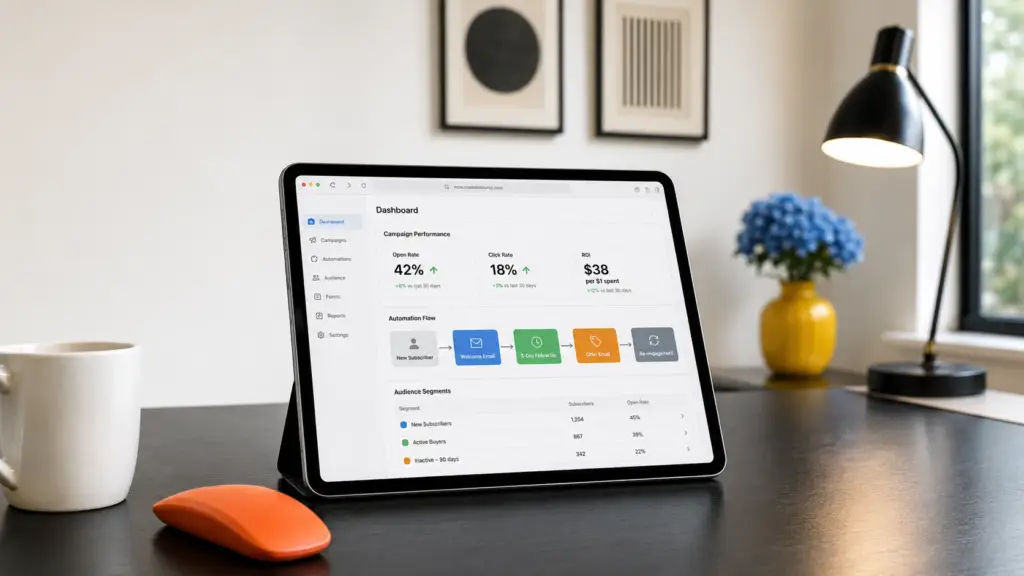
| Automation saves time and money | Automated email sequences (welcome flows, abandoned cart, re-engagement) work around the clock without manual effort. |
| Deliverability is non-negotiable | Even the best-written email fails if it lands in spam. Sender reputation, list hygiene, and authentication protocols are critical foundations. |
| Integration amplifies impact | Email works best when connected to your website, CRM, and other digital marketing channels rather than operating in isolation. |
Email marketing services are the platforms, tools, and managed solutions businesses use to create, send, automate, and measure email campaigns to their subscriber lists. They range from self-serve software to fully managed agency campaigns. For any business that wants a direct, cost-effective line to its customers, email marketing services remain one of the most powerful options available in 2026.
This guide covers everything you need to know: how these services work, which platforms lead the market, what pitfalls to dodge, and the best practices that separate genuinely effective campaigns from inbox clutter. Whether you’re a nursery owner in Surrey or an independent healthcare practitioner in South London, you’ll leave with a clear picture of what to do next.

What Are Email Marketing Services?
Email marketing services are software platforms or managed solutions that enable businesses to build subscriber lists, design email campaigns, automate sends, and track performance metrics like open rates and conversions.
At their core, these services solve a straightforward problem: sending one email to hundreds or thousands of people manually is impossible. Email marketing platforms handle the infrastructure, compliance, and analytics so you can focus on the message itself.
The Two Main Types of Email Marketing Services
There’s an important distinction worth making early. “Email marketing services” can refer to two quite different things:
- Self-serve platforms: Software tools like Mailchimp, Brevo, and HubSpot that you log into and manage yourself [1][2][3]
- Managed email marketing services: Agency-run solutions where a team handles strategy, copywriting, design, and reporting on your behalf
Most small businesses start with a self-serve platform and graduate to managed services as their needs grow. According to a review by Email Vendor Selection, the 2026 market includes well over 50 credible platforms, each with distinct strengths [4].
Why Email Marketing Still Matters in 2026
Social media reach has become increasingly pay-to-play. Organic reach on major platforms has declined sharply over the past three years. Your email list, by contrast, is an asset you own outright. No algorithm decides whether your subscribers see your message.
Industry analysts consistently note that email generates an average return of $36–$42 for every $1 spent, a figure that has held remarkably steady even as digital advertising costs have risen. According to research highlighted by SEMA, “Email continues to be one of the most cost-effective marketing channels available to businesses of any size” [5].
For local businesses in particular, a well-maintained email list creates a direct relationship with customers that no third-party platform can disrupt.
How Email Marketing Services Work
this method work by providing a hosted infrastructure that manages subscriber data, email design, sending at scale, and performance tracking, all within a single platform.
Understanding the mechanics helps you make better decisions about which platform to choose and how to configure it correctly from the start.
The Core Components of Any Email Marketing Platform
- List management: Storing subscriber contact data, managing opt-ins and unsubscribes, and segmenting contacts into groups based on behaviour or demographics
- Email builder: Drag-and-drop or HTML editors for creating visually appealing emails without needing a developer
- Automation workflows: Trigger-based sequences that send emails automatically when a subscriber takes a specific action (signing up, purchasing, abandoning a cart)
- Deliverability infrastructure: Dedicated sending servers, DKIM and SPF authentication protocols, and bounce management to ensure emails reach inboxes rather than spam folders
- Analytics and reporting: Open rates, click-through rates (CTR), unsubscribe rates, and conversion tracking
Platforms like Sender and Mailtrap have published detailed comparisons of how these components vary across tools [6][7].
A Typical Email Campaign: Step by Step
- Define your goal: Are you driving traffic to a blog post, promoting a sale, or re-engaging inactive subscribers?
- Segment your list: Identify which subscribers should receive this campaign based on past behaviour or profile data
- Write and design the email: Craft a subject line, preview text, body copy, and a clear call to action
- Set up tracking: Enable UTM parameters (tags added to links that identify traffic sources in Google Analytics) so you can measure conversions
- Test before sending: Send a test to yourself, check rendering across devices, and run a spam score check
- Schedule or send: Choose the optimal send time based on your audience’s historical engagement patterns
- Review performance: Analyse open rates, CTR, and conversion data within 48–72 hours of sending
Pro Tip: Always A/B test your subject lines. Even a small improvement in open rate (say, from 22% to 27%) compounds significantly over a list of several thousand subscribers. Most platforms including Mailchimp and Brevo offer built-in A/B testing at no extra cost.
Open-source platforms like Mautic offer a self-hosted alternative for businesses that want full data control, though they require more technical setup than hosted SaaS options [8].
Key Benefits of Email Marketing Services
The primary benefit of this strategy is direct, owned communication with your audience at a fraction of the cost of paid advertising, combined with measurable results that let you improve over time.
Financial and Strategic Advantages
- Low cost per contact: Most platforms charge based on list size or send volume, not per individual email. For a list of 1,000 subscribers, monthly costs typically range from free to £20
- High ROI: Email consistently outperforms social media and display advertising on return per pound spent
- Owned audience: Unlike social media followers, your email list belongs to you. It’s not subject to platform algorithm changes or account suspensions
- Precise targeting: Segmentation (dividing your list into smaller groups based on shared characteristics) lets you send highly relevant messages to specific subsets of subscribers
- Measurable outcomes: Every metric, from open rate to revenue generated, is trackable
At Three Girls Media, we’ve found that clients who integrate email marketing with their website and SEO strategy consistently see stronger results than those treating it as a standalone channel. The website drives sign-ups; email nurtures those visitors into paying customers.
Practical Benefits for Small Businesses
For a small business owner managing everything themselves, this approach offer a particularly compelling set of advantages:
- Automation handles follow-up sequences so you don’t have to remember to send manually
- Templates reduce the time needed to create professional-looking campaigns
- Free tiers from platforms like Kit, Sender, and Brevo let you start with zero upfront investment [9]
- Integration with ecommerce platforms means abandoned cart emails can recover lost sales automatically
For ecommerce businesses specifically, Flowium notes that email and SMS combined can account for 30–50% of total revenue for well-optimised online stores [10]. That’s a compelling case for any business selling products online.
For businesses that also rely on physical marketing materials, combining digital email campaigns with professional printing services can create a cohesive multi-channel presence that reinforces your brand both online and offline.
Pro Tip: Don’t wait until you have a large list to start. Build your email list from day one using a simple lead magnet (a discount code, a free guide, or a useful checklist relevant to your industry). Even a list of 200 engaged subscribers is more valuable than 2,000 disengaged ones.
Common Challenges and Mistakes to Avoid
The most common mistakes in email marketing are buying contact lists, neglecting list hygiene, and sending the same message to every subscriber regardless of their interests or behaviour.
In practice, these errors don’t just reduce campaign performance. They can actively damage your sender reputation, which affects whether future emails reach anyone’s inbox at all.
Platform and Technical Pitfalls
| Mistake | Why It Hurts | How to Fix It |
|---|---|---|
| Buying email lists | High spam complaints, poor deliverability, legal risk under UK GDPR | Build lists organically through opt-in forms only |
| No list segmentation | Irrelevant emails drive unsubscribes and low engagement | Segment by purchase history, location, or engagement level |
| Ignoring mobile optimisation | Over 60% of emails are opened on mobile devices; poor rendering kills conversions | Always preview on mobile before sending |
| Weak subject lines | Low open rates mean the rest of the email never gets seen | A/B test subject lines; aim for curiosity or clear value |
| Sending too frequently | Subscriber fatigue leads to unsubscribes and spam reports | Test frequency; let subscribers choose their preference |
| No clear call to action | Subscribers don’t know what to do next | One primary CTA per email, clearly visible above the fold |
Compliance and Legal Considerations
UK businesses must comply with both UK GDPR and the Privacy and Electronic Communications Regulations (PECR) when sending marketing emails. Key requirements include:
- Obtaining clear, affirmative consent before adding someone to your list
- Including a visible and functional unsubscribe link in every email
- Identifying yourself clearly as the sender
- Honouring unsubscribe requests promptly (within 10 working days under PECR guidance)
One pitfall to watch for: pre-ticked consent boxes don’t constitute valid consent under UK GDPR. Many small business owners inherit this mistake from older website forms built before the regulations tightened.
According to a discussion on TechSoup Forums, even nonprofits and small organisations need to treat email compliance seriously, as the rules apply regardless of organisation size [11].
Best Practices for Email Marketing Services in 2026
The most effective this strategies in 2026 combine AI-assisted personalisation, rigorous list hygiene, and a clear focus on subscriber value rather than volume.
The landscape has shifted noticeably over the past two years. Inbox providers like Google and Apple have become more aggressive about filtering promotional content. Subscribers are more selective. The bar for what earns an open has risen.
Personalisation and Segmentation Frameworks
The most impactful change any business can make is moving from batch-and-blast sending (the same email to everyone) to behavioural segmentation. Frameworks worth knowing:
- RFM segmentation: Divides subscribers by Recency (when they last engaged), Frequency (how often they engage), and Monetary value (for ecommerce). Particularly powerful for online stores
- Lifecycle stage segmentation: Separates new subscribers, active customers, lapsed customers, and VIPs, then sends relevant content to each group
- Behavioural triggers: Sends emails based on specific actions, such as visiting a pricing page, downloading a resource, or abandoning a cart
As of 2026, most major platforms including Campaign Monitor and Zapier-integrated tools offer built-in segmentation without requiring technical expertise [12][13].
Technical Best Practices for 2026
- Authenticate your sending domain: Set up SPF, DKIM, and DMARC records. Google and Yahoo both now require these for bulk senders, and non-compliance results in emails being rejected outright
- Clean your list quarterly: Remove hard bounces immediately and suppress subscribers who haven’t opened in 12+ months
- Use double opt-in: Requiring subscribers to confirm their address reduces spam complaints and improves list quality
- Monitor your sender score: Tools like Google Postmaster and MXToolbox let you track your sending reputation before problems escalate
- Optimise send timing: Data from multiple platforms suggests Tuesday–Thursday mornings tend to generate the highest open rates, though your specific audience may differ
Pro Tip: Our team at Three Girls Media recommends treating your email welcome sequence as your most important campaign. The first email a new subscriber receives sets expectations, establishes trust, and typically achieves 3–5x the open rate of standard campaigns. Invest disproportionately in getting it right.
For nonprofits and organisations with limited budgets, Nelson University highlights that platforms like Mailchimp have historically offered free tiers for smaller lists, though terms and thresholds have changed as of 2026 [14].

Sources & References
- Mailchimp, “Email & SMS Marketing Platform”, 2026
- Brevo, “12 Best Email Marketing Platforms (2026)”, 2026
- HubSpot, “Email Marketing Software & Free Campaign Tools”, 2026
- Email Vendor Selection, “15 Best Email Marketing Platforms 2026 (Review & Comparison)”, 2026
- SEMA, “The Top Five Online Email Marketing Services: A Buyer’s Market”, 2020
- Sender, “14 Best Email Marketing Platforms Compared (2026)”, 2026
- Mailtrap, “9 Best Free Email Marketing Platforms Compared [2026]”, 2026
- Mautic, “Email Marketing Features”, 2026
- Email Tool Tester, “The 17 Best Free Email Marketing Services for 2026”, 2026
- TechSoup Forums, “Email Marketing similar to Constant Contact”, 2026
- Campaign Monitor, “We Reviewed 11 Email Marketing Platforms for Agencies”, 2026
- Zapier, “The 8 best free email marketing services in 2026”, 2026
- Nelson University, “6 Cheap-to-free Marketing Tools for Nonprofits”, 2026
Frequently Asked Questions
1. What is the 80/20 rule in email marketing?
The 80/20 rule (also called the Pareto Principle) in email marketing means that roughly 80% of your results, whether that’s revenue, clicks, or conversions, tend to come from just 20% of your subscribers. In practice, this means your most engaged segment deserves disproportionate attention: personalised offers, loyalty rewards, and early access campaigns. Rather than chasing list growth at all costs, smart email marketers focus on identifying and nurturing that high-value 20% while running re-engagement campaigns to recover lapsed subscribers before removing them.
2. Why are people leaving Mailchimp?
Since Intuit’s acquisition of Mailchimp, users have reported a combination of rising costs, a more complex pricing structure, and the removal of the generous free tier that once supported up to 2,000 contacts. As of 2026, many small businesses find that alternatives like Brevo, Sender, or Kit offer comparable features (drag-and-drop builders, automation, analytics) at significantly lower price points or with more useful free tiers. The migration process has also become easier, with most competing platforms offering one-click list import tools.
3. What are the best free email marketing services for small businesses?
As of 2026, the strongest free tiers come from Brevo (300 emails/day, unlimited contacts), Sender (2,500 subscribers, 15,000 emails/month), and Kit (formerly ConvertKit, suited to content creators and bloggers). Each has different strengths: Brevo excels at transactional email integration, Sender at simplicity, and Kit at audience-building tools. The right choice depends on your list size, how often you plan to send, and whether you need automation on the free plan. Reviewing a current comparison like Email Tool Tester’s 2026 guide is the best starting point.
4. How often should I send marketing emails?
There’s no universal answer, but most small businesses find that one to two emails per week is the sweet spot for maintaining visibility without triggering unsubscribes. The more important variable is relevance: a highly relevant email sent three times a week will outperform a generic one sent monthly. A practical approach is to let subscribers choose their frequency preference at sign-up (daily, weekly, monthly) and honour those preferences via segmentation. Monitor your unsubscribe rate closely; if it rises above 0.5% per campaign, reduce frequency or improve content relevance.
5. What is email deliverability and why does it matter?
Email deliverability refers to the ability of your emails to reach subscribers’ inboxes rather than being filtered into spam or blocked entirely. It’s determined by your sender reputation (a score inbox providers assign based on your sending history), list quality, and technical authentication setup (SPF, DKIM, DMARC records). Poor deliverability is invisible: your platform shows the email as “sent” but it never reaches anyone. As of 2026, Google and Yahoo both enforce strict authentication requirements for bulk senders, making proper technical setup non-negotiable for any serious it strategy.
6. Do I need email marketing services if I’m active on social media?
Yes, and the two channels serve fundamentally different purposes. Social media builds awareness and reaches new audiences. this method nurture existing relationships with people who have already expressed interest in your business. Critically, your social media following is rented: platforms can change their algorithm, restrict your reach, or suspend your account at any time. Your email list is owned. For a local business in Surrey or South London, combining social media for discovery with email for retention gives you a much more resilient marketing foundation than either channel alone.
Conclusion
this strategy remain one of the most cost-effective, measurable, and reliable tools available to any business in 2026. The fundamentals haven’t changed: build a quality list, send relevant content, automate where you can, and monitor your results. What has changed is the technical bar. Authentication, mobile optimisation, and intelligent segmentation are now table stakes, not optional extras.
Choosing the right platform matters, but it’s less important than choosing the right strategy. Start with your audience’s needs, build from there, and treat your email list as the valuable business asset it is.
At Three Girls Media, we help businesses across Surrey and South London build digital presences that generate real enquiries, and this approach are a key part of that picture. Whether you need help setting up your first campaign or integrating email into a broader digital marketing strategy, our team brings the hands-on expertise to make it work. Get in touch for a free quote and let’s talk about what’s possible for your business.
Recommended Articles
Explore more from our content library: