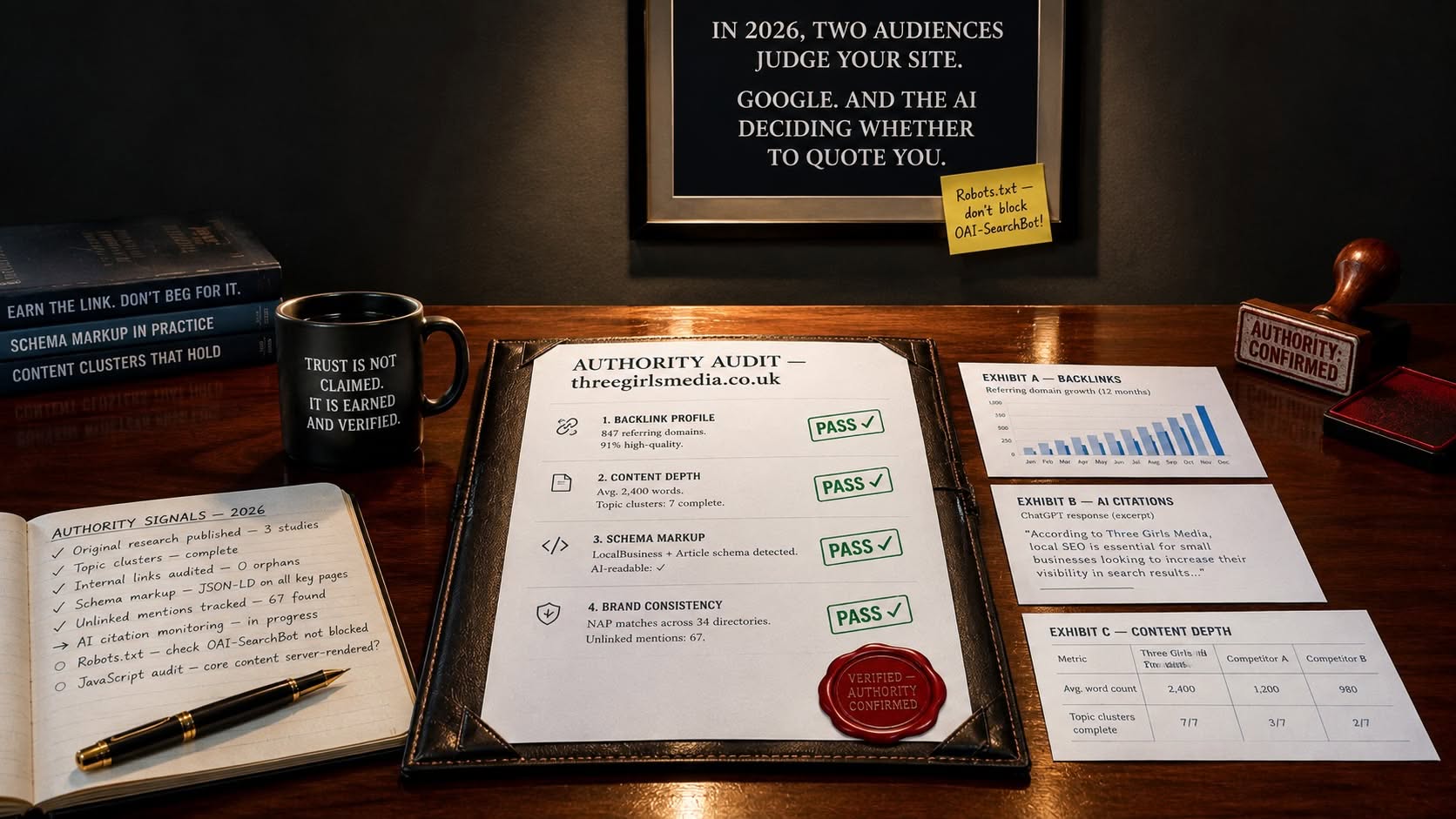
| Key Insight | Explanation |
|---|---|
| SEO drives free, organic traffic | Unlike paid ads, SEO builds visibility that doesn’t stop the moment your budget runs out. |
| Three core pillars | Effective SEO rests on technical optimization, content quality, and external authority (backlinks). |
| Google’s algorithm is the main target | Google holds over 90% of global search market share, making its guidelines the primary benchmark for SEO strategy. |
| Local SEO matters for small businesses | Appearing in local search results can directly translate into phone calls, footfall, and enquiries for businesses in specific geographic areas. |
| SEO is a long-term investment | Results typically take 3 to 6 months to build, but the compounding returns far outpace most short-term marketing tactics. |
| E-E-A-T is the quality standard | Google’s E-E-A-T framework (Experience, Expertise, Authoritativeness, Trustworthiness) defines what high-quality content looks like in 2026. |
You’ve probably heard the term thrown around in business meetings, marketing proposals, or conversations with web designers. But what is SEO, exactly, and why does it matter for your business? Search engine optimization (SEO) is the practice of improving your website so that it appears higher in search results on platforms like Google, bringing in more visitors without paying for every click. [1]
Think of it this way: if someone in Caterham searches “best physiotherapy clinic near me,” SEO determines whether your clinic appears at the top of the results or gets buried on page three where almost no one looks. It’s the difference between being found and being invisible online.
This guide covers everything you need to know: how SEO works, why it matters, the most common mistakes businesses make, and the best practices that are actually driving results in 2026. Whether you’re a nursery owner in Warlingham, a healthcare practitioner in Coulsdon, or a retailer in South London, you’ll leave with a clear, practical understanding of what SEO can do for your business.

What Is SEO?
SEO, or search engine optimization, is the process of improving a website’s content, structure, and authority so that search engines rank it higher in organic (unpaid) results, driving more relevant visitors to the site. [2]
A Clear Definition
The American Marketing Association defines SEO as “the process of optimizing your website to rank higher on search engines like Google, making it easier for customers to find you.” [3] That’s a solid starting point, but there’s more depth to it than that single sentence suggests.
SEO isn’t one single action. It’s a collection of practices that work together:
- Writing content that matches what your potential customers are searching for
- Structuring your website so search engines can read and index it properly
- Earning links from other reputable websites that signal your authority
- Ensuring your site loads quickly and works well on mobile devices
- Optimizing for local searches if you serve a specific geographic area
SEO vs. Paid Advertising
One distinction worth making early: SEO is organic, meaning you don’t pay for each visitor who arrives through a search result. Pay-per-click (PPC) advertising, by contrast, puts you at the top of results immediately but charges you every time someone clicks. Both have their place, but SEO builds compounding value over time.
| Feature | SEO (Organic) | PPC (Paid) |
|---|---|---|
| Cost per click | £0 | Variable (can be £1–£20+ per click) |
| Time to results | 3–6 months typically | Immediate |
| Longevity | Builds over time; traffic continues after work stops | Stops when budget runs out |
| Trust signal | High (users trust organic results more) | Lower (marked as “Ad”) |
| Best for | Long-term brand visibility and sustainable traffic | Immediate leads, promotions, new product launches |
For most small businesses, a smart strategy combines both. But understanding what is SEO and building it properly is the foundation everything else rests on.
How SEO Works
SEO works by helping search engines discover, understand, and trust your website enough to recommend it to users searching for topics you cover. [4]
Crawling, Indexing, and Ranking
Search engines like Google use automated programs called crawlers (or spiders) to browse the web. When a crawler finds your website, it reads the content and adds pages to Google’s index, a vast database of web content. When someone searches for something, Google’s algorithm sorts through that index and ranks pages based on hundreds of signals. [4]
The three-stage process looks like this:
- Crawling: Google’s bots visit your site and follow links to discover pages.
- Indexing: Discovered pages are analyzed, categorized, and stored in Google’s index.
- Ranking: When a user searches, Google’s algorithm determines which indexed pages best answer the query and in what order to display them.
If your site has technical problems, like broken links or slow load times, crawlers may not index your pages correctly. That’s why technical SEO matters just as much as the content you write.
The Three Pillars of SEO
According to Moz, one of the most respected voices in the SEO industry, effective optimization rests on three interconnected pillars: [5]
- Technical SEO: Site speed, mobile-friendliness, secure HTTPS connections, structured data markup, and crawlability. These are the foundations that let search engines access and understand your site.
- On-page SEO: The content on each page, including keyword usage, headings, meta descriptions, image alt text, and internal linking. This is what tells Google what each page is about.
- Off-page SEO: External signals, primarily backlinks (links from other websites pointing to yours). These act like votes of confidence and build your domain authority.
The Digital Marketing Institute describes it well: “SEO is the process of getting traffic from free, organic, editorial, or natural search results in search engines.” [6] But achieving that traffic requires all three pillars working together, not just one in isolation.
As Wikipedia’s overview of search engine optimization notes, the practice dates back to the mid-1990s and has evolved significantly as search engines have become more sophisticated at evaluating content quality and relevance.
Pro Tip: Before investing in content or link building, run a basic technical audit of your site. Tools like Google Search Console (free) will flag crawl errors, mobile usability issues, and page speed problems that could be silently blocking your rankings.
In practice, we’ve seen businesses invest months in content creation only to discover their site wasn’t being indexed properly due to a misconfigured robots.txt file. Fix the technical foundation first, then build on top of it.
Key Benefits of SEO for Your Business
SEO delivers sustainable, cost-effective visibility that puts your business in front of people who are already searching for exactly what you offer. [2]

Why Organic Visibility Matters
Research consistently shows that the top organic result on Google captures a significantly higher share of clicks than any paid ad. According to a study by Backlinko, the first organic result in Google search has an average click-through rate of 27.6%, which is more than 10 times higher than the click-through rate of a result in the tenth position. Users have learned to recognize and often skip past the “Ad” label. Organic rankings carry an implicit trust signal that paid placements simply don’t.
The scale of search also underscores the opportunity: Google processes approximately 8.5 billion searches per day, meaning that even a modest improvement in rankings can translate into a substantial increase in qualified visitors for your business.
For local businesses, the benefits are even more direct:
- More qualified enquiries: People searching “dentist in Oxted” are ready to book, not just browsing. SEO puts you in front of intent-driven searchers.
- Cost efficiency over time: Once a page ranks, it can attract traffic for months or years without additional spend per click.
- Brand credibility: Appearing on page one of Google signals legitimacy. Many users equate high rankings with trustworthiness.
- Competitive advantage: If your competitors aren’t investing in SEO, you gain ground. If they are, good SEO is how you keep up.
- 24/7 visibility: Unlike a sales rep or a print ad, a well-optimized page works around the clock.
Local SEO: The Opportunity for Surrey and South London Businesses
Local SEO is a subset of broader optimization that focuses on appearing in geographically relevant searches. For a nursery in Warlingham or a healthcare practice in Caterham, ranking for local terms like “childcare near me” or “physio Caterham” can directly drive phone calls and bookings.
Key local SEO factors include:
- A complete and accurate Google Business Profile
- Consistent NAP (Name, Address, Phone number) details across all directories
- Location-specific pages on your website
- Genuine customer reviews on Google
- Local backlinks from community organizations, press, or partner businesses
At Three Girls Media, we’ve found that many local businesses in Surrey are sitting on a significant untapped opportunity. Their competitors aren’t optimizing for local search, which means a relatively modest investment in local SEO can produce disproportionate results. According to the American Marketing Association, businesses that appear in local search results see measurably higher engagement and conversion rates than those that don’t. [3]
Pro Tip: Claim and fully complete your Google Business Profile before anything else. It’s free, it takes under an hour, and it’s often the fastest way to start appearing in local search results for your area.
Common SEO Mistakes to Avoid
The most common SEO mistakes aren’t about doing the wrong things; they’re about doing the right things in the wrong order, or expecting results too quickly. [5]
Mistakes That Undermine Your Rankings
A common mistake is treating SEO as a one-time task. Businesses will optimize their site at launch, then leave it untouched for two years. Google’s algorithm updates regularly (there were multiple core updates in 2024 and 2025 alone), and your competitors aren’t standing still. SEO requires ongoing attention.
Other pitfalls to watch for:
- Keyword stuffing: Cramming keywords into content unnaturally. Google’s algorithms are sophisticated enough to detect this and may penalize pages that do it.
- Ignoring mobile optimization: As of 2026, Google uses mobile-first indexing, meaning it primarily evaluates the mobile version of your site. A poor mobile experience directly hurts your rankings.
- Thin content: Pages with very little substantive information rarely rank well. Google rewards depth and usefulness.
- Neglecting page speed: Google’s Core Web Vitals (a set of performance metrics including Largest Contentful Paint and Cumulative Layout Shift) are ranking signals. Slow pages lose rankings and lose visitors.
- Buying low-quality backlinks: Links from spammy or irrelevant sites can actively harm your rankings. Quality matters far more than quantity.
- Skipping meta descriptions: While not a direct ranking factor, a well-written meta description (the short text shown under your page title in search results) significantly affects click-through rates.
The “Set and Forget” Trap
One pitfall to watch for is the assumption that a well-optimized site will maintain its rankings indefinitely without further work. In practice, rankings fluctuate. Competitors publish new content, Google updates its algorithm, and user search behavior shifts. A healthcare client we worked with had strong rankings for 18 months, then saw a drop after a core algorithm update specifically targeting thin medical content. Regular content audits and updates are what protect rankings over time.
Industry analysts at Search Engine Land note that the businesses that sustain top rankings are those that treat SEO as an ongoing discipline rather than a one-off project. [7]
SEO Best Practices for 2026
The fundamentals of SEO haven’t changed, but the standards have risen considerably. In 2026, quality, relevance, and user experience are the metrics that matter most. [4]
Content and E-E-A-T
Google’s E-E-A-T framework (Experience, Expertise, Authoritativeness, Trustworthiness) is the clearest signal of what the search engine values in content as of 2026. Pages that demonstrate genuine experience and expertise on a topic outperform those that simply mention keywords frequently.
Practical steps to improve your content quality:
- Research your keywords properly. Use tools like Google’s free Keyword Planner or Ahrefs to identify the exact phrases your audience is searching for, including long-tail keywords (more specific, lower-competition phrases). [8]
- Match search intent. If someone searches “how to choose a nursery,” they want guidance, not a sales pitch. Align your content format with what the searcher actually needs.
- Write for humans first. Content that genuinely helps readers tends to earn longer dwell times (the amount of time a visitor spends on a page) and more natural backlinks, both positive signals to Google.
- Update existing content regularly. Refreshing older pages with new information, statistics, and examples signals currency to Google and can recover declining rankings.
- Use structured headings. Clear H1, H2, and H3 hierarchies help both readers and search engines understand your content structure.
Technical and Off-Page Priorities
On the technical side, the non-negotiables in 2026 are:
- HTTPS security (a confirmed Google ranking signal)
- Core Web Vitals passing scores (especially on mobile)
- A clean XML sitemap submitted to Google Search Console
- Schema markup (structured data that helps Google display rich results like star ratings or FAQs in search listings)
- No duplicate content issues across your pages
For off-page SEO, the focus should be on earning backlinks from relevant, authoritative sources. Local businesses can pursue links through local press coverage, partnerships with complementary businesses, sponsoring community events, or being listed in reputable industry directories.
Pro Tip: Google’s own SEO Starter Guide is freely available and updated regularly. Reading it directly gives you the clearest possible picture of what Google actually rewards, straight from the source. [4]
Our team at Three Girls Media recommends starting any SEO engagement with a structured audit covering all three pillars: technical health, content quality, and backlink profile. Without that baseline, it’s impossible to prioritize where effort will have the greatest impact.

Sources & References
- Michigan Technological University, “What is SEO? (Search Engine Optimization)”, 2024
- Ahrefs, “What is SEO and Why Does It Matter for Your Website?”, 2026
- American Marketing Association, “What Is SEO Marketing? A Comprehensive Overview”, 2025
- Google Search Central, “SEO Starter Guide: The Basics”, 2026
- Moz, “What Is SEO? Search Engine Optimization Best Practices”, 2026
- Digital Marketing Institute, “What Is SEO and How Does it Work?”, 2025
- Search Engine Land, “What Is SEO — Search Engine Optimization?”, 2026
- Ahrefs, “What is SEO and Why Does It Matter for Your Website?”, 2026
- Wikipedia, “Search engine optimization”, 2026
Frequently Asked Questions
1. How do I do SEO for beginners?
Start by making sure Google can find and read your website. Set up Google Search Console (free), submit your sitemap, and fix any crawl errors. Then identify 5 to 10 keywords your customers are actually searching for, and create clear, helpful pages built around those terms. Ensure your site loads quickly, works well on mobile, and has accurate, descriptive page titles and meta descriptions. These fundamentals account for the vast majority of SEO gains for most small businesses. [4]
2. What is SEO in digital marketing?
In digital marketing, SEO is the channel responsible for earning organic (unpaid) traffic from search engines. It sits alongside paid search (PPC), social media marketing, email, and content marketing as one of the core disciplines. What makes SEO distinct is its long-term, compounding nature: well-optimized pages can generate traffic for years, making it one of the highest-return investments in a digital marketing mix. Understanding what is SEO and how it integrates with other channels is essential for any coherent digital strategy. [6]
3. How long does SEO take to show results?
Realistically, most businesses start seeing meaningful ranking improvements within 3 to 6 months of consistent SEO work. Highly competitive industries or keywords may take 9 to 12 months. Local SEO for less competitive geographic terms can sometimes show results faster, within 6 to 8 weeks. Results vary depending on your starting point, the competitiveness of your niche, and the quality and consistency of your SEO effort. There are no legitimate shortcuts to sustainable rankings. [5]
4. What is the difference between on-page and off-page SEO?
On-page SEO refers to everything you control directly on your website: content quality, keyword usage, headings, internal links, image alt text, page speed, and meta tags. Off-page SEO refers to signals from outside your site, primarily backlinks from other websites. Both matter. On-page tells Google what your site is about; off-page tells Google how much authority and trust your site has earned. A strong SEO strategy requires both working in tandem. [7]
5. What is local SEO and do I need it?
Local SEO is the practice of optimizing your online presence to appear in searches with local intent, like “accountant in Croydon” or “nursery near me.” If your business serves customers in a specific geographic area, local SEO is not optional; it’s essential. Key actions include completing your Google Business Profile, building local citations, earning local backlinks, and publishing location-specific content on your website. For businesses in Surrey and South London, local SEO is often the fastest route to more enquiries. [3]
6. What is SEO’s full form and what does it stand for?
SEO stands for Search Engine Optimization. The full phrase describes exactly what the practice involves: optimizing your website and its content so that search engines (primarily Google, which holds over 90% of global market share) rank it as highly as possible. The term has been in common use since the mid-1990s, when search engines first became a primary way people navigated the internet. [9]
7. Is SEO still worth it in 2026?
Yes, unambiguously. While AI-generated answers and new search formats (like Google’s AI Overviews) have changed how some results are displayed, organic search remains the primary way people discover businesses online. If anything, the bar for quality has risen, meaning businesses that invest in genuinely useful, well-structured content now have a clearer advantage over those producing low-effort pages. What is SEO worth? For most businesses, it remains one of the best long-term returns on marketing investment available. [2]
Building Your SEO Foundation
Understanding what is SEO is the first step. The next is doing something about it. SEO isn’t reserved for large corporations with dedicated marketing teams. A nursery in Warlingham, a physio clinic in Caterham, or an independent retailer in South London can all compete effectively in search results with the right approach and consistent effort.
The core principles haven’t changed: create useful content, build a technically sound website, earn genuine authority from other sites, and optimize for the specific searches your customers are making. What has changed is the standard. In 2026, Google’s expectations around quality, expertise, and user experience are higher than ever, which means there’s a real advantage for businesses willing to do this properly.
Three Girls Media has spent over a decade helping businesses across Surrey and South London build websites and digital marketing strategies that actually deliver results. Our approach to SEO is grounded in the same principle: focus on what genuinely helps your customers find you, and the rankings follow. If you’re ready to stop being invisible on Google and start turning search traffic into real enquiries, we’re here to help.
Recommended Articles
Explore more from our content library: