| Key Insight | Explanation |
|---|---|
| Digital marketing covers every online channel | Search engines, social media, email, paid ads, and your website all count as digital marketing channels. |
| It’s measurable in ways traditional marketing isn’t | You can track clicks, conversions, and ROI in real time, making it far easier to optimize spend. |
| SEO and PPC are the two core traffic drivers | SEO builds long-term organic visibility; PPC delivers immediate, targeted traffic for a set budget. |
| Your website is the foundation of everything | Every digital marketing channel ultimately drives visitors to your site, so design and UX matter enormously. |
| Small businesses can compete with large ones | Targeted local SEO and affordable PPC campaigns level the playing field for SMBs against bigger competitors. |
| Strategy beats activity every time | Posting randomly or running untargeted ads wastes budget. A clear strategy tied to business goals drives real results. |
Every business owner has heard the phrase. Not everyone knows exactly what it means in practice. So: what is digital marketing, and why does it matter so much in 2026? Digital marketing is the promotion of products, services, or brands through digital channels such as search engines, social media, email, and websites. It’s measurable, targetable, and available to businesses of every size. This guide covers every major channel, explains how the pieces fit together, and gives you a practical starting point — whether you’re running a nursery in Surrey or an independent clinic in South London.
What Is Digital Marketing?
Digital marketing is the use of internet-connected channels and technologies to promote a business, attract customers, and drive measurable results. It spans search engines, social media platforms, email campaigns, paid advertising, and your own website.
The American Marketing Association defines digital marketing as “any marketing methods conducted through electronic devices which utilize some form of a computer” [1]. That’s a broad definition on purpose. It captures everything from a Google search ad to an automated email sequence to a product page on your website.
Why the Definition Matters for Business Owners
Many business owners think digital marketing means posting on Instagram. It doesn’t. Social media is one channel among many. The full picture includes:
- Search Engine Optimization (SEO): improving your website so it appears higher in Google search results, driving free organic traffic
- Pay-Per-Click advertising (PPC): paying for ads that appear at the top of search results or on social platforms, with costs triggered only when someone clicks
- Content marketing: creating blog posts, guides, and videos that attract and educate your target audience
- Email marketing: sending targeted messages to subscribers to nurture leads and retain customers
- Social media marketing: building brand awareness and community on platforms like Facebook, Instagram, and LinkedIn
- Website design and UX: the foundation that all other channels point toward
According to Investopedia, digital marketing is now “the use of websites, apps, mobile devices, social media, search engines, and other digital means to promote and sell products and services” [2]. The key word there is sell. Every channel should ultimately connect back to a business outcome.
How It Differs from Traditional Marketing
Traditional marketing uses print, TV, radio, and outdoor advertising. Digital marketing uses the internet. The crucial difference isn’t the medium. It’s the measurability. With a flyer, you can’t know how many people read it. With a Google Ads campaign, you know exactly how many clicked, how many called, and what it cost per enquiry.
| Feature | Traditional Marketing | Digital Marketing |
|---|---|---|
| Measurability | Estimated reach only | Precise clicks, conversions, ROI |
| Targeting | Broad demographic | Specific audience, location, intent |
| Cost entry point | Often high (print runs, airtime) | Can start with any budget |
| Speed of feedback | Weeks or months | Real-time data |
| Personalization | Limited | Highly granular |
How Digital Marketing Works
Digital marketing works by connecting your business to people who are actively searching for what you offer, then guiding them from first awareness through to a purchase or enquiry.
The underlying process follows a well-established model. Marketers often reference the AIDA framework (Awareness, Interest, Desire, Action) to map how a potential customer moves from not knowing you exist to making a buying decision. Digital marketing channels map neatly onto each stage [3].
The Customer Journey Online
- Awareness: A potential customer searches Google for “physiotherapy in Caterham” or sees a Facebook ad for your nursery. They discover you exist.
- Interest: They click through to your website and read about your services, qualifications, or team. Good content and clear navigation keep them engaged.
- Desire: Positive reviews, a professional design, and clear pricing or process information build trust. They start to prefer you over competitors.
- Action: They click “Book a consultation” or fill in your contact form. This is the conversion (the point where a visitor becomes a lead or customer).
Every digital marketing channel plays a role in this journey. SEO gets you found at the Awareness stage. Your website design and content handle Interest and Desire. A well-placed call-to-action (a prompt like “Get a free quote”) drives Action.
Data and Measurement: The Engine Behind It All
What makes digital marketing genuinely different is the data layer. Tools like Google Analytics, Google Search Console, and advertising dashboards give you visibility into exactly how people find and interact with your business online.
According to Google’s own Grow with Google resource, digital marketing “refers to the strategies and tactics that businesses use to engage with their target audiences through online platforms” [4]. The word “strategies” is important. Data allows you to test, learn, and improve continuously, something no printed leaflet can do.
Pro Tip: Set up Google Analytics and Google Search Console on your website before you spend a penny on advertising. You need baseline data to understand where visitors come from and which pages they leave quickly (your bounce rate). Without it, you’re optimizing blind.
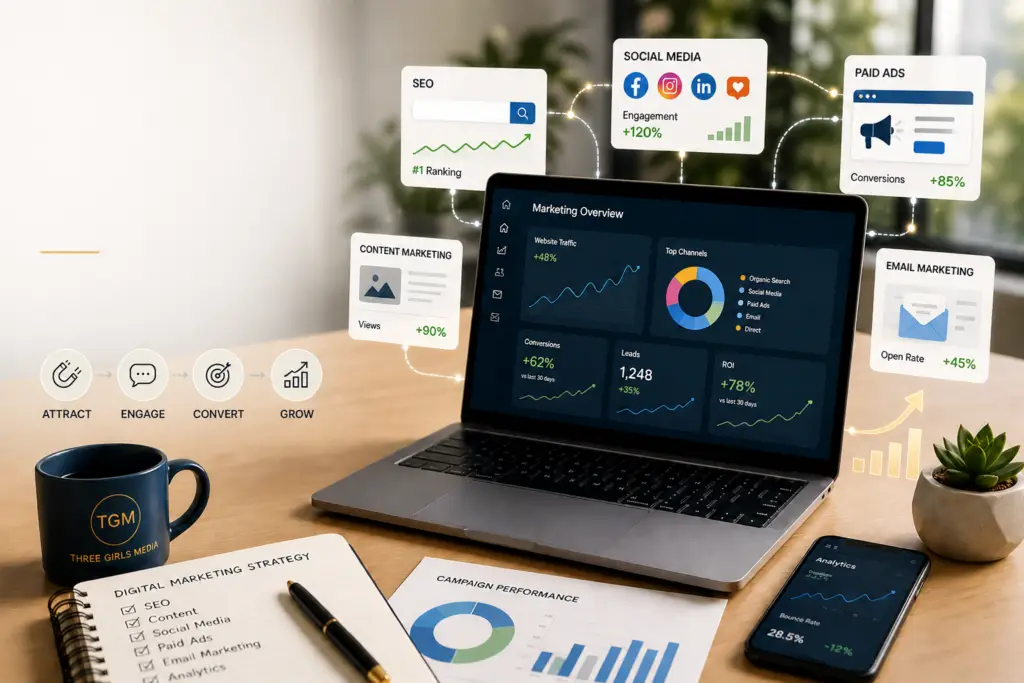
In practice, a well-run digital marketing strategy isn’t a single campaign. It’s an interconnected system where SEO builds long-term organic traffic, PPC fills gaps with immediate paid visibility, and your website converts both into enquiries or sales.
Types of Digital Marketing Channels
Digital marketing spans eight primary channel types, each serving a different purpose and audience stage. Understanding which channels suit your business is the first step to building an effective strategy.
Southern New Hampshire University identifies eight main categories of digital marketing, including SEO, content marketing, PPC, email marketing, social media, affiliate marketing, mobile marketing, and marketing analytics [5]. Here’s how each one works in practice.
The Core Channels Explained
- Search Engine Optimization (SEO): The process of improving your website’s content, structure, and authority so it ranks higher in unpaid (organic) search results. A well-optimized site for “nursery in Warlingham” can generate enquiries for years without ongoing ad spend.
- Pay-Per-Click Advertising (PPC): Paid ads on Google, Bing, or social platforms where you pay each time someone clicks. PPC delivers fast results and is highly targetable by location, keyword, and device.
- Content Marketing: Creating valuable articles, guides, videos, or infographics that attract your target audience and establish your expertise. This blog post is itself a content marketing asset.
- Email Marketing: Sending targeted messages to a list of subscribers. It has one of the highest returns of any digital channel, with research consistently showing strong ROI for every pound spent.
- Social Media Marketing: Building a presence on platforms like Facebook, Instagram, and LinkedIn to raise brand awareness, share content, and engage directly with customers.
- Affiliate Marketing: Partnering with third parties who promote your products or services in exchange for a commission on sales they generate.
- Video Marketing: Using platforms like YouTube to educate, demonstrate, or entertain your audience. Video content is increasingly favored by search algorithms in 2026.
- Marketing Analytics: Using data tools to measure performance across all channels and make informed decisions about where to invest.
For small and medium-sized businesses, the most impactful starting point is almost always SEO combined with a well-designed website. Those two elements form the foundation everything else builds on. Understanding what lead generation means in a digital context helps clarify how these channels work together to fill your pipeline with potential customers.
Key Benefits of Digital Marketing for Businesses
Digital marketing gives businesses of every size the ability to reach the right people, at the right time, with a measurable budget — something traditional advertising has never been able to offer.
Adobe’s Business Blog notes that digital marketing “boosts brand awareness, drives traffic, and hits marketing goals” through targeted channel use [6]. But the benefits go further than awareness. Here’s what businesses consistently gain from a well-executed digital marketing strategy.
Practical Advantages for SMBs
- Precise audience targeting: You can show ads only to people within five miles of your business, or only to people searching for your exact service. No wasted spend on irrelevant audiences.
- Real-time performance data: You know what’s working within hours, not months. If a campaign isn’t converting, you adjust it immediately.
- Cost flexibility: You set your own budget. A local business can start a Google Ads campaign for as little as £5 a day and scale as results come in.
- Compounding returns from SEO: Unlike paid ads that stop the moment you stop spending, SEO builds organic visibility that continues to generate traffic over time.
- Leveled playing field: A well-optimized website from a small independent clinic can outrank a large national chain in local search results. Quality and relevance matter more than budget.
- Deeper customer relationships: Email marketing and social media allow ongoing, personalized communication with customers in ways print advertising simply can’t match.
A Real-World Example
A Three Girls Media client, a healthcare practice in Surrey, previously relied entirely on word-of-mouth referrals. After launching a redesigned website with local SEO built in from the start, they began appearing in Google’s local results for relevant search terms within their area. Within 90 days, their enquiry volume had increased measurably, with new patients citing Google as their first point of contact. No additional ad spend was required at that stage.
That’s the compounding value of digital marketing done properly. You invest once in a strong foundation, and it continues working for you.
Pro Tip: Don’t treat your website and your marketing as separate projects. The most effective digital marketing strategies start with a website built to convert, then layer SEO and PPC on top. Driving traffic to a poorly designed site is like filling a leaky bucket.
According to Salesforce’s Digital Marketing Guide, digital marketing “uses digital channels and data to create personalized, engaging customer experiences that drive brand awareness, lead generation, and revenue” [7]. Lead generation (the process of attracting and capturing potential customers) is where most SMBs see the fastest measurable return.
Common Mistakes and How to Avoid Them
Most digital marketing failures aren’t caused by bad luck. They’re caused by predictable, avoidable mistakes that waste budget and produce no results.
From experience working with businesses across Surrey and South London, the same patterns come up repeatedly. Knowing what to watch for saves significant time and money.
The Most Costly Errors in Digital Marketing
- Treating digital marketing as a one-off task: A common mistake is building a website, doing a burst of activity, then going quiet. Digital marketing requires consistency. Search algorithms reward regular, quality content. Audiences need repeated touchpoints before they act.
- Ignoring mobile users: As of 2026, the majority of web traffic comes from mobile devices. A website that looks fine on a desktop but is clunky on a phone will lose visitors before they even read your first sentence.
- Chasing vanity metrics: Follower counts and page views feel satisfying but don’t pay the bills. Focus on conversion metrics: how many visitors filled in your contact form, called your number, or made a purchase.
- Skipping keyword research: Many businesses create content about what they want to say rather than what their customers are actually searching for. Keyword research (the process of identifying the exact phrases your target audience types into Google) is non-negotiable.
- Running ads to a poor landing page: Spending money on PPC ads that send traffic to a generic homepage is a fast way to burn budget. Ads should point to a specific, relevant page designed to convert that particular visitor.
- No clear call-to-action: Every page on your website should tell the visitor exactly what to do next. “Call us today,” “Book a free consultation,” or “Get a quote” — remove the guesswork.
The Misconception About “Going Viral”
One pitfall to watch for is the belief that digital marketing success requires viral content or a massive social following. It doesn’t. A nursery in Caterham doesn’t need 50,000 Instagram followers. It needs to appear at the top of Google when a local parent searches “nursery near me.” Targeted visibility beats broad popularity every time for local businesses.
Industry analysts at HubSpot consistently note that businesses which define clear goals before choosing channels outperform those that simply “try everything” [8]. Results may vary depending on your industry, budget, and competitive landscape, but starting with strategy rather than tactics is a universal principle.
Best Practices for Digital Marketing in 2026
Effective digital marketing in 2026 combines proven fundamentals with an awareness of how search engines, AI tools, and user behavior have evolved over the past two years.
The core principles haven’t changed. But the execution has. Search engines now evaluate content quality more rigorously, AI-generated content is widespread (making original expertise more valuable, not less), and users expect faster, more relevant experiences than ever before.
A Framework for Getting It Right
- Start with your website: Ensure it loads quickly (under three seconds), works perfectly on mobile, and has clear calls-to-action on every key page. This is your digital foundation.
- Define your target audience precisely: Know their location, their search intent, and the problems they’re trying to solve. For a local business, this means local SEO first.
- Prioritize SEO before paid ads: Build organic visibility through quality content and technical SEO. Paid ads are a complement to organic presence, not a substitute for it.
- Create content that answers real questions: Blog posts, FAQs, and service pages that directly address what your customers are searching for will outperform generic “about us” content every time.
- Use PPC strategically for fast wins: When you need immediate enquiries (a new service launch, a seasonal promotion), PPC delivers targeted traffic quickly. Set a clear budget and track every conversion.
- Build an email list from day one: Every website visitor who gives you their email address is a long-term asset. A regular newsletter keeps your business front of mind without ongoing ad spend.
- Measure what matters: Set up conversion tracking so you know which channels are actually generating enquiries, not just traffic.
Pro Tip: At Three Girls Media, we’ve found that businesses who integrate their website design and digital marketing strategy from the outset consistently outperform those who bolt marketing onto an existing site. The architecture of your site, its page structure, loading speed, and content hierarchy, directly affects your SEO performance and conversion rate.
What’s Changed in 2026
AI-powered search features now surface direct answers within Google results, meaning your content needs to be structured clearly to be cited by these systems. Coursera’s digital marketing resource highlights that digital marketing is “the practice of promoting brands, products, and services through digital channels and technologies” [9], and those technologies now include AI-assisted search, voice search, and automated ad optimization. Businesses that treat their content as genuinely useful, well-structured information rather than keyword-stuffed copy will benefit most from these changes.
Our team at Three Girls Media recommends treating E-E-A-T (Experience, Expertise, Authoritativeness, and Trustworthiness) as a practical checklist for every piece of content you publish. Google uses these signals to assess content quality, and meeting them consistently is the most durable SEO strategy available in 2026.
Sources & References
- American Marketing Association, “What is Digital Marketing?”, 2026
- Investopedia, “Understanding Digital Marketing: Key Types, Channels, and Examples”, 2026
- Wikipedia, “Digital Marketing”, 2026
- Grow with Google, “What is digital marketing?”, 2026
- Southern New Hampshire University, “What is Digital Marketing? 8 Types”, 2026
- Adobe Business Blog, “What is digital marketing? Everything you need to know”, 2026
- Salesforce, “Digital Marketing: A Complete Guide”, 2026
- HubSpot Blog, “Digital marketing: Everything you need to know to get it right”, 2026
- Coursera, “What Is Digital Marketing? Key Channels, Examples, and More”, 2026
Frequently Asked Questions
1. What is digital marketing in simple terms?
Digital marketing is promoting your business online so the right people find you and take action. It covers everything from appearing in Google search results and running paid ads to sending email newsletters and posting on social media. The goal is always the same: attract potential customers and convert them into real ones.
2. How do I make money from digital marketing?
There are two main paths. First, use digital marketing to grow your own business by driving more enquiries, leads, and sales through SEO, PPC, content, and email. Second, build a career or freelance practice by offering digital marketing services (SEO, paid ads, content strategy, or social media management) to other businesses. Both paths require building genuine skills in at least one or two channels before expanding. Starting with one channel, mastering it, and then adding others is far more effective than spreading yourself thin across every platform at once.
3. How do I begin in digital marketing?
Start by understanding the fundamentals: what is digital marketing, how search engines work, and what your target audience is actually searching for. Then choose one or two channels most relevant to your business (SEO and a well-designed website are almost always the right starting point for local businesses). Free resources from Google, HubSpot, and Coursera provide structured learning paths. In practice, the fastest way to learn is to apply what you read to a real website or campaign, measure the results, and iterate. Don’t try to master everything at once.
4. What are the main types of digital marketing?
The eight primary types are: Search Engine Optimization (SEO), Pay-Per-Click advertising (PPC), content marketing, email marketing, social media marketing, affiliate marketing, video marketing, and marketing analytics. For most small businesses, SEO and a conversion-focused website deliver the strongest long-term return. PPC adds immediate, targeted traffic when you need faster results or want to test new offers.
5. How much does digital marketing cost?
Costs vary significantly depending on the channels you use and whether you manage them yourself or work with an agency. A basic local SEO strategy might cost a few hundred pounds per month with an agency, while a well-managed Google Ads campaign for a local service business might run from £300 to £1,500 per month in ad spend, plus management fees. One important distinction: SEO is an investment that compounds over time, while PPC is an ongoing cost that stops generating traffic the moment you stop paying. Most effective strategies combine both.
6. Is digital marketing suitable for small local businesses?
Absolutely. Local SEO in particular gives small businesses a genuine advantage over larger national competitors, because search engines prioritize geographic relevance in local results. A well-optimized website for a physio clinic in Coulsdon can outrank a national healthcare brand for searches made by people in that area. Targeted PPC campaigns can be set to show only to people within a specific radius of your business, making every penny of ad spend relevant.
Putting It All Together
Understanding what is digital marketing is the first step. Putting it into practice is where the real work begins. The good news is that you don’t need a large budget or a dedicated marketing team to get meaningful results. You need a clear strategy, a website that’s built to convert, and a consistent approach to the channels that matter most for your specific business.
The businesses that win online aren’t necessarily the ones with the biggest budgets. They’re the ones with the clearest message, the most relevant content, and the best user experience. Those are things any business can build, regardless of size.
If you’re a business owner in Surrey, South London, or the surrounding area and you’re ready to make your online presence work harder, Three Girls Media brings over 10 years of hands-on digital marketing and web design experience to every project. From SEO-ready website builds to targeted PPC campaigns, we deliver practical, measurable results at prices that make sense for growing businesses.
Recommended Articles
Explore more from our content library: