Getting into SEO feels overwhelming at first. There’s so much to learn—keywords, backlinks, technical stuff that sounds like a foreign language. I remember sitting at my desk years ago, staring at endless blog posts, wondering if I’d ever figure this out.
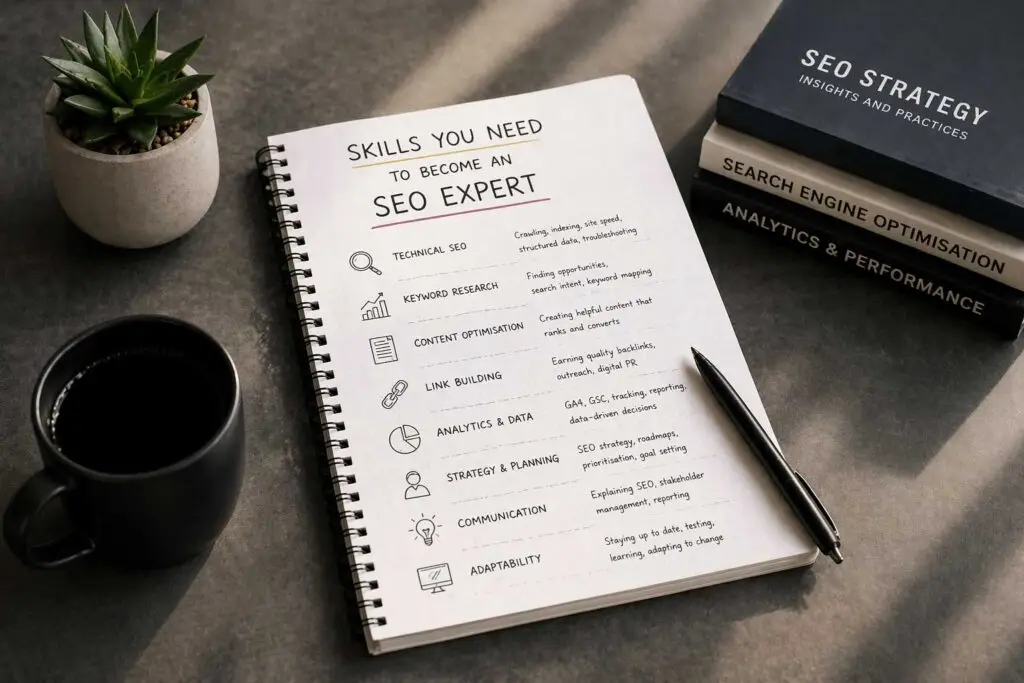
Here’s what nobody tells you upfront: SEO isn’t just one skill. It’s a collection of abilities that build on each other, and you don’t need to master everything overnight. Some skills you’ll use daily. Others become relevant as your career grows. The key is knowing which ones matter most and when to develop them.
Let me walk you through the essential SEO skills that actually move the needle, organized by experience level so you can chart your own path forward.
Are SEO Skills Still Worth Learning in 2026?
Before diving in, let’s address the elephant in the room. With AI chatbots answering questions directly, some people worry SEO is dying.
It’s not.
Search is evolving, not disappearing. People still need to find businesses, products, and information. Google processes over 8.5 billion searches daily, and that number keeps growing. The game has changed—you now optimize for both traditional search engines and AI-powered experiences—but the fundamentals remain crucial.
Companies need people who understand how search visibility works. That demand isn’t going anywhere soon.
Core SEO Fundamentals Everyone Should Master
Learning time: 2-3 months of consistent practice
These are your non-negotiables. Without these foundations, everything else crumbles.
Understanding Keyword Research
Keyword research determines which terms people actually search for when looking for content like yours. Get this wrong, and you’re creating content nobody finds.
Focus on search intent—the reason behind each query. Someone searching “running shoes” wants different information than someone searching “best running shoes for marathons.” Tools like Semrush’s Keyword Magic Tool or Ahrefs help identify these opportunities, showing metrics like search volume, keyword difficulty, and competition levels.
Start with broader terms, then branch into long-tail variations. These longer, specific phrases often convert better because they match exact user needs.
Building Quality Backlinks
Links from other websites signal trust and authority to search engines. One high-quality backlink from an industry-respected site matters more than dozens from random blogs.
Forget buying links or mass outreach. Focus on creating content worth linking to. Guest posting on relevant sites, finding unlinked brand mentions, and producing genuinely useful resources naturally attract links over time.
Optimizing On-Page Elements
On-page SEO means fine-tuning individual pages to match search intent and improve user experience. This includes title tags, meta descriptions, headers, internal links, and content structure.
Google Search Console shows which pages have low click-through rates—these are your best optimization opportunities. Update vague titles to something specific and compelling. “SEO Tips” becomes “10 SEO Tactics That Actually Improved Our Rankings.”
Use descriptive anchor text for internal links. Skip “click here” in favor of “learn about meta description optimization.” Small changes compound into significant results.
Managing Crawlability and Indexing
If search engines can’t crawl your site or index your pages, nothing else matters. Your content simply won’t appear in results.
XML sitemaps guide search engines to your important pages. Keep them updated with only canonical URLs. Your robots.txt file controls which areas bots can access—block admin sections and low-value pages while ensuring access to essential resources like CSS and JavaScript.
Google Search Console becomes your diagnostic center here. The Page Indexing Report reveals crawl errors and excluded pages. The URL Inspection Tool helps diagnose specific issues like noindex tags or blocked resources.
Analyzing Competitors Strategically
Competitor analysis reveals gaps in your strategy and opportunities you’re missing. Which keywords do they rank for that you don’t? What content performs well for them? Where do their backlinks come from?
Use tools like Semrush’s Keyword Gap to compare your rankings against competitors. Filter for keywords where they rank in the top 10 but you don’t rank at all. These represent your quickest wins.
SEO Copywriting That Converts
SEO copywriting balances readability with optimization. Write for humans first, then weave in keywords naturally. Your headlines should hook readers immediately while addressing search intent.
Structure matters. Short paragraphs, clear subheadings, and bullet points improve scannability. Hemingway Editor flags complex sentences and readability issues. Grammarly catches grammar problems.
Reading and Interpreting Data
SEO generates mountains of data. Rankings, traffic, bounce rates, conversion rates, user behavior—it’s endless. Analytical reasoning helps you make sense of it all and identify actionable patterns.
When reviewing performance in Google Analytics or Search Console, dig deeper. Traffic dropped? Why? Rankings fell? For which pages and keywords? Their content outranked yours? What specifically did they do better?
This diagnostic thinking separates average SEOs from exceptional ones.
Using AI Tools Effectively
AI prompt engineering means crafting precise instructions to get useful outputs from tools like ChatGPT or Claude. The clearer your prompt, the better the result.
Instead of “cluster these keywords,” try “Group these keywords into three intent-based categories: informational, commercial, and transactional. Format the output as a table.”
I use AI for creating content outlines, analyzing competitor headlines, generating schema markup, and extracting data patterns. Mastering prompts saves hours of manual work.
Technical SEO Skills That Set You Apart
Learning time: 6-12 months for solid competence
Technical SEO intimidates many people. It shouldn’t. You don’t need to become a developer, but understanding these concepts helps you diagnose issues and communicate with technical teams.
HTML Basics
HTML structures web content. Knowing how to work with it gives you control over crucial SEO elements without always needing developer help.
Focus on understanding headers (H1, H2, H3 hierarchy), meta tags for titles and descriptions, alt text for images, canonical tags to prevent duplicate content, hreflang for international targeting, and robot directives for controlling crawling and indexing.
Free courses on Codecademy or YouTube tutorials get you started. Use Chrome’s “Inspect Element” tool to analyze HTML on live sites.
JavaScript Rendering
Modern websites increasingly rely on JavaScript frameworks like React or Vue.js. If Google can’t render this content properly, it won’t index it.
While Googlebot handles JavaScript better than before, problems still arise. The URL Inspection tool in Search Console shows pages as Googlebot sees them, revealing rendering issues.
Speed Optimization
Site speed directly impacts user experience and rankings. Slow sites frustrate visitors and hurt conversions.
Google PageSpeed Insights and GTMetrix identify specific bottlenecks—oversized images, render-blocking scripts, or slow server response times. Focus on compressing images, minimizing code, enabling browser caching, and optimizing critical rendering paths.
Schema Markup Implementation
Schema markup helps search engines understand page content more completely. It makes you eligible for rich results—enhanced listings showing star ratings, prices, images, or event details.
Learn to implement common schema types manually, not just through plugins. Test implementations with Google’s Rich Results Test and the Schema Markup Validator.
Strategic Internal Linking
Internal linking distributes authority across your site and guides both users and search engines to important content. Use descriptive anchor text and link from high-authority pages to newer or lower-visibility pages.
Screaming Frog’s crawl visualization shows your linking structure, helping identify orphaned pages and uneven link distribution.
Excel and Google Sheets Proficiency
You’ll constantly work with data exports, keyword lists, and performance reports. Mastering spreadsheets dramatically improves efficiency.
Learn pivot tables for summarizing data, VLOOKUP for matching information across datasets, and SUMIF for conditional calculations. Build simple dashboards to track key metrics visually.
Leadership and Management Capabilities
Learning time: 2-4 months to build fundamentals
As you advance, people skills become as important as technical knowledge.
Creating Meaningful Reports
SEO reporting translates data into stories that non-technical stakeholders understand. Your reports should clearly show progress toward business objectives—not just vanity metrics.
Include organic traffic growth, keyword ranking improvements, conversion rate changes, and backlink acquisition. Use visual dashboards that highlight key performance indicators clearly.
Leading Cross-Functional Teams
SEO projects involve content writers, developers, designers, and marketers. Effective leadership means coordinating these diverse groups toward common goals.
Use collaboration tools like Asana or Trello for transparency. Communicate clearly about priorities and deadlines.
Managing Projects Successfully
SEO initiatives span weeks or months with multiple moving parts. Project management ensures everything stays on track.
Learn methodologies like Scrum for iterative workflows. Break large initiatives into manageable milestones.
Prioritizing Effectively
Not all tasks deserve equal attention. The Eisenhower Matrix helps categorize work by urgency and importance.
Handle critical issues affecting site performance immediately. Schedule important long-term efforts like link building. Delegate or eliminate low-priority tasks.
Enterprise-Level SEO Expertise
Learning time: 6-9 months to develop competence
Enterprise SEO handles massive scale and complexity. These advanced skills separate senior professionals from the rest.
Scaling SEO Operations
Large sites need automation and systematization. Manually handling thousands of pages doesn’t work.
Invest in robust platforms like Semrush or Ahrefs for comprehensive audits. Learn automation tactics for repetitive tasks. Create standardized workflows and document processes so teams work independently.
Python for Automation
Python automates repetitive SEO tasks and processes large datasets efficiently. Even basic Python knowledge saves enormous time.
Use it to extract metadata, clean URLs, generate sitemaps, or pull ranking data. Google Colab lets you run Python scripts without local setup.
International SEO Strategy
Global SEO adapts content for different countries, languages, and regions. This involves implementing hreflang tags correctly, structuring region-specific URLs, and understanding local search behaviors.
Building Your SEO Skill Set Strategically
You don’t need everything immediately. Start with foundational skills—keyword research, on-page optimization, and basic analytics. Build confidence through hands-on practice, ideally on your own site where mistakes don’t matter.
As you grow comfortable, layer in technical capabilities. Finally, develop leadership and enterprise skills as opportunities arise.
Subscribe to newsletters like Search Engine Land for industry updates. Take courses, read documentation, and most importantly—practice constantly.
Every ranking improvement you generate, every site audit you complete, and every traffic increase you drive makes you better at this craft. That’s how expertise develops—through consistent, intentional effort over time.
Related reading: Want to Rank on the First Page of Google? Here’s What Actually Moves the Needle, Proven Ways to Boost Your Website Traffic in 2026.