Understanding how customers move from strangers to loyal buyers isn’t just helpful—it’s essential for growth. The marketing funnel gives you that roadmap, showing exactly where people are in their journey and what they need from you at each stage.
Not everyone who discovers your brand is ready to buy immediately. Some just learned about their problem. Others are comparing solutions. And some are ready to purchase right now. Speaking to all these people the same way would be a costly mistake.
Understanding the Marketing Funnel
A marketing funnel maps the customer journey from initial awareness to purchase and beyond. It’s called a “funnel” because you start with a wide audience at the top, and fewer people move through each stage until you’re left with paying customers at the bottom.
The funnel helps you understand where potential customers are in their decision-making process. Someone searching “what causes back pain” has completely different needs than someone searching “buy ergonomic office chair.” The funnel shows you how to serve both.
Most customers who enter your funnel won’t make it to the bottom—that’s normal. Your job is to optimize each stage so the right people move forward while unqualified leads filter out naturally.
Why Marketing Funnels Matter
Marketing funnels help you deliver the right message at the right time. They show you where leads drop off, which tactics work, and where to focus your resources for maximum impact.
A well-built funnel improves conversion rates by matching content to buyer readiness, reduces wasted ad spend, identifies weak points where customers lose interest, guides content creation, and increases customer lifetime value through retention planning.
Three Marketing Funnel Models That Work
The Simple Three-Stage Funnel
This straightforward approach works well for businesses just starting out:
Top of Funnel (ToFu) – People discover they have a problem and start looking for information.
Middle of Funnel (MoFu) – Prospects understand their problem and actively compare solutions.
Bottom of Funnel (BoFu) – People are ready to choose and looking at specific products and pricing.
The AIDA Model
AIDA stands for Attention, Interest, Desire, and Action—a proven framework since 1898.
Attention – Grab awareness with compelling content that speaks to a real problem.
Interest – Build curiosity by demonstrating relevant expertise.
Desire – Make them want your specific solution by highlighting benefits.
Action – Provide a clear path to purchase with minimal friction.
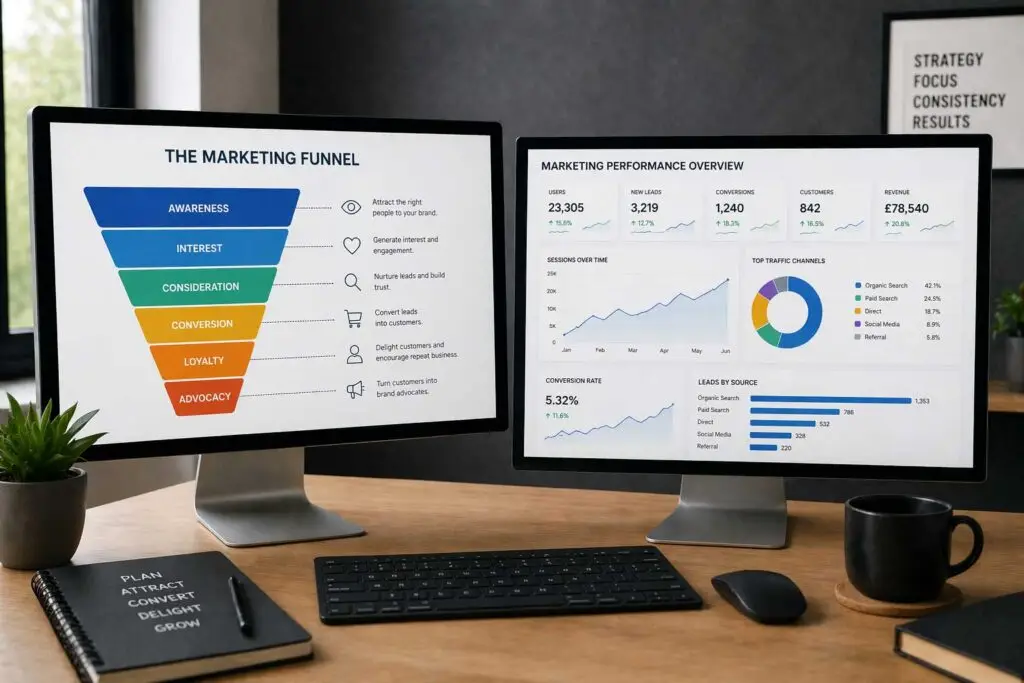
The Five-Stage Detailed Funnel
For complex sales cycles, this expanded model works best:
Awareness – Initial discovery of your brand
Consideration – Active comparison phase
Conversion – The purchase decision
Loyalty – Repeat purchases and engagement
Advocacy – Customers recommend you to others
This recognizes that customer journey doesn’t end at purchase—retention and referrals matter.
Top of Funnel: Attracting the Right Audience
At this stage, most people don’t know you exist. Your goal is getting discovered by people who actually have the problem you solve.
Know Who You’re Trying to Reach
Define your ideal customers based on data, not assumptions. Use Google Analytics to analyze current visitors and customers—demographics, interests, and behavior patterns show you who’s already converting.
Compare different segments in your demographic reports to see which audiences engage most and convert at higher rates. Look for patterns in age ranges, locations, and interests that consistently produce better results.
Study competitors using tools like Semrush to reveal who visits competitor sites and what else they’re interested in. This shows where your potential customers already spend time online and what content resonates with them.
Create specific buyer personas including their goals, challenges, and decision-making process. When you know exactly who you’re talking to, everything from content to ad targeting becomes more effective.
Create Content That Attracts Searchers
The best top-of-funnel strategy is content marketing answering questions prospects actually ask.
People at this stage use informational searches like “how to,” “what is,” or “guide to.” They’re looking for answers, not products. Find these keywords using Semrush’s Keyword Magic Tool or Google Keyword Planner.
Focus on keywords with decent search volume—generally above 100 monthly searches—and reasonable competition levels. Look for terms where your expertise gives you an advantage in creating genuinely helpful content.
If you sell project management software, create content around “how to manage remote teams” or “project planning mistakes.” You’re being helpful, not selling yet. This approach builds trust before asking for anything in return.
Other effective tactics include guest posting on sites your audience reads, social media content that gets shared within your niche, digital PR that earns mentions on relevant publications, video content that ranks on YouTube, and podcast appearances where your customers listen.
Don’t spread yourself too thin. Pick one or two channels where your audience actually hangs out and excel there rather than maintaining weak presence everywhere.
Middle of Funnel: Building Trust and Preference
By this stage, people know they need a solution. Now they’re figuring out which one is best. Your job is demonstrating why yours makes sense.
Show Your Expertise
Create content that goes deeper than surface-level information. Prospects want to understand how solutions work, what makes one better than another, and what results they can expect.
Think comparison guides, case studies with real numbers, detailed how-to content, educational webinars, and product demos that show actual functionality. This content should be genuinely educational, not thinly veiled sales pitches.
For SEO, target keywords with commercial intent like “best [product] for [use case]” or “[product type] comparison.” These terms signal someone is actively evaluating options and getting closer to a decision.
Answer questions thoroughly about implementation, cost, integration, and expected results. If prospects are researching solutions, they have specific concerns. Address these proactively rather than waiting for them to ask.
Manage Your Online Reputation
Middle-funnel prospects check reviews and ratings carefully. A few negative reviews without professional responses can derail otherwise ready buyers.
Search for your brand regularly and set up Google Alerts for new mentions. For local businesses, claim your Google Business Profile and respond to all reviews—both positive and negative.
Handle criticism professionally. How you respond often matters more than the criticism itself. Show you care about customer experience and actively work to resolve issues.
Bottom of Funnel: Converting Ready Buyers
At the bottom, people are ready to purchase. They’re comparing final options and looking at pricing. Your goal is making choosing you as easy and obvious as possible.
Optimize Your Landing Pages
Every product page is a landing page where someone decides whether to buy. These pages need to work hard.
Match search intent – If someone searches “buy standing desk under $500,” show relevant desks in that price range immediately, not your brand story.
Reduce friction – Every extra click, confusing element, or missing information costs sales. Make the path to purchase dead simple.
Build confidence – Use customer testimonials, trust badges, money-back guarantees, and clear product information. Bottom-funnel buyers want reassurance they’re making the right choice.
Have clear calls to action – Tell people exactly what to do next. “Add to Cart,” “Start Free Trial,” or “Schedule Demo” should be obvious and easy to find.
Use tools like Semrush’s On Page SEO Checker to identify optimization opportunities based on what’s working for competitors in your space.
Target High-Intent Keywords
Bottom-funnel buyers use transactional keywords like “buy,” “price,” “discount,” “near me,” or specific product names. Optimize product pages for these terms and ensure pages load quickly on mobile devices—technical issues kill conversions.
Create location-specific pages if you serve multiple areas. Make sure your site works flawlessly on mobile since many purchases now happen on phones.
Consider retargeting ads for people who visited but didn’t convert. Sometimes people need multiple touchpoints before they’re ready to commit.
Turn Customers Into Advocates
The funnel doesn’t end at purchase. What happens after someone buys determines whether they return, spend more, and refer others.
Follow up with helpful resources. Send guides on getting maximum value from their purchase. Ask for feedback and make it genuinely easy to get support when they need it.
Consider a referral or loyalty program. Your happiest customers are your best source of new customers, and they’ll recommend you if given a reason to.
Measuring Funnel Performance
Track different metrics at each stage to identify where your funnel needs work.
Top of Funnel Metrics
Track traffic volume, page views, click-through rate, social engagement, and email signup rate. These show whether you’re attracting your target audience.
Middle of Funnel Metrics
Monitor time on page, pages per session, return visitor rate, email open rates, and content downloads. These reveal whether you’re building trust.
Bottom of Funnel Metrics
Watch conversion rate, cart abandonment, cost per acquisition, return on ad spend, and customer lifetime value. These tie directly to revenue.
Use Google Analytics for tracking. Set up goals for each stage to see where people drop off.
Building Your Marketing Funnel
Map your customer’s actual journey by talking to recent customers about how they found you. Look at analytics to see common paths to purchase.
Audit your current content and tactics. Do you have appropriate content for each stage? Focus on one stage at a time—if traffic is low, work on top-of-funnel before worrying about conversion rates.
Test and refine continuously. Small improvements at each stage compound into significantly better results. A 10% improvement in traffic, consideration, and conversion rates doesn’t give you 30% growth—it gives you 33% because these gains multiply.
The marketing funnel is a practical framework for understanding your customers and serving them better at every stage. Get it right, and you’ll see more qualified leads, higher conversions, and customers who stick around.
Related reading: Proven Ways to Boost Your Website Traffic in 2026, Content Creation Is Harder Than It Looks — Here’s How to Actually Do It Right.