Most SEO advice online is either too vague to act on or buried in jargon that makes a simple concept feel impossible. This guide cuts through that. Whether you’re trying to understand why your pages aren’t ranking or looking for a smarter path to page one, what follows covers the ranking factors that genuinely matter — backed by Google’s own documentation and corroborated by real-world data.
What an SEO Ranking Actually Is
An SEO ranking is your webpage’s organic position for a given search query. When someone types a question into Google and hits enter, every result they see has a position — and that position was earned, not bought.
Position matters a lot more than most people realize. According to Semrush’s State of Search data, the #1 organic result earns roughly 10x the clicks of the #10 result. That gap compounds fast. Ranking on page two is, for most queries, functionally invisible.
The mechanism behind all of this is Google’s algorithm — a constantly evolving system designed to surface the most relevant, trustworthy, and useful content for any given search. Google doesn’t publish its full algorithm. But between official documentation, developer statements, and large-scale correlation studies, we know enough to work with.
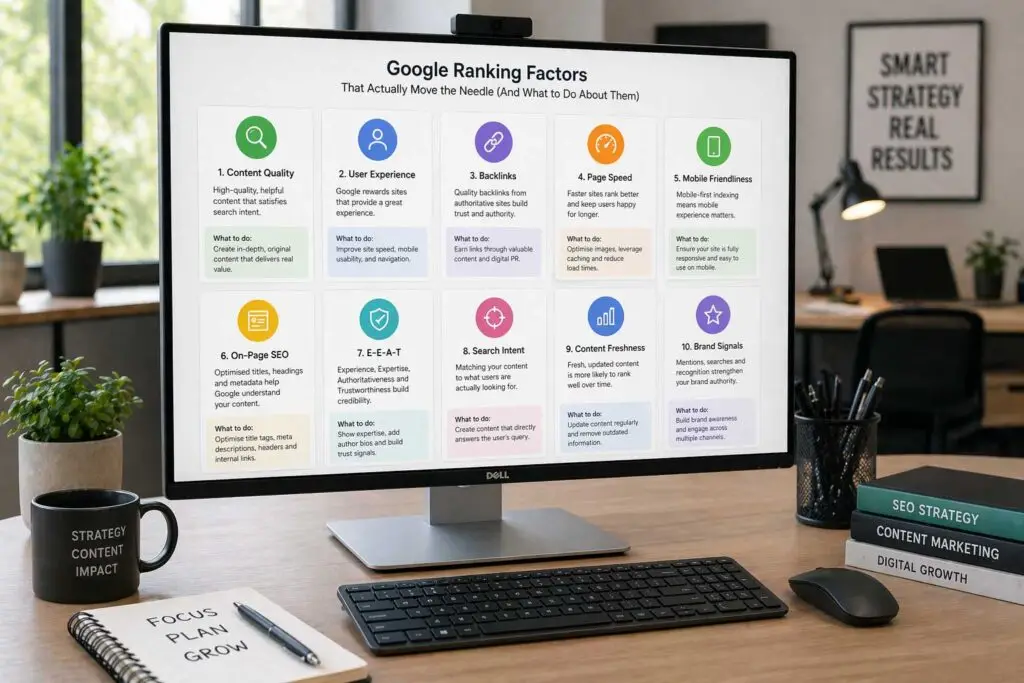
The Core Google Ranking Factors You Need to Understand
Content Relevance
If there’s one factor Google has been most transparent about, it’s relevance. In Google’s own search documentation, the company states that the most basic relevance signal is whether a page contains the same keywords as the search query. But that’s only the surface.
Modern Google uses natural language processing (NLP) to understand meaning — not just words. It identifies entities (people, places, things, concepts), understands context, and interprets synonyms and related terms. This means stuffing a keyword in your title tag fifteen times doesn’t cut it anymore. What Google wants is content that genuinely addresses the intent behind a query.
Search intent falls into four main buckets: informational (people want to learn something), navigational (people want to find a specific site), commercial (people are researching before buying), and transactional (people are ready to act). Mismatching intent is one of the most common reasons otherwise solid content fails to rank.
If you’re targeting “best project management tools,” for instance, Google expects a comparison article — not a homepage or a product landing page. The SERP itself tells you what format works.
Content Quality and E-E-A-T
Google’s quality guidelines revolve around a framework called E-E-A-T — Experience, Expertise, Authoritativeness, and Trustworthiness. It’s not a direct ranking signal in the technical sense, but it shapes how Google’s human quality raters evaluate pages, and those evaluations feed into how the algorithm is trained and refined.
Experience refers to firsthand knowledge — has the author actually used the product, visited the place, or lived through the situation they’re describing? Expertise is about depth and accuracy. Authoritativeness comes from how your site is regarded in its niche. Trustworthiness covers accuracy, transparency, and honest representation.
E-E-A-T matters most for YMYL content — Your Money or Your Life topics like health, finance, legal advice, and safety. For these subjects, Google holds content to a higher standard because the stakes for users are higher.
Practical ways to strengthen E-E-A-T include publishing accurate, well-cited content, displaying clear author credentials, keeping information updated, and citing authoritative sources like NIH, CDC, or peer-reviewed research where relevant.
Backlinks and Domain Authority
Google has been somewhat cagey about how much backlinks matter. Google’s Gary Illyes has publicly said links aren’t as important as the SEO community tends to believe. And yet, correlation data consistently shows that high-ranking pages tend to have more and higher-quality backlinks than low-ranking ones.
The reality is probably somewhere in the middle: backlinks matter, especially in competitive niches, but a handful of genuinely relevant, high-authority links from trusted sites will outperform dozens of weak or unrelated ones. Quality beats quantity here, decisively.
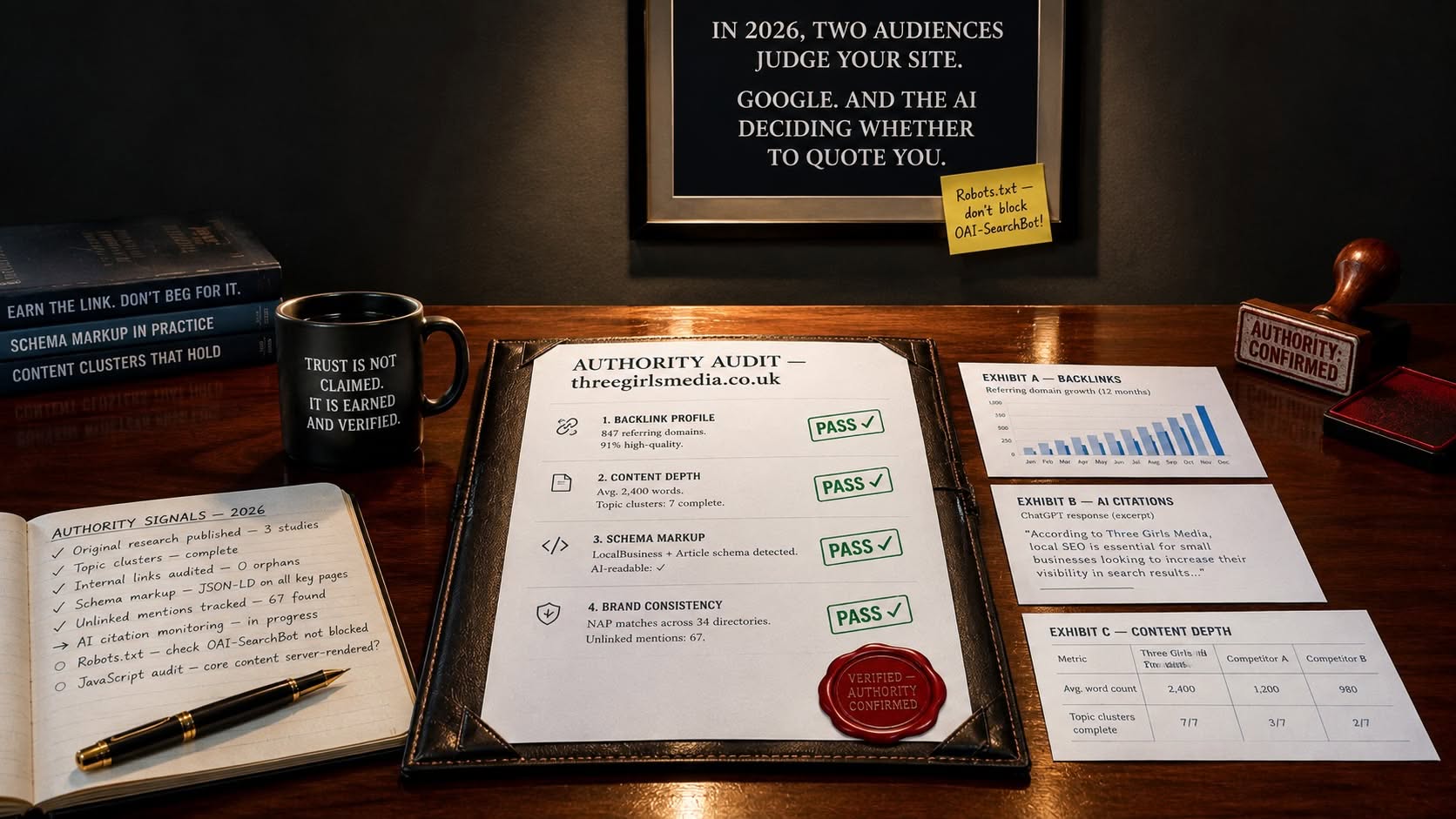
Eight of the top 20 ranking factors identified in Semrush’s Ranking Factors Study are backlink-related. The signals include the total number of referring domains, the authority of those domains, the relevance of the linking pages, and the anchor text used.
Earning good backlinks comes from creating content worth linking to and then making sure the right people see it. Digital PR, original research, expert commentary, and comprehensive guides tend to attract links naturally. Cold outreach to relevant publishers, responding to journalist queries via services like HARO, and pursuing unlinked brand mentions are all legitimate acceleration strategies.
Technical SEO and Page Experience
Technical SEO doesn’t generate rankings on its own, but it removes the ceiling on what your content can achieve. If Google can’t crawl your site efficiently, your pages can’t be indexed. If they can’t be indexed, they can’t rank — full stop.
The most critical technical foundation includes clean site architecture, proper use of canonical tags, a submitted XML sitemap, and no critical crawl errors. Google Search Console is your primary window into these issues — the Page Indexing report, Coverage report, and Manual Actions section are worth checking regularly.
Core Web Vitals — Google’s metrics for loading speed (LCP), interactivity (INP), and visual stability (CLS) — are confirmed ranking signals, though Google has also clarified that great content can outrank a fast page if the quality gap is large enough. Mobile-friendliness and HTTPS are also confirmed signals, though both are now near-universal baseline expectations rather than differentiators.
One technical factor that’s easy to overlook: intrusive interstitials (pop-ups that block content immediately on page load) are a negative signal. Google explicitly penalizes pages that make it hard for users to access the content they came for.
How to Actually Improve Your Rankings
Target Keywords You Can Realistically Win
Keyword research isn’t just about finding what people search for — it’s about finding terms you have a credible shot at ranking for. A brand-new site targeting “credit cards” isn’t competing with NerdWallet anytime soon. But that same site could own a specific niche within personal finance.
Tools like Google Keyword Planner and Semrush’s Keyword Magic Tool help you identify keyword difficulty alongside search volume. Prioritizing lower-competition, high-intent keywords — especially long-tail variations — gives you real traction while you build authority.
Long-tail keywords (three or more words, more specific intent) typically convert better and compete less. “Project management software for freelancers” is a smaller market than “project management software,” but it’s a much more winnable fight, and the person searching it knows exactly what they want.
Match Your Content Format to Search Intent
Once you’ve picked a keyword, look at the SERP before writing a single word. The format of the top results tells you what Google has decided satisfies searcher intent. If every result is a listicle, a listicle is probably what you need. If they’re all long-form guides, follow that lead. Fighting the format rarely works.
Also pay attention to the subtopics covered across the top results. These represent what searchers expect an answer to include. Gaps in your coverage are gaps in your relevance.
Build Backlinks Strategically
The most sustainable approach to link building is creating assets people actually want to reference — original data, detailed how-to guides, free tools, or genuinely novel perspectives on a topic. Beyond that, proactive outreach is essential. Email publishers who cover your topic. Pitch yourself as a source to journalists. Find broken links on authoritative sites and offer your content as a replacement.
One of the highest-leverage tactics for earning authoritative backlinks is original research. Publishing your own study or survey on a topic gives other publishers a citable source — and they’ll link back to you for it.
Fix Technical Issues Before They Compound
Technical SEO debt accumulates quietly. A redirect chain here, a duplicate title tag there — individually small, collectively costly. Running a regular site audit using Google Search Console or a dedicated crawl tool helps you catch issues before they affect rankings.
Pay particular attention to: indexability of your key pages, page speed on mobile, structured data implementation, and whether your internal linking structure gives appropriate weight to your most important pages.
A Final Word on Ranking Factors
Google’s algorithm processes hundreds of signals simultaneously. No single factor is a magic key. Content relevance, quality signals, backlinks, and technical health all interact with each other — and the weight each carries shifts depending on query type, industry, and competition level.
What doesn’t change is the underlying logic: Google wants to send searchers to pages that genuinely solve their problem. Build content with that in mind, make it technically accessible, earn credible links, and your rankings will follow.
For deeper reading on SEO strategy, Google’s own Search Central documentation is an underused resource that goes far beyond most third-party summaries.
Related reading: Want to Rank on the First Page of Google? Here’s What Actually Moves the Needle, Content Creation Is Harder Than It Looks — Here’s How to Actually Do It Right.