Most SEOs assume PageRank is a relic from the early 2000s. Something Google quietly buried when they pulled the public toolbar scores back in 2016. That assumption is costing people rankings.
In March 2024, a significant leak of internal Google API documentation revealed that PageRank is not only still alive — it’s running in multiple versions simultaneously. If you’ve been treating link authority as a secondary concern, this should change your perspective entirely.
What Is Google PageRank, Really?
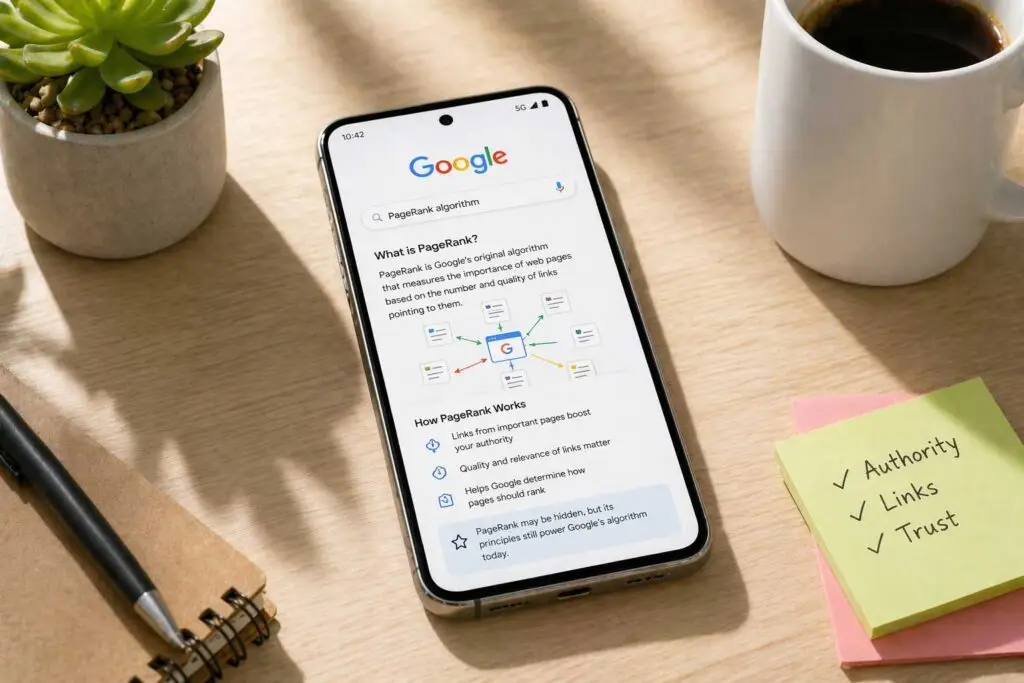
PageRank is the algorithm Larry Page and Sergey Brin developed in 1996 while at Stanford. At its core, it’s elegantly simple: it treats hyperlinks as votes of confidence. A page that receives links from many trusted sources is considered more authoritative than one that doesn’t — and that authority directly influences where it appears in search results.
The original patent assigned every webpage a score on a logarithmic scale from PR0 to PR10. Because of the logarithmic nature of the scoring, jumping from PR2 to PR4 wasn’t double the authority — it could represent a 25x difference in perceived importance. That’s a substantial gap, and it explains why earning links from genuinely authoritative sites matters far more than collecting dozens of low-quality ones.
What made PageRank revolutionary wasn’t just the concept. It was the insight, captured in their original research paper, that “the citation graph of the web is an important resource that has largely gone unused in existing web search engines.” Before Google, search engines ranked pages largely by keyword density. PageRank changed everything.
The 2024 Leak Confirmed What Google Never Officially Said
When Google retired the public PageRank toolbar in 2016, many SEOs quietly concluded the algorithm had been phased out. Google’s Gary Illyes pushed back on that in 2017, confirming on X that PageRank was still a ranking factor — but the statement largely got ignored.
The 2024 leak was harder to dismiss. The internal documentation revealed at least four distinct PageRank variants actively in use:
RawPageRank appears to be the foundational calculation — a page’s raw link-based importance score before any modifiers are applied.
PageRank2 is an updated iteration, though the specific differences from the original aren’t publicly documented.
PageRank_NS (nearest seed) is particularly interesting. It likely measures how close a page is to Google’s internally maintained list of trusted “seed sites” — high-authority domains like major news publications and established institutions. The further you are from these seed sites in the link graph, the less trust Google extends to your content.
FirstCoveragePageRank captures the PageRank value assigned when Google first discovers a page. This could influence how quickly new content gets indexed and initially ranked.
The seed site concept ties back to a 2006 patent that many in the SEO community believe replaced the original PageRank formula after it expired. Under this model, authority isn’t just about how many links point to you — it’s about how connected you are to a core network of trusted web properties.
The Factors That Shape PageRank Flow
Understanding that PageRank exists is one thing. Understanding what moves it is where practical SEO improvement happens.
Link Quality Over Link Quantity
A single link from a genuinely authoritative domain passes far more PageRank than fifty links from low-authority, loosely related sites. This has been true since the beginning, and if anything the gap has widened as Google’s understanding of link quality has become more sophisticated.
When a high-authority page links to you, it transfers a portion of its authority. But if that same page links to 200 other sites, the share you receive is diluted. Relevance also plays a role — a link from a topically related site signals more than one from an unrelated domain, even if both have similar authority profiles.
Anchor Text — A Signal That Can Help or Hurt
Anchor text — the visible, clickable words in a hyperlink — was once something SEOs obsessed over. Stuff the right keywords into your anchor text, get enough links with that anchor text, and rankings would follow. That era is long gone.
Google now treats manipulative anchor text patterns as a spam signal. If a disproportionate number of links pointing to your site use identical keyword-rich anchor text, that’s a red flag rather than a ranking advantage. Natural link profiles show variety: branded anchors, partial matches, generic phrases like “click here,” and bare URLs. Strive for that variety rather than chasing exact-match anchors.
You can audit your current anchor text distribution using tools like Semrush’s Backlinks Analyzer — enter your domain, navigate to the Anchors tab, and review what’s most common. If one phrase dominates heavily, it’s worth investigating whether that pattern looks natural.
The “Reasonable Surfer” Model
The original PageRank formula treated every link on a page as equal. Google’s “reasonable surfer” patent, filed in 2004, refined this significantly. It introduced the idea that links are more valuable based on how likely a real user is to click them.
A link placed prominently in the main body content of an article carries more weight than one buried in a footer or hidden in a sidebar widget. A contextually relevant link that a reader would logically want to follow passes more authority than one that exists purely for SEO purposes. This is why editorial links — the kind a journalist or blogger places naturally within content — remain the gold standard.
Internal Links Distribute Authority Across Your Site
One of the most underutilized PageRank levers is entirely within your control: internal linking. When a page on your site earns external links, it accumulates authority. That authority doesn’t have to stay concentrated on one URL — strategic internal linking lets you distribute it to pages that might not attract as many external backlinks on their own.
This matters especially for what’s sometimes called orphaned pages — content that has no internal links pointing to it. Google can struggle to discover and evaluate these pages, and they receive no PageRank flow from the rest of your site. Tools like Semrush’s Site Audit flag orphaned pages directly, making it straightforward to find and fix these gaps.
A logical site architecture — where important pages are accessible within a few clicks from the homepage and are connected to related content — naturally supports good PageRank distribution without requiring complicated manipulation.
Nofollow Links and PageRank Sculpting
For years, SEOs attempted “PageRank sculpting” by adding rel="nofollow" attributes to certain internal links, trying to concentrate authority on priority pages. Google’s Matt Cutts clarified in 2009 that this tactic doesn’t work the way people thought — the presence of nofollow links still dilutes the authority available to other links on the page, it just doesn’t pass any to the linked destination.
Then in 2019, Google updated how it treats nofollow attributes — shifting from a hard rule to a “hint.” Google may now choose to pass PageRank through nofollow links when it deems appropriate. The practical upshot: don’t obsess over nofollow/dofollow distinctions on every link. Focus on earning genuinely good links and building sensible internal structures instead.
Why the Public Score Disappeared (And What Replaced It)
Google stopped updating the public PageRank toolbar scores in December 2013, and officially retired the toolbar in March 2016. The stated reason was straightforward: the visible score had created perverse incentives. SEOs were trading, buying, and selling links almost entirely based on toolbar PageRank, and the manipulation had become widespread enough that Google considered the public metric more harmful than helpful.
The algorithm didn’t disappear. The scoreboard did.
For those who need a proxy metric, Semrush’s Authority Score provides a 0–100 measure that factors in backlink quantity and quality, estimated organic traffic, and spam signals. It’s not a direct translation of PageRank, but it’s a reasonable approximation of overall domain strength. Ahrefs’ Domain Rating and Moz’s Domain Authority serve similar purposes. None of these third-party metrics directly influence Google’s algorithm — they’re diagnostic tools, not ranking factors themselves.
How to Actually Improve Your PageRank
Since you can’t see your PageRank score anymore, you’re working to improve the underlying conditions that produce strong PageRank: authoritative inbound links and a well-structured site.
On the link-building side, the strategies that hold up are the ones that prioritize earning links rather than manufacturing them. Digital PR and outreach — getting your content in front of journalists and publishers who cover your topic — produces the editorial links that pass the most authority. Guest contributions on reputable industry sites, done with genuine value rather than thin content, still work. Broken link building, where you identify dead links on relevant pages and pitch your content as a replacement, tends to have a higher success rate than cold outreach because you’re solving a real problem for the site owner.
On the technical side, audit your internal link structure regularly. Make sure your highest-priority pages are receiving links from other pages on your site, not just from external sources. Use crawl tools to surface orphaned content, and check that your navigation architecture actually reflects what you want Google to prioritize.
PageRank remains, after nearly three decades, one of the most reliable signals Google has for evaluating content quality and authority. The tools and terminology have evolved, but the fundamental principle holds: links from trusted sources, navigating through a logically structured site, tell Google what’s worth ranking.
Build for that, and you’re building for longevity.
Related reading: What Skills Do You Need to Become an SEO Expert?, How Does Website Structure Actually Affect Your Rankings?.